The EU’s age-verification tool set was exposed by a security researcher within minutes: local configurations could be tweaked on the fly. The claim that it only proves your age but doesn’t require you to hand over your passport suddenly looks awkward. When I saw this, I was flipping through several security-token contract codes and realized that the two things were actually talking about the same point: trying to prove you’re qualified, yet always being asked to surrender the entire file. Digging further into that loophole, I finally saw just how precisely Dusk’s Citadel identity layer gets it right. @Dusk
In the contract, it’s all clearly written who can buy and how long tokens are locked—but how can the chain confirm that the counterparty is still a qualified investor right now? Who is behind an address, whether their status is still valid, and whether changing jurisdictions would violate rules are things you simply can’t know. Compliance isn’t something you check once at issuance and then done; it has to track the asset across its full lifecycle. Without an identity layer, a whitelist is just a list of addresses—no matter how thick the door is, it’s basically missing the access control.
Common approaches are still to outsource verification to an off-chain server: each transaction is checked centrally first, then the certificate is signed. This works, but identity data is all kept by the platform. If something goes wrong, you’re looking at a major data breach. And swapping services means re-verification again. I’ve had enough of this kind of repeated submission too. #dusk $DUSK
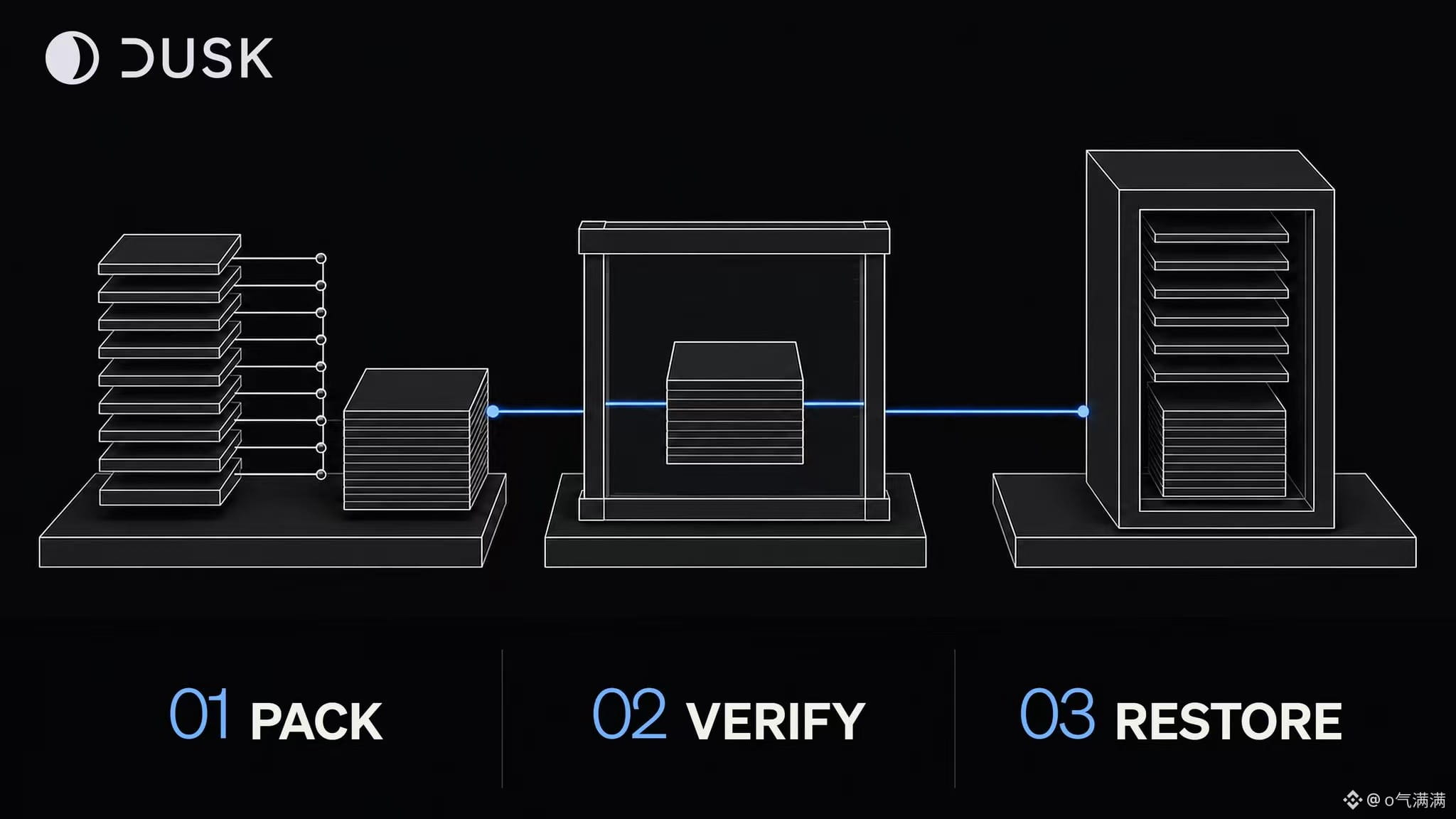
Citadel changed the way it thinks. Verification happens once. The credential is then proved on-chain using zero-knowledge proofs. After that, you only need to prove “I meet the requirements,” without submitting the original materials again. It’s like a bar bouncer only checks that you’re old enough, without photocopying your entire ID book. The contract can verify who signed the credential and whether it’s been revoked right then. Putting this layer into the Dusk pipeline is the key step. For securities issuance you need to verify eligibility; for payments you need to verify identity. Citadel closes the loop on both ends. Even if assets and payments are solid, without continuously verifiable identity, compliance can easily become a hollow exercise. User habits will take time to build, but European digital identity is also moving toward selective disclosure—Dusk is essentially fixing the path ahead of time. $BTC
I’ll be watching Citadel credential issuance volume and real-world usage scenarios. Whether on-chain identity becomes the true gate for compliance assets is something I’m still observing. What do you think?
In the contract, it’s all clearly written who can buy and how long tokens are locked—but how can the chain confirm that the counterparty is still a qualified investor right now? Who is behind an address, whether their status is still valid, and whether changing jurisdictions would violate rules are things you simply can’t know. Compliance isn’t something you check once at issuance and then done; it has to track the asset across its full lifecycle. Without an identity layer, a whitelist is just a list of addresses—no matter how thick the door is, it’s basically missing the access control.
Common approaches are still to outsource verification to an off-chain server: each transaction is checked centrally first, then the certificate is signed. This works, but identity data is all kept by the platform. If something goes wrong, you’re looking at a major data breach. And swapping services means re-verification again. I’ve had enough of this kind of repeated submission too. #dusk $DUSK
Citadel changed the way it thinks. Verification happens once. The credential is then proved on-chain using zero-knowledge proofs. After that, you only need to prove “I meet the requirements,” without submitting the original materials again. It’s like a bar bouncer only checks that you’re old enough, without photocopying your entire ID book. The contract can verify who signed the credential and whether it’s been revoked right then. Putting this layer into the Dusk pipeline is the key step. For securities issuance you need to verify eligibility; for payments you need to verify identity. Citadel closes the loop on both ends. Even if assets and payments are solid, without continuously verifiable identity, compliance can easily become a hollow exercise. User habits will take time to build, but European digital identity is also moving toward selective disclosure—Dusk is essentially fixing the path ahead of time. $BTC
I’ll be watching Citadel credential issuance volume and real-world usage scenarios. Whether on-chain identity becomes the true gate for compliance assets is something I’m still observing. What do you think?