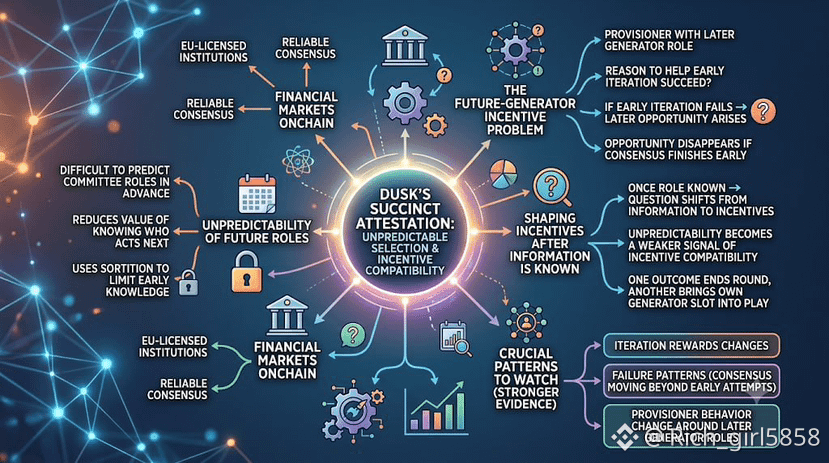
Dusk's Succinct Attestation is designed to make future committee roles difficult to predict in advance.
That matters as Dusk pushes to bring financial markets onchain with EU-licensed institutions, where consensus has to remain reliable even after future roles start becoming known.
Unpredictable selection helps reduce the value of knowing who will act next. But it does not automatically mean the incentives stay neutral once a future role becomes known.
What I don't know yet is whether a Dusk provisioner with a later generator role still has every reason to help the current iteration succeed. Dusk's own discussion of the future-generator incentive problem gives one useful mechanism to watch. If the current iteration fails, a provisioner selected to generate a block later in the round may get an opportunity that would disappear if consensus finished earlier. That is a different problem from predicting the selection itself.
Dusk can use sortition to limit how early a future role becomes known. Once that role is known, though, the question shifts from information to incentives. A provisioner now knows that one outcome ends the round, while another could bring its own generator slot into play. That makes unpredictability a weaker signal of incentive compatibility than it first appears. The stronger evidence is how Dusk handles that second stage: how rewards change across iterations, how often consensus moves beyond earlier attempts, and whether provisioner participation changes when later generator roles become relevant.
I would learn more from those patterns than from the unpredictability of selection alone. The question is whether Dusk's consensus design can keep future roles hard to anticipate while still giving provisioners the strongest reason to help the earliest viable iteration succeed. I am watching iteration rewards, failure patterns and provisioner behavior around later generator roles next.
#dusk $DUSK @Dusk
That matters as Dusk pushes to bring financial markets onchain with EU-licensed institutions, where consensus has to remain reliable even after future roles start becoming known.
Unpredictable selection helps reduce the value of knowing who will act next. But it does not automatically mean the incentives stay neutral once a future role becomes known.
What I don't know yet is whether a Dusk provisioner with a later generator role still has every reason to help the current iteration succeed. Dusk's own discussion of the future-generator incentive problem gives one useful mechanism to watch. If the current iteration fails, a provisioner selected to generate a block later in the round may get an opportunity that would disappear if consensus finished earlier. That is a different problem from predicting the selection itself.
Dusk can use sortition to limit how early a future role becomes known. Once that role is known, though, the question shifts from information to incentives. A provisioner now knows that one outcome ends the round, while another could bring its own generator slot into play. That makes unpredictability a weaker signal of incentive compatibility than it first appears. The stronger evidence is how Dusk handles that second stage: how rewards change across iterations, how often consensus moves beyond earlier attempts, and whether provisioner participation changes when later generator roles become relevant.
I would learn more from those patterns than from the unpredictability of selection alone. The question is whether Dusk's consensus design can keep future roles hard to anticipate while still giving provisioners the strongest reason to help the earliest viable iteration succeed. I am watching iteration rewards, failure patterns and provisioner behavior around later generator roles next.
#dusk $DUSK @Dusk