#dusk $DUSK @Dusk 🔧 Some tools look very familiar from the outside—like a regular phone—but the entire back-end processing layer is built to higher security standards.
That’s also what caught my attention when researching Dusk.
Previously, privacy on blockchain was often understood simply as “hiding transaction data.” But Dusk’s approach goes beyond the outer shell. Privacy is pushed all the way down into the underlying cryptographic layers, from elliptic curves and specialized hash functions to zero-knowledge systems like PLONK, so that verifiable proofs can be created without disclosing all the information behind them. This is the foundation for programmable privacy and selective disclosure: sensitive data is protected by default, yet can still be revealed to the right authorized party when needed.
The more interesting part is how they blend this with a familiar experience. DuskEVM lets developers still use Solidity, EVM wallets, and tools like Hardhat or Foundry. Transactions are executed on this layer, then anchored into DuskDS for settlement and data assurance. One side is the familiar infrastructure to reduce friction for builders; the other is a cryptographic layer designed for financial workflows that can’t assume everything is publicly disclosed by default.
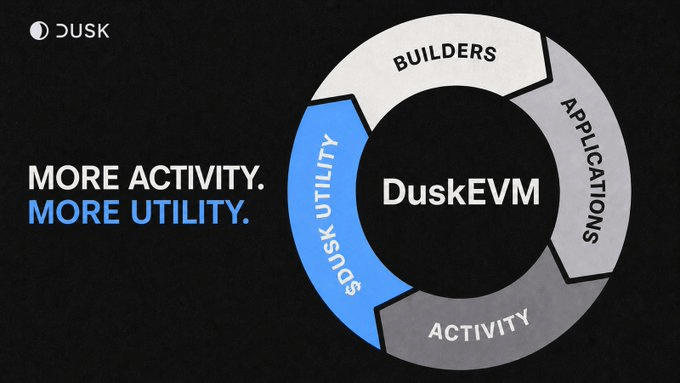
What I want to watch with Dusk isn’t just whether it has privacy or not. It’s whether the combination of EVM compatibility with zero-knowledge and selective disclosure is truly practical enough to move sensitive financial workflows on-chain. When market infrastructure starts to connect to real activity, the role of $DUSK will become clearer—not just as a transaction token, but as fuel for those very processes
That’s also what caught my attention when researching Dusk.
Previously, privacy on blockchain was often understood simply as “hiding transaction data.” But Dusk’s approach goes beyond the outer shell. Privacy is pushed all the way down into the underlying cryptographic layers, from elliptic curves and specialized hash functions to zero-knowledge systems like PLONK, so that verifiable proofs can be created without disclosing all the information behind them. This is the foundation for programmable privacy and selective disclosure: sensitive data is protected by default, yet can still be revealed to the right authorized party when needed.
The more interesting part is how they blend this with a familiar experience. DuskEVM lets developers still use Solidity, EVM wallets, and tools like Hardhat or Foundry. Transactions are executed on this layer, then anchored into DuskDS for settlement and data assurance. One side is the familiar infrastructure to reduce friction for builders; the other is a cryptographic layer designed for financial workflows that can’t assume everything is publicly disclosed by default.
What I want to watch with Dusk isn’t just whether it has privacy or not. It’s whether the combination of EVM compatibility with zero-knowledge and selective disclosure is truly practical enough to move sensitive financial workflows on-chain. When market infrastructure starts to connect to real activity, the role of $DUSK will become clearer—not just as a transaction token, but as fuel for those very processes