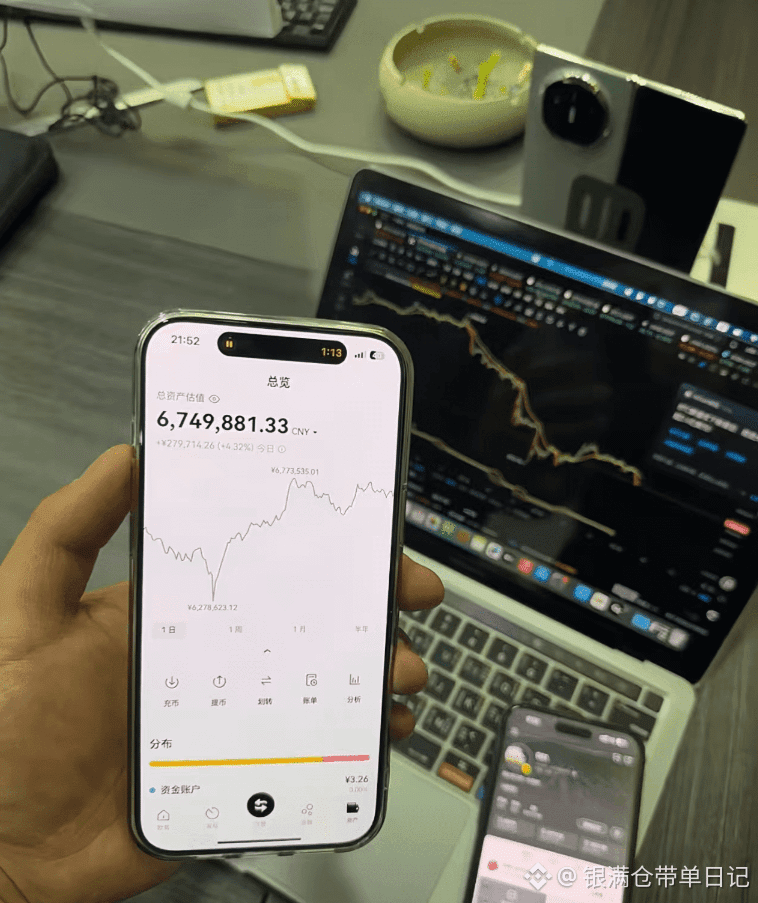
The Truth of Contracts: Either on the Rooftop or Steadily Landing $DOGE
Playing contracts, don't hold onto fantasies. The market only has two outcomes: either it pushes you to the peak, or it directly clears you out.
When I first entered the market, I also paid tuition: staying up late to watch the market, high-frequency trading, and just a slight increase in floating losses would make me lose my composure; a single needle could take away all my principal. It wasn't until later that I realized: liquidation is not an accident; it's the tuition that comes from a lack of understanding that will eventually need to be paid.
High leverage is a gentle trap
Do you think 3 times or 5 times is safe? In fact, it just postpones the risk. Once leverage is high, losses increase exponentially, and when you add in fees and slippage, the account is slowly drained through frequent trading.
The harsher reality is the mathematical rule: $PAXG
Lose 50%, you need to double to break even;
Lose 90%, you need to multiply by 9 to recover.
Those who survive rely on a set of "anti-collapse systems"
I no longer place orders based on feelings, but establish rules:
Observe the narrowing and widening using the BOLL indicator to judge trend momentum;
Set a single stop-loss not exceeding 3% of the principal, refusing emotional averaging down;
Trade no more than 2 times a day to avoid overtrading.
Don't challenge market probabilities with intuition $ZEC
If you always rely on "I feel like" to place orders, the problem is never bad luck, but rather your lack of a sustainable system.
In this game of contracts, rules are greater than mindset, and systems are stronger than intuition.
If you're tired of repeatedly facing liquidation, why not take a break, replace "gambling" with "rules," and perhaps you'll discover: the market never deceives; it's your own cognitive gaps that do. @银满仓带单日记