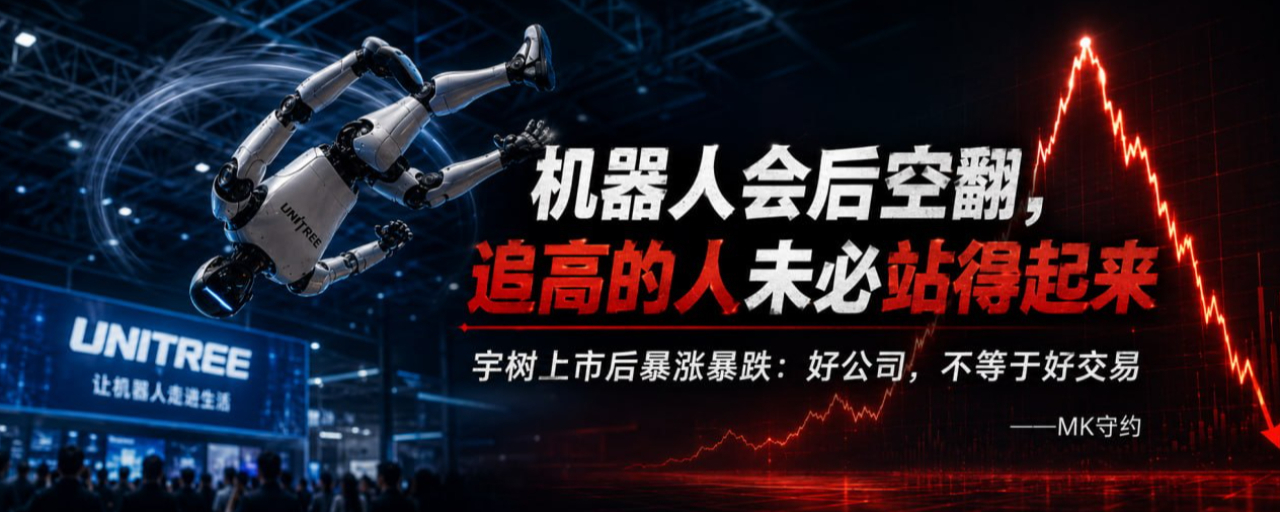


Unitree has gone public.
The robot can run. It can jump. It can flip. And so can the stock price.
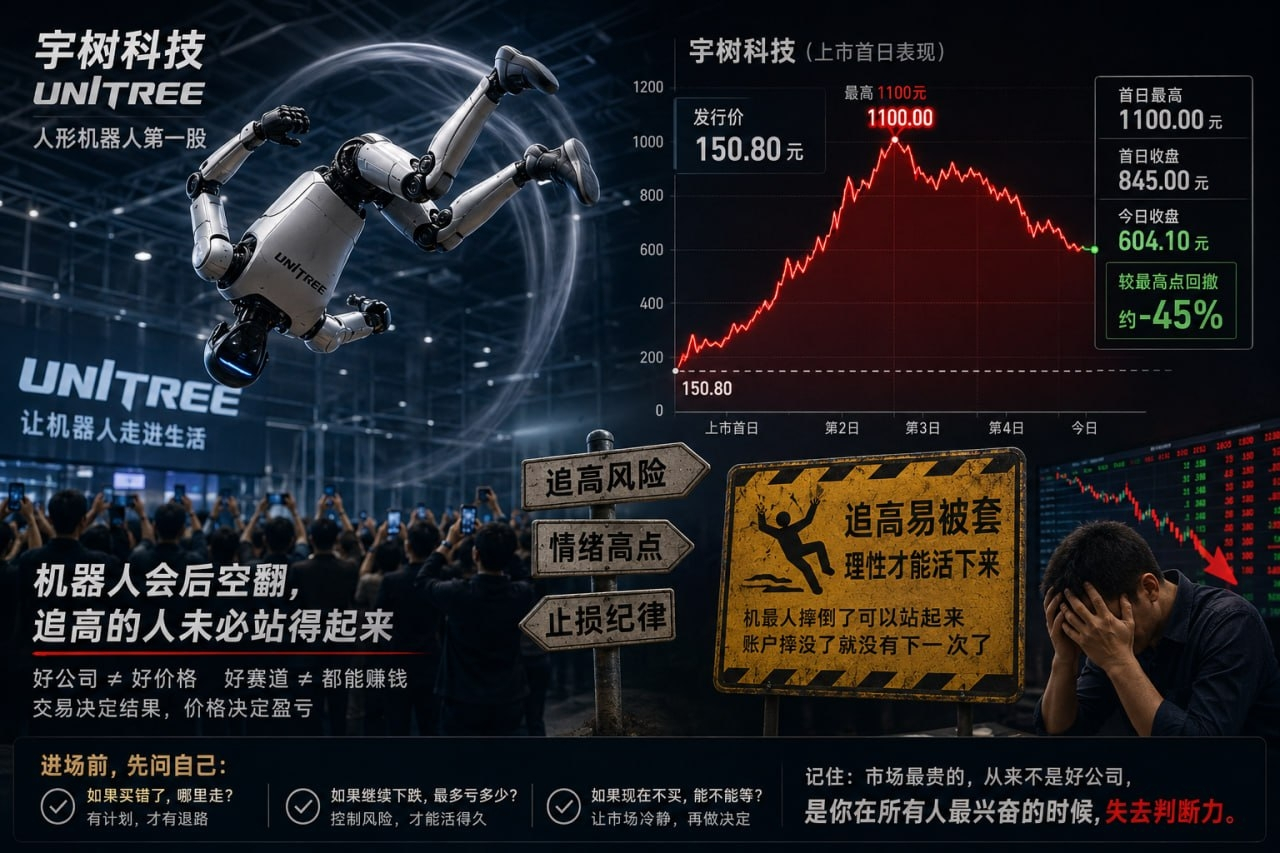
Issue price: 150.80 yuan. On the first day of listing, it surged as high as 1,100 yuan and closed at 845 yuan.
Today’s close was 604.10 yuan.
From the peak, over four trading days it has already pulled back by about 45%.
But even if it drops down to here, the stock price is still about four times the issue price.
This is the most real place in the market.
A good company.
A good sector.
A very bad trade.
These three things can all happen at the same time.
When many people rushed in around 1,100 yuan, what they were buying was no longer Unitree.
You’re buying “the first stock of humanoid robots.”
You’re buying “the next trillion-dollar track.”
You’re buying “if you don’t get on the train now, you’ll never have another chance.”
In the end, you’re buying your own impatience.
Of course you can be bullish on robots.
I also admit that Unitree isn’t just a shell that tells stories.
It has products.
Has income.
And it truly has sold robots out.
The latest R1—its official starting price has already been cut to $4,900, showing that the company is indeed moving toward scaling, lower costs, and a developer ecosystem.
But I need to remind you of something.
A good company doesn’t mean any price is a good price.
A great track doesn’t mean everyone who charges in can make money.
What the company is solving is whether robots can actually enter the real world.
What traders are solving is: at what price do you buy this reality?
This is completely different.
When Unitree hit a peak of 1100 yuan on the first day of listing, the market was already pricing in more than just today’s products and profits.
And there are future factories, too.
The future household.
The future of embodied intelligence.
Even the imagined future ten years from now was stuffed into that day’s stock price in advance.
When everyone is talking about the future, the real risks often lie right now.
People who chase after highs are most likely to make one mistake.
He will take the company’s long-term logic and find reasons for his own short-term losses.
When buying, they said they were doing short-term trades.
After it drops, they say “look ten years ahead.”
Keep falling, and then they start studying the industrial revolution.
This isn’t an investment.
After you get trapped, you temporarily give yourself belief.
Truly mature trading won’t cancel the stop-loss just because the company is good enough.
Nor will they give up judging the price just because the track is sexy enough.
Before you enter, ask yourself:
If you buy it wrong, where do you exit?
If it keeps falling, what’s the most I can lose?
If I don’t buy now, can I wait until the market has finished releasing the first wave of emotions?
If you can’t answer these three questions, don’t rush to talk about the robot world ten years from now.
Why can Unitree’s robots do backflips?
Because it has a control system.
Every move has posture feedback.
If the focus is wrong, it will correct itself immediately.
Trading is the same.
You don’t have feedback.
They won’t correct their errors.
No stop-loss.
Even if the direction is right, you may still end up crashing to the ground in the end.
Remember that.
The market’s most expensive thing is never a good company.
Is it you who loses judgment when everyone else is most excited?
If the robot falls, it can stand up again.
If your account is gone, there won’t be a next time.
—MK keeps his word