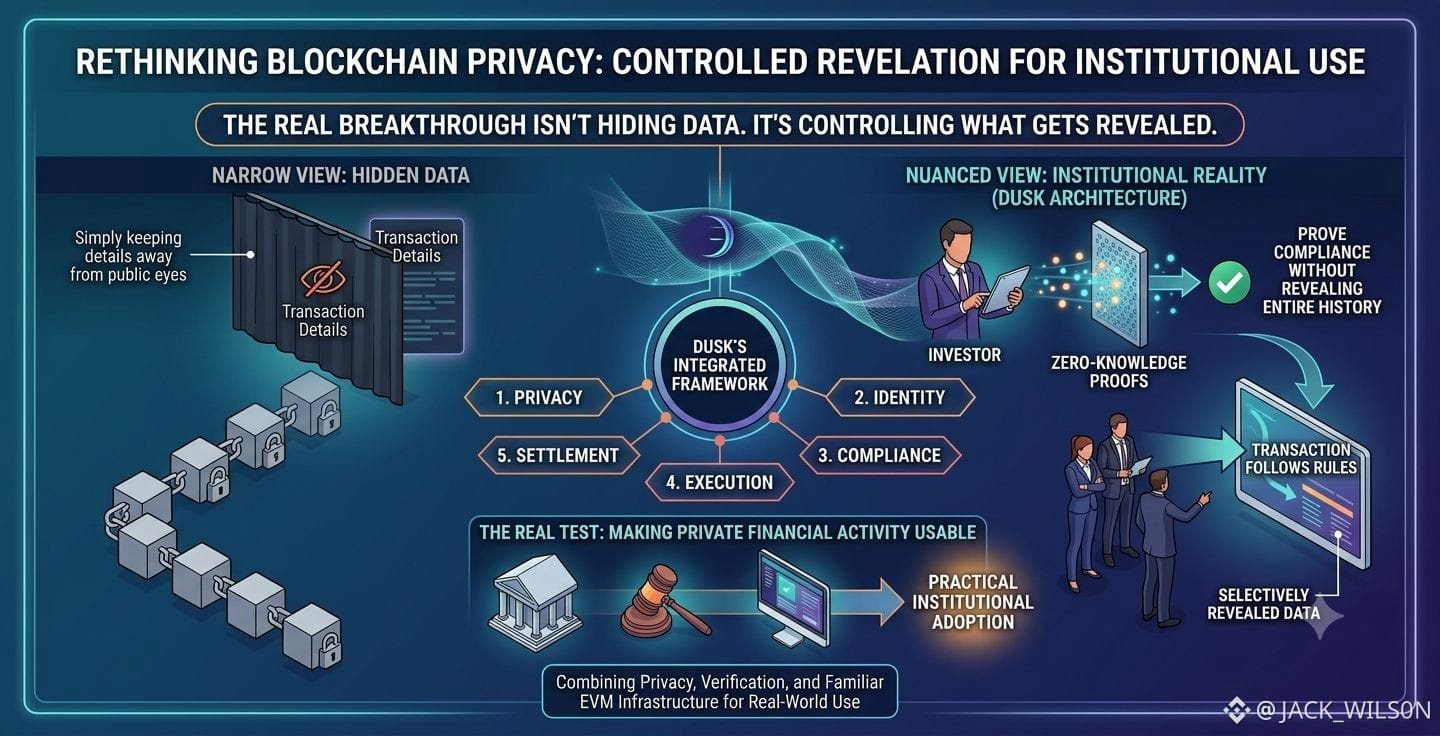

The Real Breakthrough Isn’t Hiding Data. It’s Controlling What Gets Revealed.
The more I look into Dusk, the more I think I was viewing blockchain privacy too narrowly.
At first, I saw privacy as simply keeping transaction details away from public eyes. But finance needs something more nuanced.
Sometimes you need to prove something without exposing everything behind it.
That’s what makes zero-knowledge proofs interesting to me.
Imagine an investor proving they meet a certain requirement without revealing their entire financial history. Or a transaction proving it follows the required rules without making every underlying detail public.
That feels much closer to how real financial markets actually work.
And this is where Dusk starts getting more interesting than just “a private blockchain” in my eyes.
Privacy has to work alongside identity, compliance, execution and settlement. If any one of those pieces creates too much friction, the technology becomes difficult to use in the real world.
What I like about Dusk is that the architecture seems to approach the problem from that broader direction rather than treating privacy as an isolated feature.
But I’m still watching one thing closely.
Can this combination of privacy, verification and familiar EVM infrastructure become practical enough for institutions to actually use?
Because that, to me, is the real test.
Not whether Dusk can hide data.
But whether it can make private financial activity usable.
#dusk @Dusk $DUSK