Recently, many people have been watching privacy public chains. The first reaction is always anonymous transfers or money laundering to avoid tracing. But if you take apart the technical materials for @Dusk again, you’ll find that focusing only on “concealed transactions” completely underestimates the real pain point of how compliance-oriented institutions are getting their workflows on-chain.
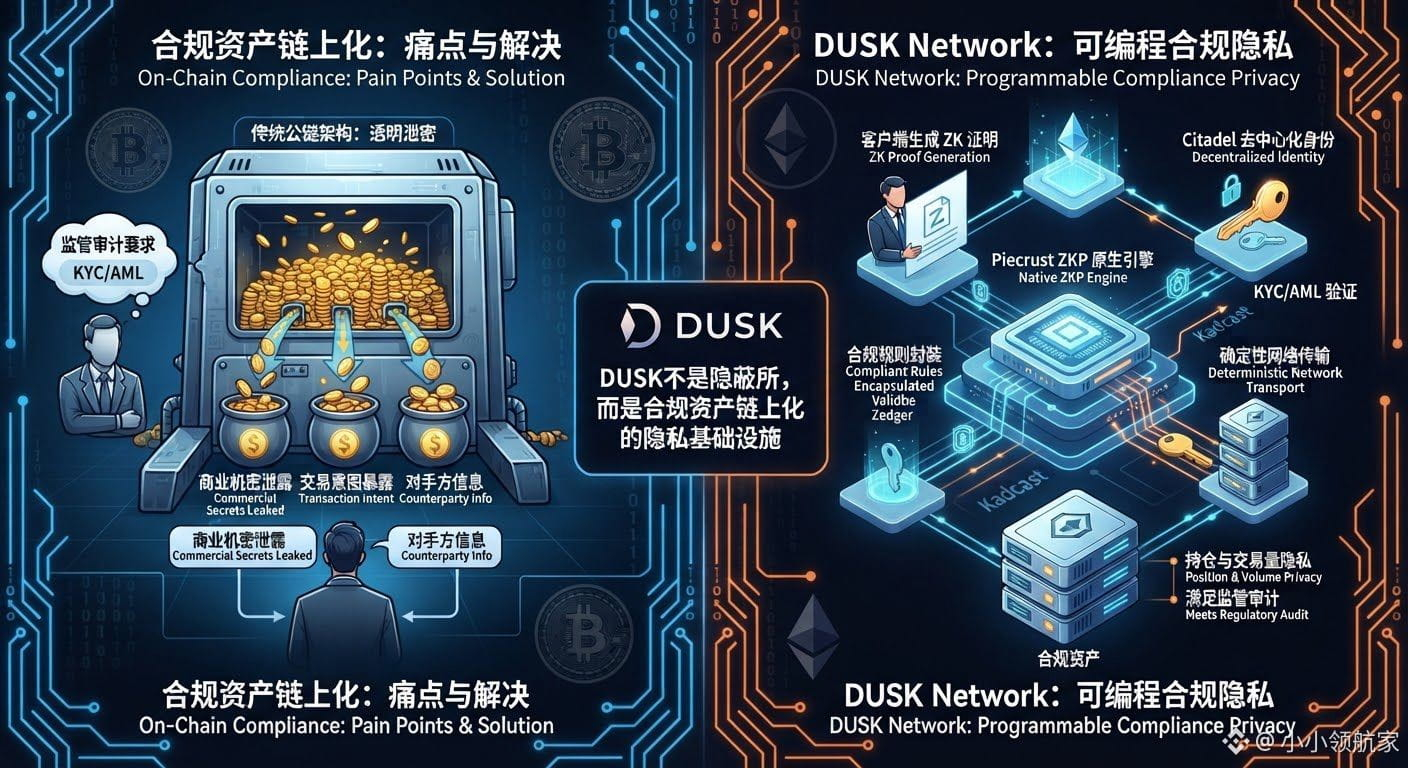
If institutions don’t put transactions on-chain, it’s not essentially because they fear addresses being exposed—it’s because the current public-chain architecture can’t resolve the fundamental contradiction: how to complete on-chain matching and settlement without leaking transaction intent and business secrets to the entire network.
Dusk’s real value lies in turning zero-knowledge proofs (ZKPs) into a native computing engine through the Piecrust virtual machine, rather than merely doing post-facto verification like many plug-in ZK solutions. In the layer of Zedger, it directly encapsulates asset ownership and compliance rules together. Combined with Kadcast’s deterministic network transmission and Succinct Attestation’s consensus mechanism, the whole system completes a seriously hardcore closed loop:
from generating ZK proofs on the client side, to nodes verifying compliance without ever touching plaintext, and finally to decentralized identity authentication (KYC/AML) through Citadel.
The key is not simply that it provides privacy—it enables institutions to meet the regulatory audit requirements essential for decentralized finance without disclosing their holdings, trading volumes, or counterparty information. This is not just anonymity; it’s programmable compliance privacy.
Of course, this architecture still has to consider real-world scenarios. First, Succinct Attestation consensus’s deterministic latency behavior under extreme network delays still needs large-scale mainnet validation in complex environments. Second, the ecosystem development threshold for Piecrust is not low. Compared with conventional EVM, writing zero-knowledge proof circuits and the development workflow present practical challenges in both efficiency and debugging difficulty.
In the public-chain race to this day, the route that $DUSK is taking is very clear: it’s not trying to provide a hidden place to evade regulation, but to build a truly usable privacy infrastructure for the on-chain transformation of compliant assets. Add an image
#dusk $DUSK @Dusk
If institutions don’t put transactions on-chain, it’s not essentially because they fear addresses being exposed—it’s because the current public-chain architecture can’t resolve the fundamental contradiction: how to complete on-chain matching and settlement without leaking transaction intent and business secrets to the entire network.
Dusk’s real value lies in turning zero-knowledge proofs (ZKPs) into a native computing engine through the Piecrust virtual machine, rather than merely doing post-facto verification like many plug-in ZK solutions. In the layer of Zedger, it directly encapsulates asset ownership and compliance rules together. Combined with Kadcast’s deterministic network transmission and Succinct Attestation’s consensus mechanism, the whole system completes a seriously hardcore closed loop:
from generating ZK proofs on the client side, to nodes verifying compliance without ever touching plaintext, and finally to decentralized identity authentication (KYC/AML) through Citadel.
The key is not simply that it provides privacy—it enables institutions to meet the regulatory audit requirements essential for decentralized finance without disclosing their holdings, trading volumes, or counterparty information. This is not just anonymity; it’s programmable compliance privacy.
Of course, this architecture still has to consider real-world scenarios. First, Succinct Attestation consensus’s deterministic latency behavior under extreme network delays still needs large-scale mainnet validation in complex environments. Second, the ecosystem development threshold for Piecrust is not low. Compared with conventional EVM, writing zero-knowledge proof circuits and the development workflow present practical challenges in both efficiency and debugging difficulty.
In the public-chain race to this day, the route that $DUSK is taking is very clear: it’s not trying to provide a hidden place to evade regulation, but to build a truly usable privacy infrastructure for the on-chain transformation of compliant assets. Add an image
#dusk $DUSK @Dusk