

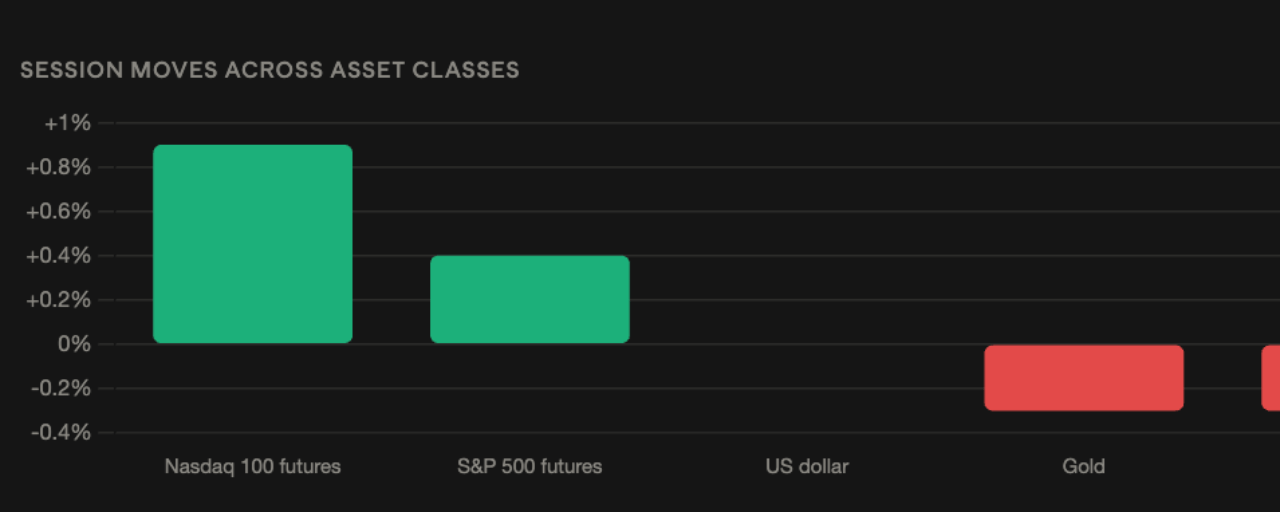


Global stocks rose as chipmakers rebounded, with falling bond yields adding support after Brent crude slid below $90 a barrel, according to Bloomberg. S&P 500 futures climbed 0.4% and Nasdaq 100 futures advanced 0.9%, while Nvidia was poised to break its longest losing streak since 2022. Gold snapped a four-day run of gains, the dollar held steady, and the 10-year Treasury yield declined three basis points.
Brent Crude Falls Below $90 on Reports of US Diplomatic Return to the Middle East
Brent fell to its lowest in a week after the New York Times reported the US is preparing to send diplomats back to embassies in the Middle East — a signal that Washington does not anticipate a renewal of full-scale conflict with Iran.
The diplomatic read is a meaningful shift in the risk framework. Prior de-escalation signals throughout the conflict were bilateral statements or strike pauses that repeatedly reversed within days. Physically returning diplomatic staff to regional embassies is an operational commitment rather than a rhetorical one — governments do not redeploy personnel into territory they expect to become a war zone.
That matters for the transmission chain that has governed markets all summer. Oil above $90 fed inflation expectations, which kept yields and the dollar firm, which capped risk assets. Brent below $90 loosens the first link, and the 10-year yield falling three basis points is the second link responding.
The caveat is that the 60-day ceasefire lapsed in mid-August without a deal, Hormuz shipping fell to near zero, and new US sanctions on Iran's crypto, gold, shipping, aviation and technology sectors were announced this week. Diplomatic redeployment and maximum economic pressure are running simultaneously.
Nvidia Set to Break Longest Losing Streak Since 2022 as Chip Stocks Firm
Chip stocks firmed ahead of Nvidia's earnings, with the company positioned to end its longest losing streak since 2022. Marvell rose 3.45% in pre-market trading, AMD 2.69%, Arm 2.62%, KLA 2.45% and Micron 2.38% — reversing Monday's broad hardware selloff that saw Applied Optoelectronics fall 11.66%.
Energy Group Capital's Amanda Lyons framed the underlying shift precisely: the fundamental debate has moved from whether AI demand exists to whether the extraordinary infrastructure buildout can keep generating sufficient economic returns.
That reframing explains the disconnect that has persisted through August. Amazon posted 37% AWS growth, CoreWeave beat on sales, SK Hynix committed $38 billion to memory capacity and HIVE signed a $350 million GPU cloud deal — yet the Nasdaq fell 2% last week with semis down more than 4%. Demand is not the question. Return on invested capital is.
Nvidia's position has also changed. Once a straightforward bellwether, it has become involved in orchestrating funding across the AI ecosystem — which makes its guidance a statement about the health of its own customer base as much as its order book.
Warsh Jackson Hole Speech and US Treasury Moves Are the Week's Macro Tests
Traders are watching the US Treasury's next moves with long-dated yields still near multi-decade highs, alongside a slate of economic data and Fed Chair Kevin Warsh's end-of-week speech — his first major address as chief and a test of his pared-back communication style.
Nuveen strategist Laura Cooper said investors face plenty to digest heading into September, from the Fed's reaction function and a potential rate hike to whether AI earnings can revive tech enthusiasm.
The communication-style framing is the underappreciated risk. MUFG's Derek Halpenny expects Warsh to continue offering limited forward guidance, and warned that if credible fiscal consolidation measures are not announced, the long end could be particularly impacted. Fidelity's Jurrien Timmer has separately identified reduced Fed transparency as a driver of the term premium surge — less transparency means more uncertainty, and more uncertainty means higher risk premia. A Warsh who says little may itself be a bond-market event.
Bitcoin Tops $80,000 as Druckenmiller Criticizes Bessent's Bond Intervention
Bitcoin briefly surged past $80,000 before paring gains, benefiting from renewed sector optimism after Treasury Secretary Scott Bessent's bond-market intervention fueled demand for dollar alternatives. Bitcoin was rejected near its 50-week moving average at $81,085 after reaching an intraday high of $81,265.
Stanley Druckenmiller — the billionaire who mentored Bessent early in his career — suggested his former pupil was making a mistake, writing in a Wall Street Journal column that governments defending prices against fundamentals always lose.
Druckenmiller's critique is the sharpest articulation of the concern MUFG raised in more measured terms. Treasury buybacks reduce the supply of long-dated paper private portfolios must absorb, mechanically lowering the term premium. They do not change the fiscal trajectory underneath: US national debt at $39.91 trillion, a 30-year auction drawing 5.22% — the highest since 2001. Investors demanding higher compensation to hold 30-year US debt are pricing solvency, not supply mechanics.
The irony for crypto is that Druckenmiller's bearish view on the intervention is structurally bullish for Bitcoin's debasement framing. If governments cannot defend bond prices against fundamentals indefinitely, the scarce-asset case strengthens. Bitcoin ETFs have taken more than $2.5 billion over six consecutive sessions, and gold, though it snapped a four-day run Tuesday, remains near record highs.
Volkswagen Job Cuts and Oura's $3 Billion IPO Filing
In corporate news, Volkswagen labor representatives warned planned cuts could eventually affect as many as 140,000 jobs. Smart-ring maker Oura is seeking to raise as much as $3 billion in a US IPO.