



Doing real finance on a publicly transparent blockchain is, in essence, a “commercial suicide” event—any large capital that exposes its positions, order placement intentions, and the counterpart network on-chain will only have its fills cleaned up by sniping bots and competitors. But fully anonymous mixers, on the other hand, directly cross regulatory red lines, making compliance impossible. That’s why projects claiming to be RWA under that banner have been around for years, yet traditional capital at the trillion scale still can’t get in: on-chain there is no compliant EVM that can both keep things private and provide regulators with a verifiable ledger.
DuskEVM mainnet is set to officially launch soon, directly targeting this trillion-level compliant blue ocean. What many people don’t know is that @Dusk_Foundation is actually an established blue-chip asset that has been listed on Binance since 2019, with an exceptionally clean capital structure. On the eve of the mainnet “big move” being rolled out, the current price is still lying low around $0.073, and the circulating market cap is only $36 million. In today’s institutional infrastructure segment, such a mix of strong certainty and a low valuation is extremely rare.

I. Zero-barrier Ethereum experience: Institutions and developers don’t need to “reinvent the wheel” at all
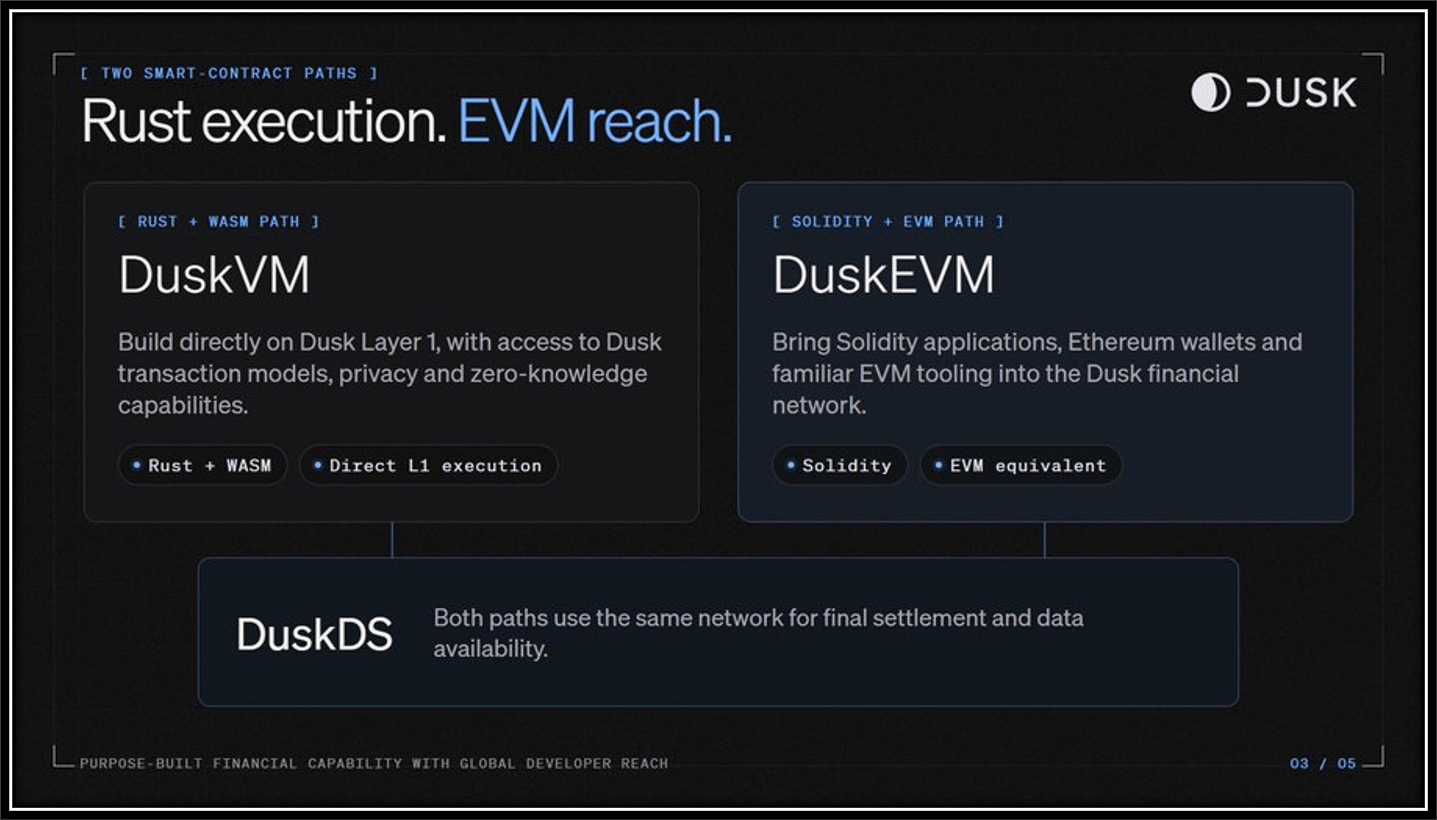
Many public chains that focus on privacy and high performance have their biggest Achilles’ heel: ecosystem isolation—forcing developers to learn niche languages, and even leaving them without a usable wallet. DuskEVM smashes through this wall directly:
Full-suite EVM toolchain seamlessly reused: Developers continue writing Solidity and Vyper, and can deploy directly with Foundry, Hardhat, viem, and ethers—virtually zero migration cost.
Native Ethereum wallet direct connection: Institutions and regular users directly use everyday EVM wallets, familiar RPC nodes, and block explorers—no learning curve at all.
DUSK serves as the core Gas: all computation fuel for the entire EVM execution layer is consumed in $DUSK. The cross-chain bridge freely moves between L1 and DuskEVM—every additional transaction in the ecosystem directly consumes tokens.
II. Clear bottom-layer division of labor: execution is as fast as lightning, settlement is as solid as a rock
DuskEVM uses a highly forward-looking modular Rollup architecture, fully decoupling “computation execution” from “base-layer settlement.”
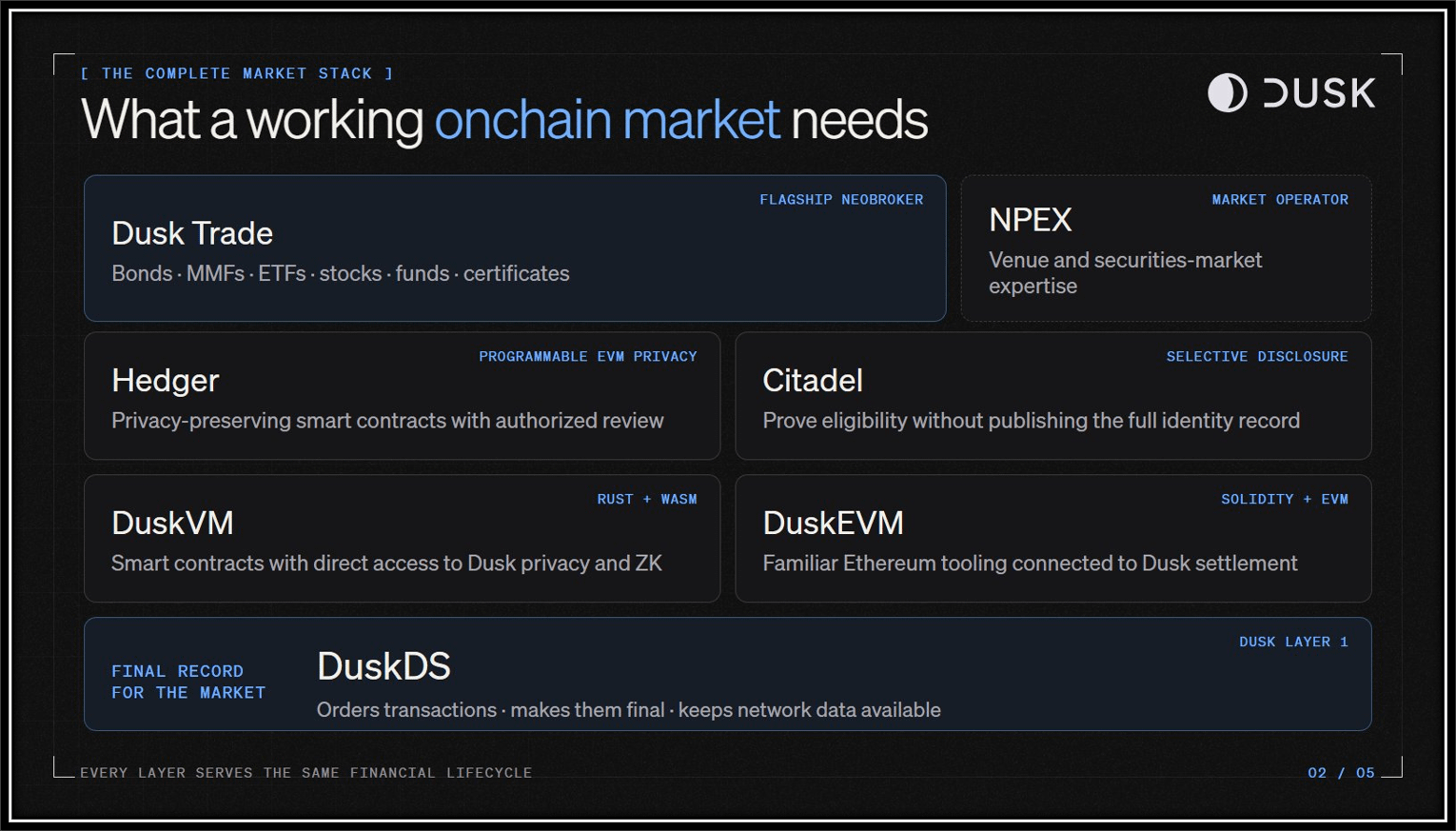
At the architectural level, the core division of labor is experienced in practice: DuskEVM’s execution layer smart contract execution and state update sequencer provide lightning-fast response; L2 confirmations are ultra-fast, and high-frequency trading won’t lag. DuskDS settlement and DA-layer bulk data publication, state commitments, and consensus-based decentralized data availability—fault proofs are anchored, and settlement has absolute certainty. Dusk Bridge securely orchestrates cross-layer asset and message transmission, allocating liquidity of DUSK tokens and coordinating interaction with underlying instructions.
Users submit orders on the frontend; the execution layer packs and returns results in seconds. Then, a batch-processing component submits the state to the underlying DuskDS for final settlement. This architecture perfectly meets the strict requirements of regulated securities trading—“fast matching” and “legal-level final settlement.”
III. In-house Hedger Engine: top-tier dimensionality reduction with homomorphic encryption + zero-knowledge proofs
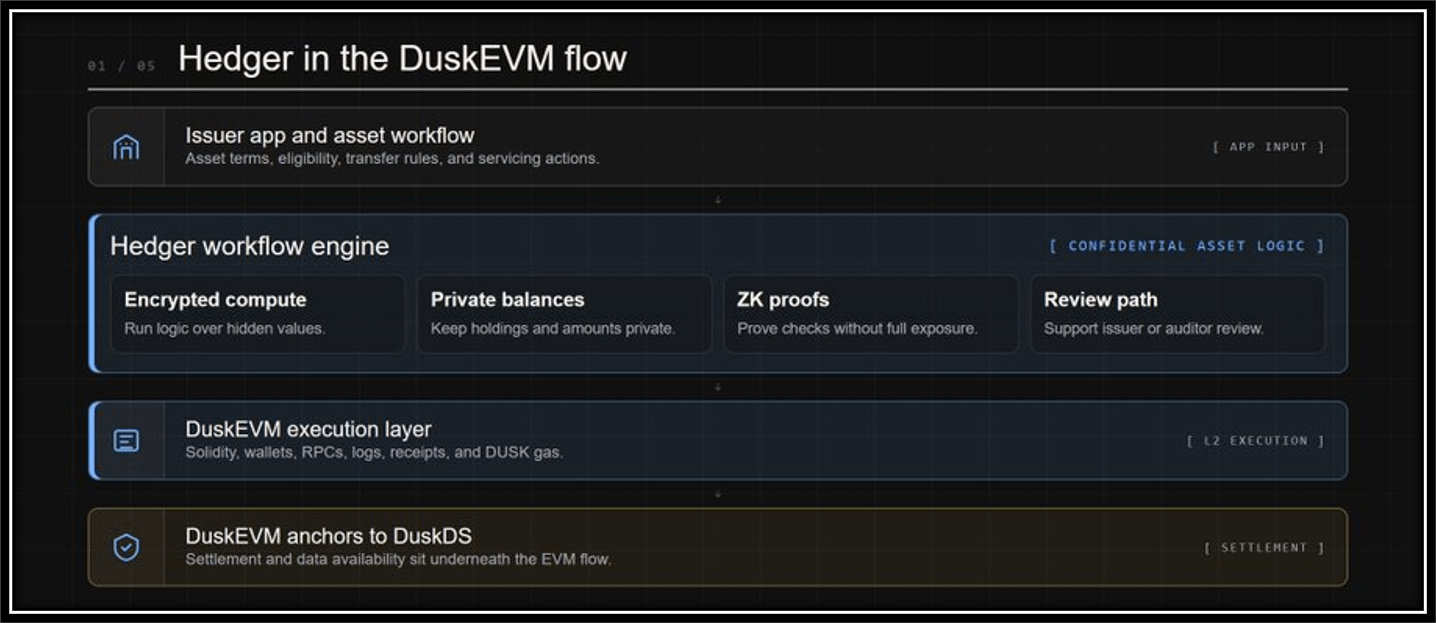
Most DeFi privacy projects only pile on ZK (zero-knowledge proofs) and can’t handle complex financial computations at all. Hedger, the privacy engine developed in-house by the Dusk team, directly pioneers a dual-cryptography fusion:
Homomorphic Encryption (HE, based on ECC ElGamal): The system doesn’t need to decrypt; it can perform addition, subtraction, multiplication, and division on account balances directly in the “ciphertext state,” protecting sensitive holdings.
Zero-Knowledge Proofs (ZKPs): Prove that transfers and business logic are compliant and legitimate without disclosing the input numeric values.
Obfuscated Order Books: Institutional large-lot order placements and trading intentions are completely hidden, completely eliminating MEV sandwich attacks and malicious front-running trades.
Browser-side 2-second instant proof generation: In the past, running a privacy proof would make a privacy-proof “fan” spin for minutes. Hedger’s lightweight circuits can generate proofs on the web in under 2 seconds—so smooth it feels like you’re not even using privacy computation.
IV. A 4–5 step closed loop: hard-wire the ERC-3643 compliant asset flow onto the chain
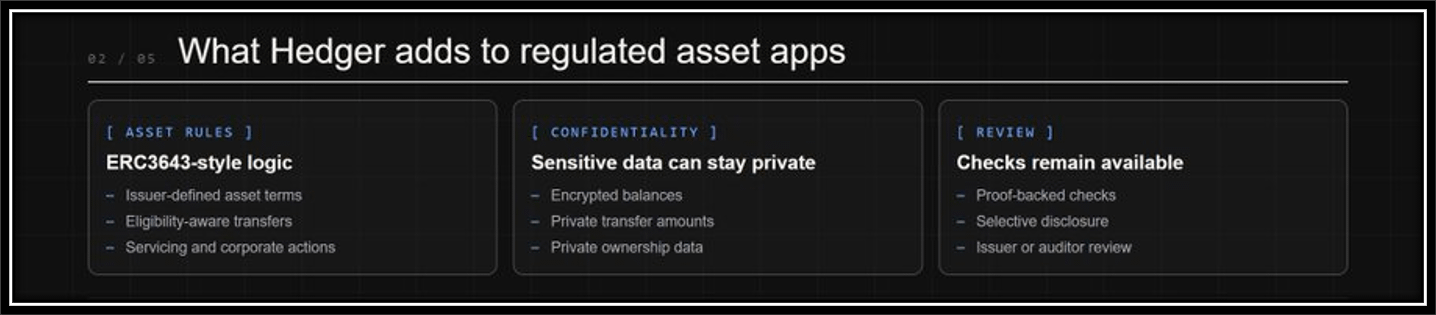
Traditional compliant finance can’t let assets be “transferred however you want.” Hedger embeds compliant rules that meet regulatory standards (such as ERC-3643) directly into the entire trading workflow, forming a standardized closed loop:
1. Configure: The issuer locks in participant thresholds, transfer restrictions, and corporate dividend logic inside the smart contract.
2. Verify: Before any interaction occurs, the system pre-checks and validates the investor’s compliance credentials.
3. Ciphertext Protection (Protect): Wallet balances, transfer amounts, and the relationship with counterparties are all encrypted end-to-end and never leave the chain in the clear.
4. Confidential Transfer (Transfer): Complete private point-to-point transfers under constraints of compliant rules.
5. Authorized Audit (Audit): Regulators can audit accounts through a reserved selective disclosure channel—both confidential and compliant.
V. Severe value mismatch: understand DUSK before the trillion-RWA explosion
Why should we pay special attention to DUSK right now?
A flywheel where multiple parties win: The licensed European exchange NPEX has already planned to bring more than €300 million in real-world assets onto Dusk, with deep integration from infrastructure giants like Chainlink. Real institutions entering bring real Gas consumption—not air-based staking.
Extremely cheap chips: Compared with those empty Layer2 projects with valuations of tens of billions of dollars and a full stack of VC unlock sell pressure, DUSK is a well-established compliant public chain that has spent years deeply building base-layer cryptography. Its mainnet and confidential EVM are fully deployed, and Binance’s spot price is only around $0.073.
When trillion-dollar traditional securities and RWA truly move to the chain at large scale, the market will ultimately buy base-layer infrastructure that can “handle the EVM ecosystem, business confidential information, and regulatory compliance all at once.” DuskEVM has already set the standard for this track. Judging by valuation and market display, the value-for-money of DUSK at this stage is self-evident.
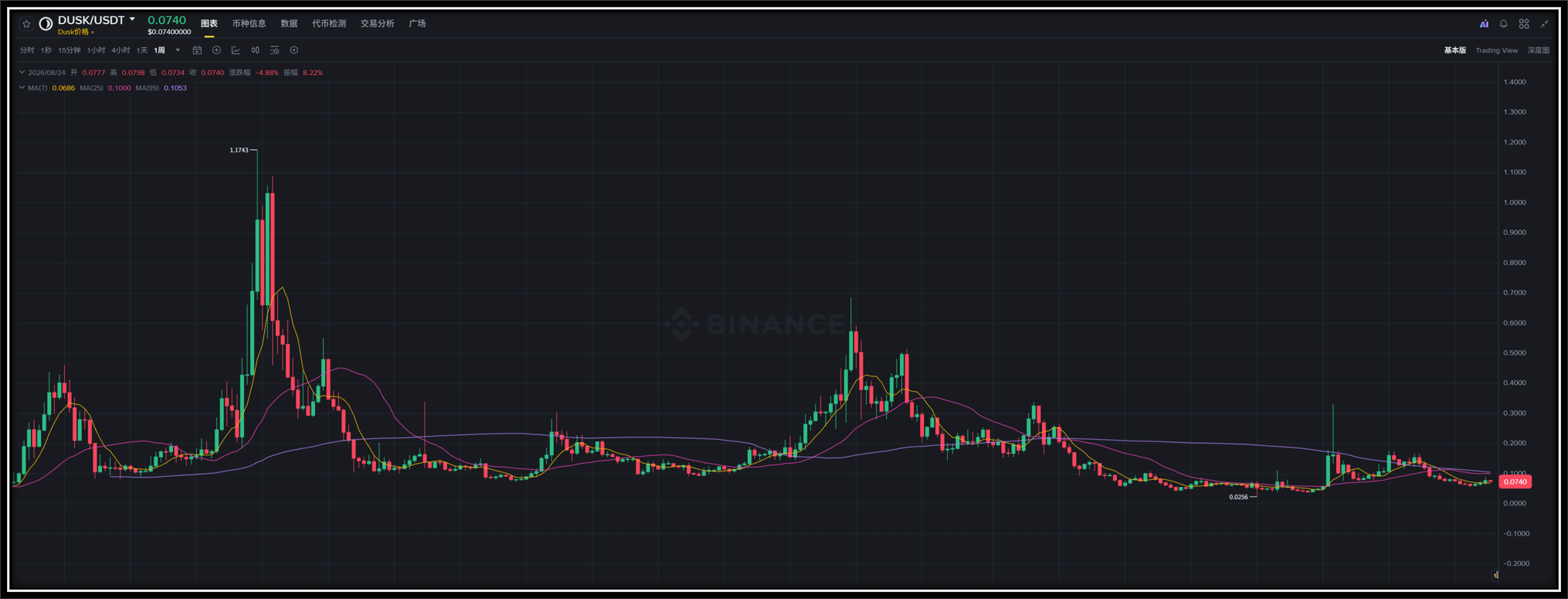
Currently, the market cap is only tens of millions of dollars, basically in a long-term bottom accumulation range. With the launch of the core catalyst—DuskEVM mainnet—landing, together with the gradual entry of several hundred million euros in real-world assets from licensed European institutions, real Gas consumption and institutional narratives will form a strong synergy. My personal expectation is that a 2–3x valuation re-assessment is highly likely to happen within the next period. After all, Dusk’s highs in the 2021 and 2024 bull markets were $1.17 and $0.68 respectively. It is very possible that this positive development will lift the price to around $0.2. In a market where overvalued empty shell projects are everywhere, a well-established compliant asset that has real deliverables, licenses, and accumulated chips is absolutely a chance with an excellent risk-reward ratio.