



US spot Solana ETFs extended their inflow streak to a fifth session Monday, adding $33.5 million in the largest single-day total of 2026 and pushing cumulative net inflows to a record $1.22 billion, according to SoSoValue data. Total trading volume reached $166.8 million, the highest since October 2025. The five-session streak running from August 18 netted $61.8 million.
Solana ETF Daily Inflows and Trading Volume Reach 2026 Highs
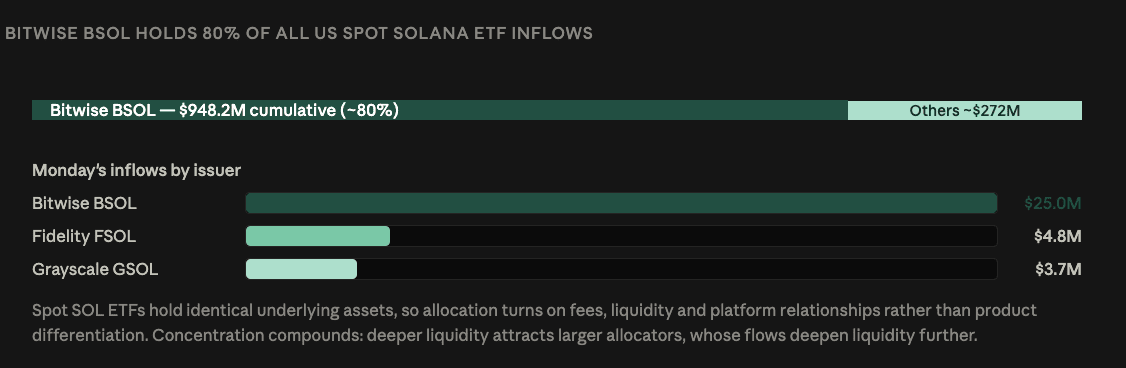
Monday's $33.5 million marked the strongest single day for US spot Solana ETFs since December. Bitwise's BSOL led with $25 million, Fidelity's FSOL added $4.8 million, and Grayscale's GSOL contributed $3.7 million, per Farside data.
Trading volume of $166.8 million is the more forward-looking number. Volume measures secondary market activity rather than net creation, and a reading at its highest since October 2025 indicates the products are seeing genuine two-way institutional participation rather than one-directional accumulation into thin markets.
Bitcoin, Ether and Solana ETF Inflow Streaks Run Simultaneously
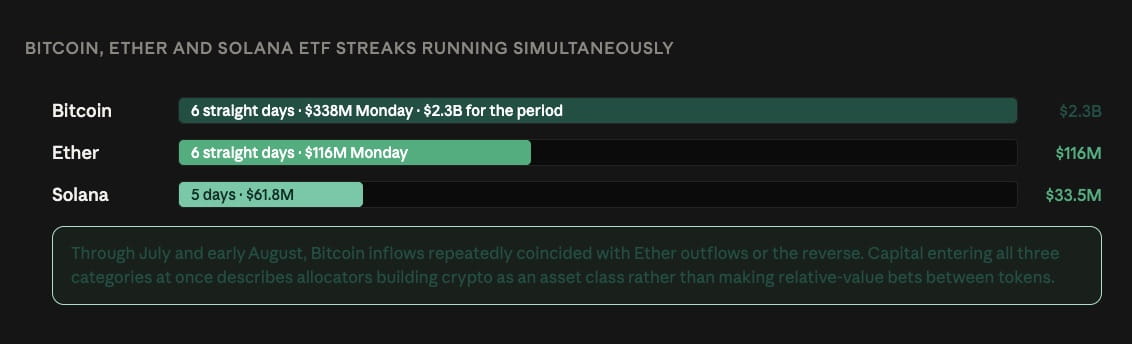
Bitcoin ETFs logged a sixth consecutive positive session with $338 million in inflows, taking the period total to $2.3 billion — their strongest weekly run since October 2025. Ether ETFs recorded $116 million on August 24, extending their own streak to six straight days.
Three simultaneous multi-day streaks across Bitcoin, Ether and Solana products represent the broadest institutional participation of the current recovery. Prior periods of ETF strength were concentrated rather than uniform: through July and early August, Bitcoin inflows repeatedly coincided with Ether outflows, or the reverse. Capital entering all three categories at once describes allocators building crypto exposure as an asset class rather than making relative-value bets between individual tokens.
The October 2025 benchmark recurs across all three datasets — Bitcoin's strongest weekly run since then, Solana's highest volume since then, Ether ETFs at their best since early October 2025. That period marked peak institutional enthusiasm in the prior cycle, with Bitcoin near its $126,000 record. Matching those flow levels from substantially lower prices describes institutions deploying into strength rather than chasing a top.
Bitwise BSOL Holds 80% of All US Spot Solana ETF Inflows
Bitwise's BSOL accounts for $948.2 million of the $1.22 billion cumulative total — roughly 80% of all capital that has entered US spot Solana ETFs. That is an unusually concentrated share for a multi-issuer category. In the Bitcoin ETF market, BlackRock's IBIT leads but faces meaningful competition from Fidelity's FBTC and others.
The concentration reflects first-mover positioning and distribution rather than product differentiation. Spot Solana ETFs hold identical underlying assets, so allocation decisions turn on fees, liquidity and existing platform relationships. BSOL's early lead compounds: deeper liquidity attracts larger allocators, whose flows deepen liquidity further. FSOL at $4.8 million and GSOL at $3.7 million Monday are competing for a much smaller share of incremental flow.
Solana ETF Cumulative Inflows Since the October 28 Debut
US spot Solana ETFs posted 21 consecutive days of inflows following their October 28 launch, adding more than $620 million in that opening run. Reaching $1.22 billion cumulative means roughly half of all capital that has ever entered these products arrived after that initial streak.
That subsequent period included Bitcoin's decline from $126,080 to $57,750 and Solana trading as low as the $60s. Continued accumulation through a severe drawdown is the detail that carries more weight than the record headline — it describes structural allocation rather than momentum chasing. Products that absorb capital in conditions where momentum-driven flows would reverse are demonstrating a different kind of demand.
Solana Open Interest and Derivatives Positioning During the Rally
Solana's derivatives structure has been constructive through the recovery. Open interest rebounded to 66.88 million tokens earlier in August, the most since July 10, as the token recovered from near $70 to over $76 and broke above the Ichimoku cloud — a widely tracked momentum confirmation signal.
During last week's rally, SOL futures showed the same pattern as Bitcoin, Ether and XRP: open interest declining while price rose. That configuration indicates spot-driven buying and short covering rather than fresh leverage, which carries materially less unwind risk than a leverage-fueled advance.
TDX Strategies had specifically recommended December optionality on SOL alongside Bitcoin when implied volatility sat at 2026 lows, citing catalyst density in the December window. The ETF inflow acceleration adds a spot-demand component to that positioning thesis.
Jackson Hole and Core PCE Are the Risks to Crypto ETF Inflow Streaks
Three ETF categories running simultaneous streaks into a week containing the Jackson Hole symposium, July core PCE, Q2 GDP revisions and Nvidia earnings is a setup with meaningful two-way risk.
The flows have been driven by the same macro backdrop that drove the price rally: Treasury Secretary Bessent's bond buyback expansion pushing yields and the dollar lower, with the DXY at 98.9 below its 200-day average of 99.1. MUFG strategist Derek Halpenny has flagged that the buyback addressed supply mechanics rather than the fiscal trajectory underneath, warning the long end could face renewed pressure if Bessent's speech omits credible consolidation measures.
ETF flows respond to macro conditions with a lag. A hawkish Warsh on Friday or a core PCE upside surprise Wednesday would not reverse Monday's inflows, but would test whether an institutional bid running six days across Bitcoin and Ether and five across Solana persists once the macro tailwind weakens.