

21st Century Business Herald reporter Wu Jianan
On the evening of August 24, BOWAY Storage (688525.SH) released its 2026 interim results.
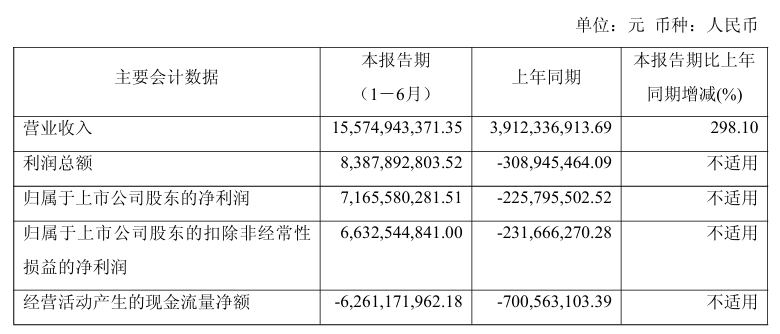
During the reporting period, in the first half of 2026 the company achieved operating revenue of 15.575 billion yuan, up 298.1% year on year; net profit attributable to shareholders of the listed company was 7.166 billion yuan, up 3,273.48% year on year; after excluding share-based payment expenses, net profit reached 7.256 billion yuan, surging 9,701.92% year on year.
By quarter, net profit was 2.899 billion yuan in the first quarter, rising to 4.267 billion yuan in the second quarter, up 47% quarter-on-quarter; profits showed an accelerating pace quarter by quarter.
The core reason for the surge in performance is the double resonance between the AI computing power boom and the storage industry entering a high-activity cycle.
On the edge side, representative storage products such as ePOP have been adopted by globally well-known companies including Meta, Google, Alibaba, Xiaomi, and XTF (Xiao Tian Cai), as well as Rokid and Airo, for AI/AR glasses, smartwatches, and other wearable devices. In the first half of the year, revenue from AI emerging edge-side storage products was about RMB 2.86 billion, surging 433.58% year over year and up 126.98% quarter over quarter.
While net profit has skyrocketed, standing at the takeoff point of the memory industry’s super cycle, Boweide Storage is experiencing an extreme tug-of-war between high growth and high risk. Signs such as negative cash flow from operating activities, rising inventory balances, and a high asset-liability ratio are still present.
In the secondary market, Boweide Storage’s share price staged a “roller-coaster” pattern within one year. It rose from just over a hundred yuan at the end of 2025, hit a historical peak of 517 yuan at the end of June 2026, and then fell again to around 225 yuan. Its cumulative gain since the start of the year exceeds 98%.
Meanwhile, the company is making a second push for a Hong Kong stock IPO, accelerating its “A+H” dual-listing strategy.
As of the close on August 25, Boweide Storage was at RMB 227.82 per share, up 0.99%, with a total market capitalization of RMB 107.4 billion.
With the dual catalysts of the AI computing power boom and the storage industry entering a super cycle, this Shenzhen-based company, which started out with storage modules, is rewriting its growth trajectory with impressive financial results.
In the first half of 2026, all key financial indicators of Boweide Storage surged across the board. Operating revenue was RMB 15.575 billion, up 298.10% year over year; the parent-attributable net profit was RMB 7.166 billion, up by more than 32 times.
Total assets increased from RMB 15.521 billion at the end of 2025 to RMB 33.348 billion; the weighted average return on net assets reached as high as 78.69%, up by 86.22 percentage points from -7.53% in the same period last year.
Boweide Storage believes that during the reporting period, the company’s operating revenue grew significantly, mainly benefiting from the AI computing power boom and the storage industry entering a high-activity cycle. At the same time, the company’s product and customer mix continues to improve, and it has been increasing investment in areas such as chip design, solutions, advanced packaging and testing, and testing equipment, thereby enhancing its market competitiveness.
Sustained scaling up of AI edge-side storage products is a key component of performance growth.
The company’s representative products such as ePOP have advantages including low power consumption, fast response, and being light, thin, and compact. They have been applied in intelligent wearable devices such as AI/AR glasses and smartwatches by well-known domestic and international enterprises including Meta, Google, Alibaba, Xiaomi, Xiao Tian Cai, Rokid, and Airo Innovation.
In the first half of the year, revenue from Boweide Storage’s AI emerging edge-side storage products was approximately RMB 2.86 billion, up 433.58% year over year, and up 126.98% quarter over quarter.
According to data from Frost & Sullivan, based on 2025 revenue, the company is the world’s largest supplier of AI emerging edge-side semiconductor storage solutions.
Boweide Storage believes that in 2026, as AI glasses roll out at scale, the company’s cooperation with key customers such as Meta will deepen further, which will drive continued growth in the related storage product business.
From the perspective of the supply chain, Boweide Storage carried out strategic inventory buildup. As of the end of the reporting period, inventory balance was RMB 18.168 billion, up 130.89% compared with the end of 2025.
At the same time, Boweide Storage continues to deepen cooperation with major global storage wafer manufacturers, continuously signing LTA (long-term supply agreements). In March and June this year, respectively, it disclosed two long-term raw material procurement agreements signed with storage manufacturers. The company has cumulatively committed to procurement of US$3.3608 billion, thereby securing core raw material supply resources for the next two years.
Boweide Storage said that by signing the above agreements, on the one hand, it stabilizes the supply channels for core raw materials, ensures orderly delivery of orders, and strengthens the stability of customer cooperation. On the other hand, through a long-term locked pricing mechanism, it smooths cyclical fluctuations in the industry, reasonably controls procurement costs, stabilizes its profitability level, and improves operational stability and market competitiveness.
The company’s R&D spending is also continuously increasing. The financial reports show that in the first half of 2026, Boweide Storage’s R&D expenses were RMB 344 million, up 26.01% year over year.
From a technology standpoint, the company’s self-developed domestic eMMC controller chips have achieved large-scale mass production and delivery across multiple fields. Its UFS controller chips have completed known-die (return-to-wafer) validation, and are expected to be introduced into terminal applications in the second half of 2026. Meanwhile, the company has also moved into the design of small-capacity NAND Flash media and has reached strategic cooperation with leading domestic foundries to develop small- and medium-capacity SLC/MLC NAND products at nodes such as 24nm/19nm.
Beyond the storage business, Boweide Storage has also extended upstream into wafer manufacturing. It serves areas such as advanced memory, storage and compute integration, and optoelectronic co-packaging through its wafer-level advanced packaging and testing manufacturing project.
In terms of capacity planning, Boweide Storage stated that its wafer-level advanced packaging and testing manufacturing project is planned to achieve a monthly production capacity of 5,000 wafers by the end of 2026, and to increase to 10,000 wafers per month by the end of 2027. If customer onboarding goes smoothly, the company expects to officially contribute revenue starting at the end of 2026.
Despite strong financial performance, behind the high growth there remain concerns about pricing, inventory, and cash flow.
Since the fourth quarter of 2025, the supply-demand relationship in the NAND Flash and DRAM markets has tightened significantly, and prices for storage wafers have accelerated upward.
The upward price trend is expected to continue. According to TrendForce data, the company expects that in the third quarter of 2026, general DRAM prices will rise quarter over quarter by 13% to 18%, and NAND Flash prices will rise quarter over quarter by 10% to 15%.
In investor research and surveys conducted in June this year, Boweide Storage stated that based on market expectations, benefiting from the demand boom driven by AI applications and token usage, product pricing still has some room to rise, and manufacturers have shifted to locking capacity for 2027 and beyond.
“In terms of costs, the company values its inventory using the moving weighted average method. Each time a new purchase is put into stock, the cost is recalculated. Since purchases are made each quarter, the purchase price tends to increase and costs therefore rise, and the pricing of our products follows the market,” Boweide Storage said.
From gross margin, we can see the company’s volatility with industry cycles. From 2023 to the first half of 2026, Boweide Storage’s consolidated gross margins were 1.71%, 18.19%, 21.44%, and 54.81%, respectively.
The company acknowledges that if, in the future, prices of storage wafers fluctuate significantly, it will cause significant fluctuations in the profit margins of storage products, and it may even require the company to recognize large impairment provisions for assets such as inventory, thereby substantially reducing the company’s earnings.
In terms of inventory levels, from the end of 2023 through the first half of 2026, the proportion of Boweide Storage’s inventory book value to its total assets was 56.10%, 44.43%, 50.70%, and 54.48%, respectively. Inventory size at the end of each period was relatively large, and the proportion of total assets at the end of each period was also relatively high.
Accompanying this, net cash flow from operating activities was negative. In the first half of 2026, Boweide Storage’s net cash flow from operating activities was RMB -6.26 billion.
The company explains that the main reason is that it adopts a strategic procurement approach for key raw materials such as storage wafers, resulting in higher cash outlays for purchasing raw materials during the reporting period.
In fact, the storage industry that Boweide Storage operates in has a capital-intensive characteristic: the business requires substantial funding. However, the company has relatively limited equity financing and relies mainly on debt financing, which is why its asset-liability ratio remains relatively high.
From 2023 to the first half of 2026, Boweide Storage’s consolidated asset-liability ratio was 69.66%, 69.47%, 64.47%, and 61.64%, respectively.
At present, Boweide Storage is accelerating the pace of its “A+H” dual-platform listing. The company first submitted its application to list shares on the Hong Kong Stock Exchange in October last year. This year in May, it resubmitted the filing.
Boweide Storage believes that listing in Hong Kong aims to leverage the international capital market platform of Hong Kong-listed stocks to strengthen its capital strength. The fundraising will mainly be used to enhance R&D capabilities and promote product innovation, among other things.
Although tidal currents are turbulent, in terms of the industry landscape, the global storage chip market is highly concentrated, and China’s domestic memory sector still has considerable room for development.
According to Gartner data, in the first quarter of 2026, the share of domestically produced DRAM is below 10%, and the market share of domestic NAND Flash chips is below 15%. With the ongoing release of domestic storage manufacturers’ capacity, continuous process iterations, and product validation, the penetration opportunities for China’s domestic storage industry chain in areas such as servers, smart terminals, automotive electronics, and industrial applications are expected to further open up.
In particular, AI infrastructure and edge AI are jointly changing the structure of storage demand. Gartner expects that in 2026, the number of global AI server shipments will be about 3.693 million units, up about 55.6% year over year, accounting for roughly 26.4% of total global server shipments.
On the device side, global AI PC shipments in 2026 are expected to be approximately 109 million units, accounting for about 46.0% of total PC shipments; global AI smartphone shipments are expected to be about 531 million units, accounting for about 47.1% of total smartphone shipments.
AI training, inference, and edge-side model execution place higher demands on capacity, bandwidth, and energy efficiency, which will drive storage products to upgrade toward high performance, large capacity, and high added value.
In the secondary market, Boweide Storage’s share price performance in 2026 has been extremely strong. On June 26, during intraday trading, the company’s share price reached a high of 517 yuan per share, setting a new all-time high.
From the beginning of the year to the peak on June 26, the company’s share price surged by as much as 336.76%. After that, the stock experienced a deep correction. As of the close on August 25, the share price was RMB 227.82 per share, which is “cut in half” from this year’s peak. However, from the beginning of the year to date, the cumulative gain of this stock is still over 98%.
On August 11, Boweide Storage released an announcement stating it plans to repurchase the company’s shares with an amount of not less than RMB 200 million and not more than RMB 250 million. The repurchase price will not exceed RMB 468.24 per share, and the repurchased shares will be used to reduce registered capital, showing the company’s confidence.
On one side are the moat of AI edge-side storage positioning and wafer-level packaging and testing integration. On the other side are real constraints such as cyclical volatility, high inventory levels, and negative cash flow. Whether Boweide Storage can translate the benefits of a super cycle into the capability to survive through cycles will continue to test this billion-yuan market-cap company.