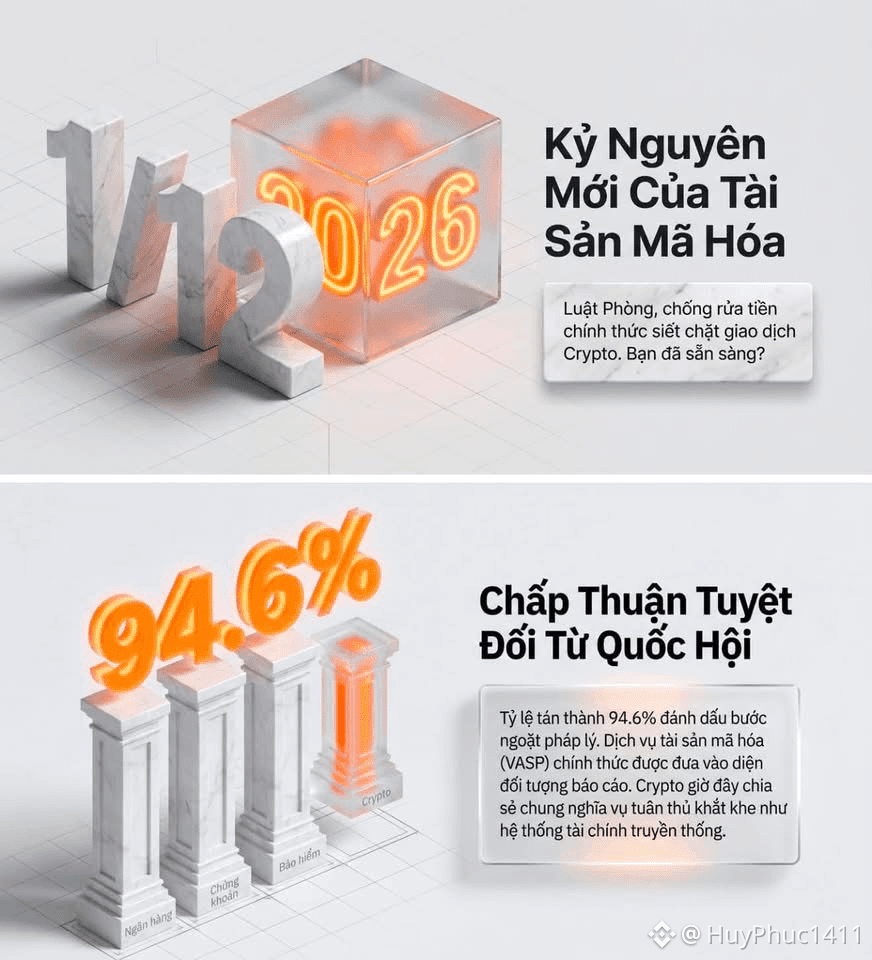
🚨 From 1/12/2026, cryptocurrency services will officially be brought under the spotlight for anti-money laundering
The National Assembly has just passed the Law on Anti-Money Laundering (amended), placing tokenized asset services under mandatory reporting and strict supervision. The law takes effect from 01/12/2026.
It’s not only large transactions that will be scrutinized—splitting money or using anonymous wallets may also trigger alerts. The State Bank of Vietnam will closely monitor 15 suspicious signs, summarized into 5 groups:
1. Suspicious transactions
- Split funds to evade reporting; a newly opened account with quick deposit-withdrawal, or an account long unused suddenly making a large transaction.
- Accept severe losses and high fees just to transfer money quickly.
2. Sophisticated circulation:
- Multiple wallets consolidate funds into one wallet, or one wallet disperses funds across many wallets.
- Use anonymous coins and coin-mixing services (mixers). - Transfer funds to countries on the FATF blacklist.
3. Hiding identity:
Refuse/delay KYC, use fake documents, VPN/fake IPs, multiple accounts sharing the same IP/device, or constantly changing information.
4. Linked to the underworld:
- Transactions with wallets previously tied to dark web, scams, extortion, or gambling.
- Money from fraudulent ICOs, pyramid schemes, or unlicensed exchanges.
5. Borrowing someone else’s name:
The named person has very limited understanding of crypto but conducts large transactions, or always follows instructions from others.
What do exchanges and users need to do?
- Exchanges must upgrade monitoring (IP, cross-chain, wallet history...) and require stricter KYC.
- Users need to make the source of funds transparent and be ready to provide additional information.
These regulations aim to clean up the market, protect investors, and meet international standards (FATF). The crypto market will become more transparent and professional.
What does AE think about this new regulation?
$ADA $SAND
The National Assembly has just passed the Law on Anti-Money Laundering (amended), placing tokenized asset services under mandatory reporting and strict supervision. The law takes effect from 01/12/2026.
It’s not only large transactions that will be scrutinized—splitting money or using anonymous wallets may also trigger alerts. The State Bank of Vietnam will closely monitor 15 suspicious signs, summarized into 5 groups:
1. Suspicious transactions
- Split funds to evade reporting; a newly opened account with quick deposit-withdrawal, or an account long unused suddenly making a large transaction.
- Accept severe losses and high fees just to transfer money quickly.
2. Sophisticated circulation:
- Multiple wallets consolidate funds into one wallet, or one wallet disperses funds across many wallets.
- Use anonymous coins and coin-mixing services (mixers). - Transfer funds to countries on the FATF blacklist.
3. Hiding identity:
Refuse/delay KYC, use fake documents, VPN/fake IPs, multiple accounts sharing the same IP/device, or constantly changing information.
4. Linked to the underworld:
- Transactions with wallets previously tied to dark web, scams, extortion, or gambling.
- Money from fraudulent ICOs, pyramid schemes, or unlicensed exchanges.
5. Borrowing someone else’s name:
The named person has very limited understanding of crypto but conducts large transactions, or always follows instructions from others.
What do exchanges and users need to do?
- Exchanges must upgrade monitoring (IP, cross-chain, wallet history...) and require stricter KYC.
- Users need to make the source of funds transparent and be ready to provide additional information.
These regulations aim to clean up the market, protect investors, and meet international standards (FATF). The crypto market will become more transparent and professional.
What does AE think about this new regulation?
$ADA $SAND