


This article comes from the WeChat Official Account: Yiyuguancha (ID: yiyuguancha), By/HAL.
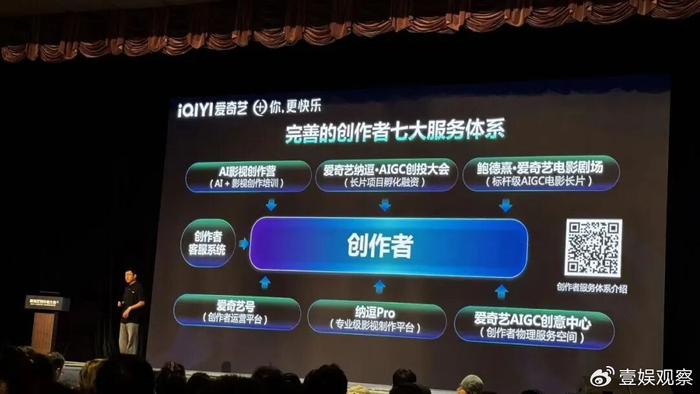
Recently, iQIYI held a creators’ conference in Beijing.
More than 2,000 AIGC creators and industry partners attended on site. In addition, hundreds of creators from Shanghai, Guangzhou, Chengdu, Wuhan, and Wuxi joined via live-stream branch sessions. Although the conference name didn’t include “AI,” judging from the attendee profile, the announcements, and the support policies, AIGC is clearly the real protagonist of this event.
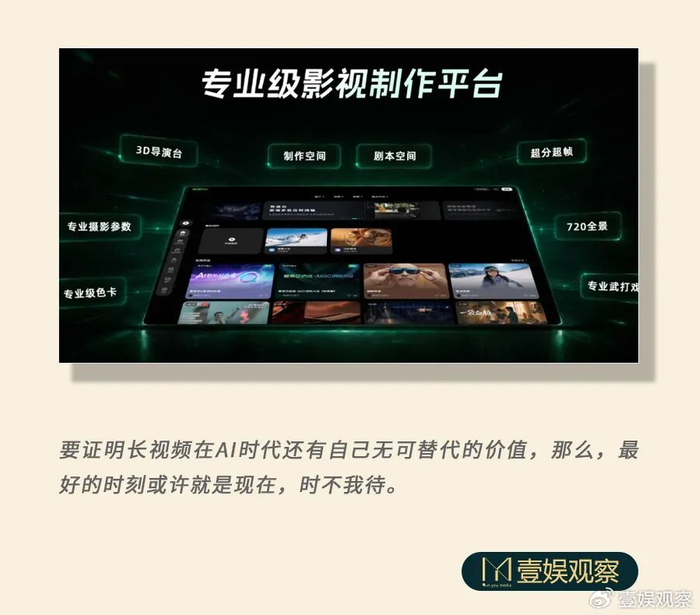
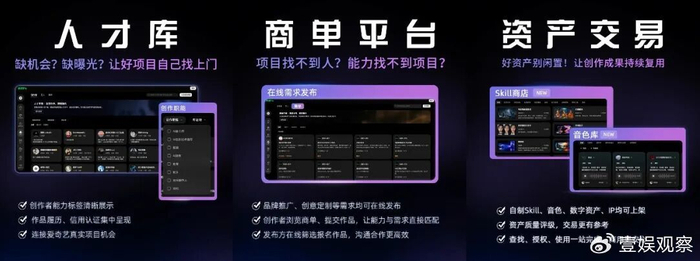
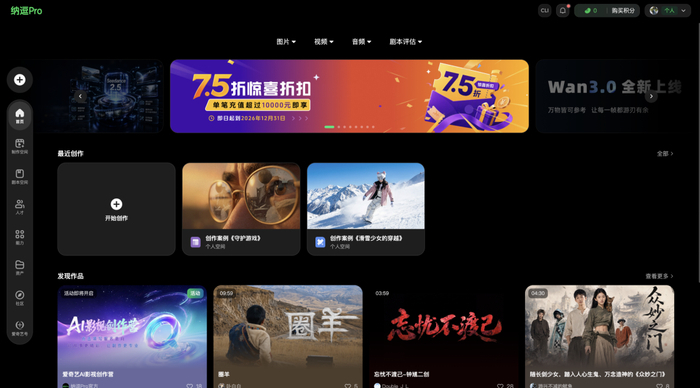
At the event, iQIYI introduced the Nadao Pro, which iterated more than 200 features over the past three months, and also rolled out a talent pool, a business order marketplace, digital asset trading, and the Skill Store. Meanwhile, an ecosystem around Nadao’s points top-ups, model calls, and commercial services is beginning to take shape step by step.
This means that what iQIYI needs to do is no longer just an AI tool that helps internal crews cut costs and improve efficiency. It is trying to repackage the IP, production methods, creator relationships, and content distribution capabilities accumulated over the past decade and more into an AI film and television production platform for the entire industry.
The results have been significant. Finished works have been continuously tested by the market, and talent reserves have likewise been continuously expanding.
The narrative crafted by iQIYI and Nadou is quite effective in the current wave of AI capital.
The financing rounds and speed of many AI video tools are all accelerating, and even IPO news keeps emerging. They all speak in the same tone about how professionally they can produce finished works; whether there can be an AI content ecosystem mechanism is not important. On the other side of the ocean, a U.S. startup called Preview has cumulatively raised $12 million, with Sequoia leading a $10 million seed round, stating that “what AI video lacks now is precisely a video version of Cursor.”
So, what are iQIYI and Nadou, which are one step ahead in film and television professionalism, IP reserves, content ecosystem, and technical control, still waiting for?
What iQIYI should do now, in addition to continuing to improve the AIGC professional content production process around Nadou, is also spin it out from the existing business system, establish a clear corporate entity, introduce external shareholders and industrial capital, and give Nadou its own financing, valuation, and incentive mechanism.
After all, in today’s AI market, capital throwing money around is similar to scratching a five-cent lottery ticket.
01 The “scarcity” of Nadou Pro
Over the past few years, the long-form video industry has never truly escaped growth pressure.
Membership scale is gradually approaching its ceiling, advertising budgets are being continuously diverted by short video and other content formats, yet content costs are very hard to reduce in sync. The platform can still rely on hit series to create periodic growth, but whether a hit can appear and how long it can last remain highly uncertain.
When performance pressure becomes an industry-wide problem, the entire long-form video industry needs to answer this question: as the growth model driven by memberships, advertising, and hits gradually reaches its ceiling, where exactly is the next growth curve?
It now seems that iQIYI’s answer is AIGC.
This is also why, although the event on August 20 was called a “Creator Conference,” its actual core was AIGC creators. Nadou Pro, AI film and television creation camps, AIGC creative centers, investment conferences, compute support, and revenue-sharing policies for AI content have already formed a relatively complete business line.
?iQIYI Creator Conference
For iQIYI, AIGC can no longer be regarded as a marginal technology. Whether it is Nadou Pro as a productivity tool, or content produced with AI participation and aired on the platform, all are becoming part of iQIYI’s core content business.
In the past month, iQIYI consecutively launched three AIGC online feature films with runtimes exceeding one hour: (Qitan: Zhibian Du Huangxu), (Soul Ferry: Butterfly Dream), and (Soul Ferry: Dream of the Heavenly Maiden).
The quality of the three films can of course be debated, but they at least prove one thing: iQIYI has already begun to move AI feature-length films from occasional technical experiments toward continuous content supply.
What is even more noteworthy is that among them are both original projects developed from scratch and mature IP repurposed for reuse.
What iQIYI is verifying is not just “whether AI can make a movie,” but whether AI can become a new production method for the platform to continuously develop IP and expand content supply.
What is needed behind this has never been just a video generation model.
?AIGC feature-length film (Qitan: Zhibian Du Huangxu)
It also requires IP licensing, the participation of professional screenwriters and directors, compliant use of actors’ images and voices, control of long-form narratives, production management, content review, distribution, and subsequent commercialization. The threshold for generating a beautiful shot is rapidly decreasing, but organizing hundreds or thousands of shots into a work that can officially go online is still a professional undertaking.
This is exactly where Nadou Pro truly differs from most AI video agents on the market.
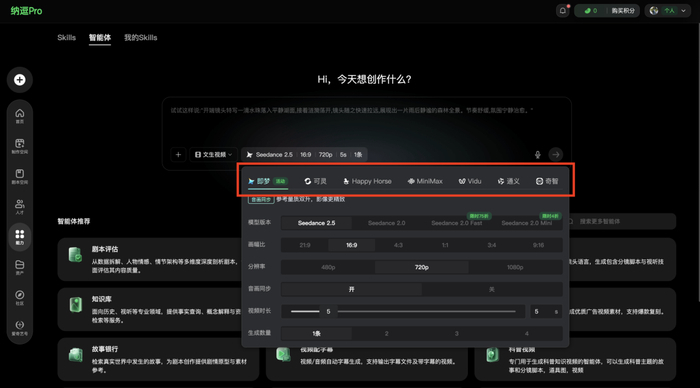
From the underlying technology perspective, Nadou did not choose to self-develop a video generation model that directly competes with Keling and Seedance, but instead integrated multiple models and focused on workflows, agents, and film and television resources. On the surface, this seems to mean Nadou’s technical barrier is not as solid as that of products with self-developed models.
But model aggregation does not mean there is no moat.

The same video model can be integrated by a dozen platforms, and generation capabilities will rapidly become widespread once the model is opened up. Relying only on calling models to earn token arbitrage inevitably ends up making one a carrier of compute and tokens. What is truly hard to replicate is who can make these models enter professional production workflows and steadily produce content that can be broadcast, distributed, and monetized.
What iQIYI can give Nadou is precisely this part.
The IP, digital assets, and film and television production experience accumulated over nearly twenty years can become Nadou’s production materials; the cooperative relationships formed with directors, screenwriters, actors, production companies, and post-production teams can become Nadou’s creator network; and iQIYI’s own capabilities in review, distribution, recommendation, and revenue sharing can help creators complete the last mile from content production to commercial return.
This is also why most AI video creation tools on the market, even when integrated with the same models as Nadou, still mostly circle around short dramas, advertising, or e-commerce promotion videos.
?AIGC feature-length film (Soul Ferry: Butterfly Dream)
Even as professional tools, there is still a threshold for professional video and film and television content.
It can be said that Nadou’s core value as an AI film and television tool still lies in iQIYI’s many years of accumulated film and television industry capabilities.
If Nadou can only exist as one of iQIYI’s internal products, these capabilities are still merely tools for long-form video platforms to reduce costs. Only when it begins to serve more film and television companies, creators, and commercial clients can it possibly become a truly independent business.
02 AI narrative monetization should be done early rather than late; iQIYI must be more aggressive than later entrants
Kuaishou has already provided iQIYI with a sufficiently direct reference.
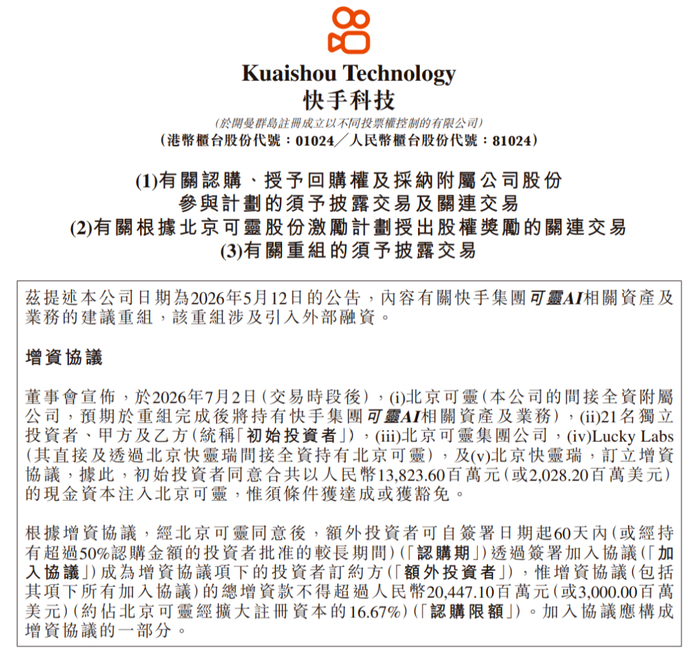
In July this year, Kuaishou promoted the restructuring of its Keling business and launched an external capital increase with a ceiling of $3 billion, with a post-investment valuation of about $18 billion.
It should be said that Keling’s split financing is the most important inspiration for Nadou.
When Keling is placed inside Kuaishou, the capital market finds it difficult to independently assess its technology, revenue, and growth potential; once it has an independent entity, external shareholders, and a clear financing path, the AI value that was previously obscured by the short-video main business finally has a chance to be repriced.

?Keling AI independent financing of nearly $3 billion
Nadou and Keling are of course not exactly the same.
Keling’s core asset is a video generation model, and its competitors are Seedance, Vidu, Hailuo, and other foundational models worldwide; Nadou is closer to an application platform that aggregates models, film and television workflows, and industrial resources.
But that does not prevent Nadou from raising independent financing.
An AI application company does not need to first own a foundational model in order to be entitled to a high valuation. When Yanyu Technology, which owns products such as LibTV, recently completed about $300 million in financing, its valuation already exceeded $2 billion.
It can be said that what the current capital market truly values is not only whether a company can train models, but also whether it can control user access, build workflows, generate revenue, and occupy an irreplaceable industrial position—or in other words, whether it is good at marketing.
Compared with AI video applications that merely call models, Nadou instead possesses a set of assets that are much harder to assemble temporarily.
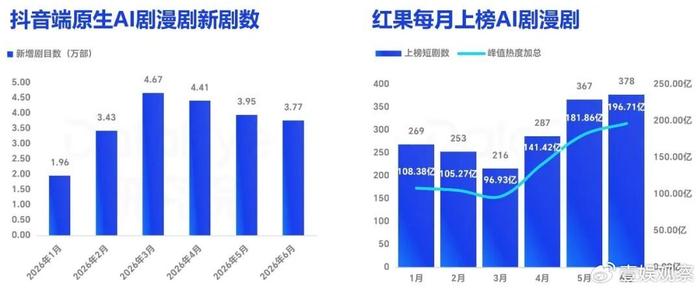
Because no matter how many video agents emerge in the market to hype AI short dramas, no matter how they are made, in essence they are still working for Douyin.
?(DataEye 2026 First-Half AI Drama/Comic Data Report)
And iQIYI clearly has more choices: how movies, series, and animation should be initiated, how budgets should be controlled, how the core creative team should be organized, what content can pass review, and how it should be distributed.
These capabilities mainly served iQIYI itself in the past, but now they fully have the chance to be productized by Nadou and turned into services for the entire industry.
The problem is that as long as Nadou remains wrapped inside iQIYI, its development will be constrained by the boundaries of traditional long-form video business.
First, AI film and television is still an industry that requires continuous investment. Model usage, compute subsidies, product development, asset building, and team expansion all require funding. Long-form video platforms themselves are still under operational pressure, and Nadou can hardly rely on parent-company investment forever while competing with AI companies that have raised hundreds of millions or even billions of dollars.
Independent financing can give Nadou dedicated funds for expansion, and it can also reduce iQIYI’s pressure of bearing long-term investment alone while maintaining control.
Second, only an independent company can establish a more attractive talent incentive and valuation system. If an AI product team can only share in the valuation of a traditional video platform, it will be difficult to compete long-term with foundational model companies and AI startups for talent. After the split, Nadou can truly turn product growth into team returns through independent equity and options.
A more realistic issue is industry neutrality.
If Nadou in the future only serves iQIYI internally, its ceiling will at most be iQIYI’s own content demand. But if it wants to become a professional film and television production infrastructure, it must serve other production companies, advertising companies, short-drama teams, and IP organizations.
Whether a film and television company is willing to put unpublished scripts, character assets, and production data into iQIYI’s internal system is a completely different question from whether it is willing to use an independent AI film and television company with clear data boundaries and commercial rules.
If Nadou wants to access demand beyond the platform, it must maintain sufficiently close resource ties with iQIYI while also establishing sufficiently clear company and business boundaries.
iQIYI could fully continue to hold a controlling stake in Nadou and keep Nadou consolidated, while introducing external shareholders such as cloud computing companies, model companies, film and television production organizations, and industry funds; it could also continue to provide Nadou with IP, digital assets, and production resources, while Nadou raises funds through external financing for product expansion, compute investment, and ecosystem building.
As for whether it should go public in the future, that is a question to discuss only after Nadou completes independent financing and establishes a viable business model.
For iQIYI, spinning off Nadou is not only a financing issue, but also an opportunity to rediscover the value of its own assets.
For a long time, the capital market has evaluated long-form video platforms based on memberships, advertising, content costs, and hit cycles, making it difficult to assign a sufficiently high price to an AI film and television production platform within the same valuation framework.
Letting Nadou raise financing independently is equivalent to letting the market answer for the first time separately: how much are iQIYI’s years of accumulated IP, production capabilities, and creator resources worth in the AI era?
iQIYI has already proven through the continuous launch of AIGC feature-length films that it is not merely a content platform that only talks about AI; Nadou has also proven through its tools, assets, creators, and transaction system that it should not just be a new internal business of iQIYI.
If it truly wants to prove that long-form video still has irreplaceable value in the AI era, then the best moment may well be now; time waits for no one.