


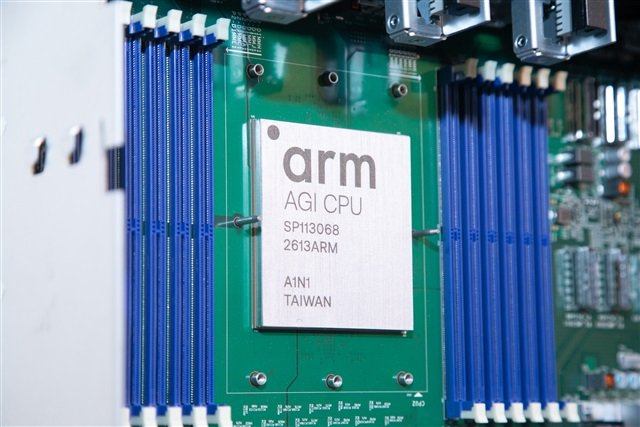
At the Hot Chips 2026 conference, Arm officially positioned its AGI CPU as a key compute foundation to prevent AI agents from “tripping over themselves.” Eddie Ramirez, Senior Vice President of Marketing for Arm’s Cloud AI business, and Jeff Defilippi, Senior Director of Product Management, provided a detailed explanation of the chip’s technical architecture and market demand.
Market position and growth drivers
Arm data shows that it has delivered 1.5 billion Neoverse cores to data centers, including 500 million delivered within the past nine months. Currently, Arm’s share in the host CPU market for AI server platforms exceeds 60%, and the number of enterprises deploying Arm-based architectures in the cloud has surpassed 120,000.
Arm believes that Agentic AI is the core driving force behind growth. The company forecasts that by 2030, the number of tokens used by AI agents could grow by 24 times. This means that after years of accelerators dominating, general-purpose CPUs are returning to center stage. In enterprise automation workloads, the split between CPU and accelerator is roughly 50:50; software development scenarios lean toward CPUs (60:40), while financial analysis relies more on accelerators (40:60).
Technology architecture and performance specifications
This AGI CPU is based on the Neoverse V3 core architecture and uses TSMC’s 3nm process with a dual-chiplet design. Each chiplet contains more than 50 billion transistors, and the total power consumption for the entire chip can reach up to 300W. To address yield issues, although each chiplet is designed with 70 cores, 4 are disabled, so the number of usable cores per CPU is 136.
In terms of core specifications, Neoverse V3 features a 10-wide dispatch, 384+ out-of-order execution windows, and an 8-wide retirement width. It is equipped with 64KB instruction/data cache, 8 ALU units, and 3 branch units, with L2 loads to the execution path in 10 cycles. Each core has 2MB private L2 cache, with a clock speed up to 3.7GHz.
To keep memory latency under 100 nanoseconds, Arm integrates memory and I/O on the same die. The chip supports 96 PCIe Gen6 lanes, CXL 3.0, the AMBA CHI extension link, and DDR5-8800 memory, with a maximum single-chip memory capacity of up to 6TB. Each chiplet also includes 140MB of private L2 cache, a consistent CMN interconnect, and 1MB of shared system-level cache per core.
Ecosystem and business outlook
In rack-scale deployments, Arm says the design can integrate up to 8,160 CPU cores across 30 1U servers within a 36kW power limit. The company claims that under the same power design, its performance is more than twice that of an equivalently configured x86 system.
At present, partners such as Supermicro, ASRock, and Lenovo are actively developing related server products. Supermicro has launched rack-level 2U four-node and 1U four-node systems that support liquid cooling. Arm is also promoting reference designs for 1U dual-node and 2U dual-socket servers.
Due to strong market demand, Arm has raised its customer order forecasts for AGI CPUs in 2027 and 2028 from $1 billion to $2 billion. This move marks an important step for Arm in establishing a key position in the AI infrastructure space. Its Armv9 architecture has already been widely used in products such as NVIDIA Vera/Rosa, Microsoft Azure Cobalt, Google Axion, AWS Graviton, and Fujitsu Monaka.
[Starway Tech Graphics/Images丨Patrick, originally published on ZAKER Technology; please cite the source]