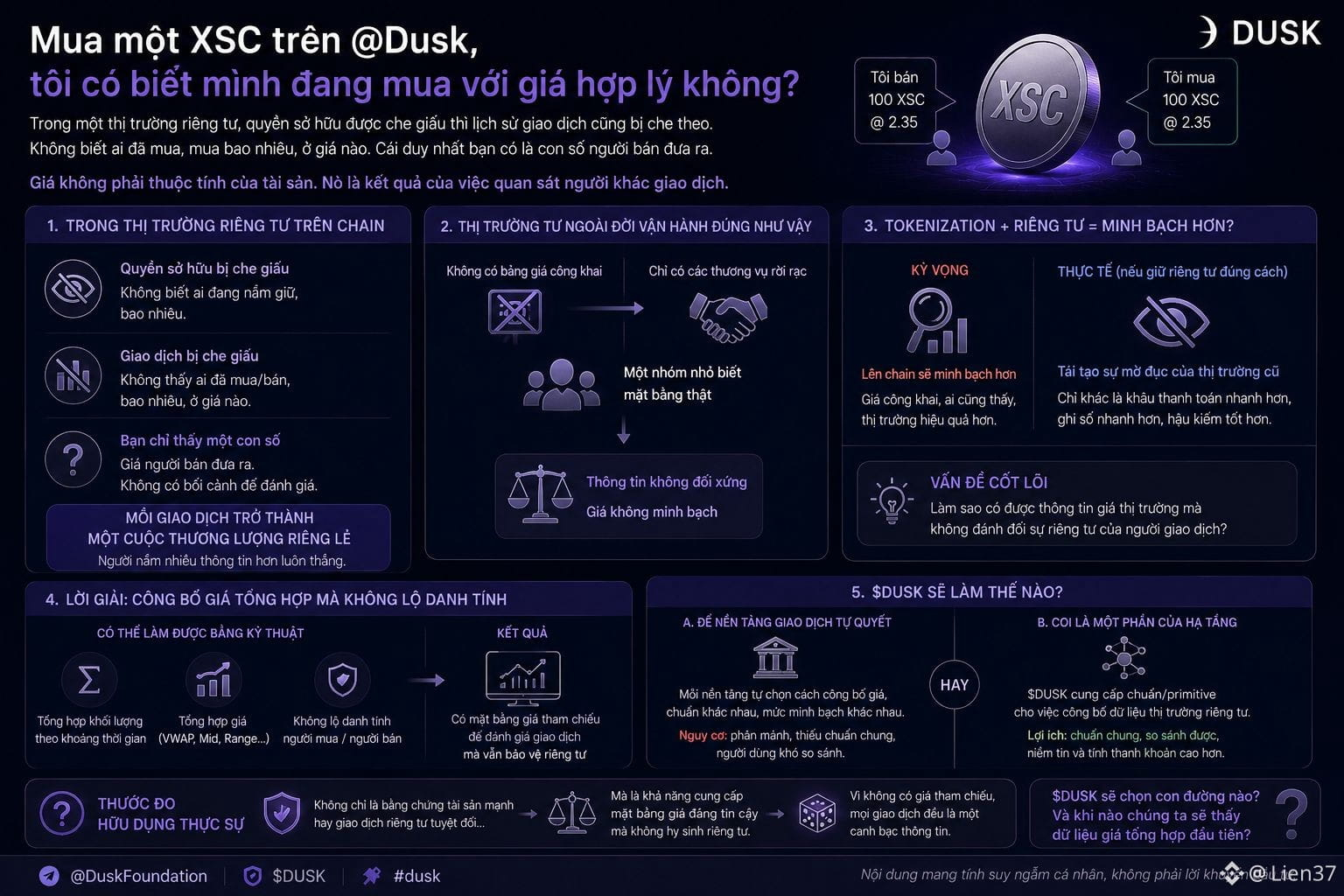
I kept wondering whether, when buying an XSC on @Dusk , I would know if I was paying a fair price.
like a deal, a price, and that’s it.
except in a market where ownership is concealed, the trading volume is concealed too.
I don’t know whether anyone bought last week, how much, or at what price. The only thing I have is the number the seller provides. That’s where my brain keeps trying to find a way to rationalize a scam. Because price isn’t a property of the asset. It’s the result of observing how other people trade.
Once you remove that observation layer, each trade becomes its own isolated negotiation, and the party with more information always wins. Wait—hold on. The real-world private markets work exactly the same way—no price board, only scattered transactions and a small group who know the real baseline. That’s the weird part. We often say tokenization will make private markets more transparent. But if the privacy layer is preserved exactly as designed, it recreates the same price opacity as the old market.
The only difference is that settlement is faster.
Turns out I just assumed that once it’s on-chain, prices would be public.
Maybe the solution is to publish an aggregated price without revealing the identities of both sides—technically it’s doable, but someone has to choose to do it.
I’m curious whether $DUSK will leave that decision up to each exchange platform, or treat it as part of the infrastructure.
#dusk $BTC $ETH