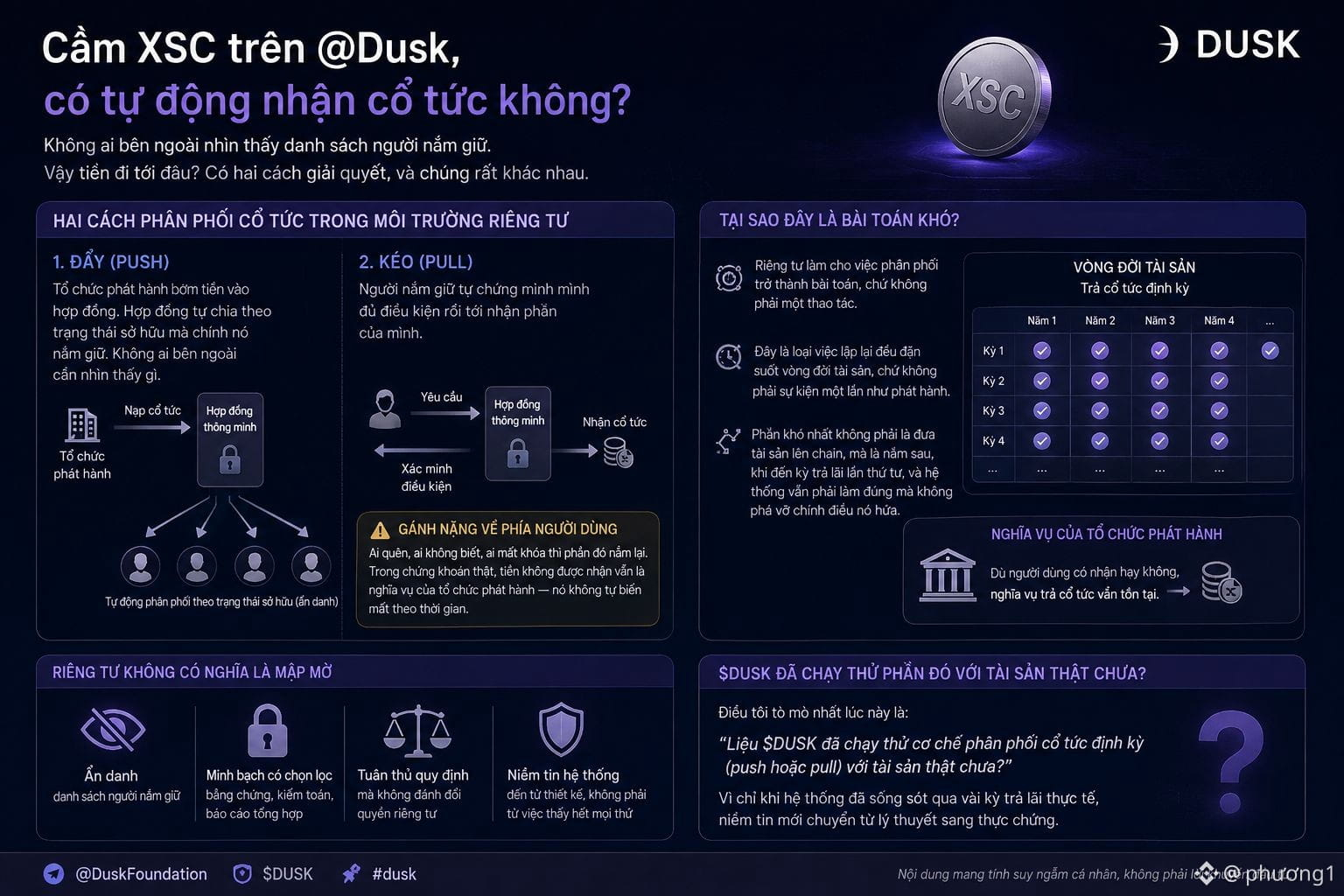
I kept wondering: when I hold an XSC on @Dusk , will I automatically receive dividends?
As an asset, as a cash flow coming in—that’s it.
Except that to pay dividends, the issuing organization must know whom to pay, and that’s exactly what’s being concealed.
They don’t see the list of holders. So where does the money go? That’s where my brain keeps trying to figure out the fraud. There are two ways, and they’re very different. One is push — the issuing organization pumps money into the contract, and the contract distributes it according to the ownership status it itself holds, so nobody outside needs to see anything.
Two is pull — the holder proves on their own that they’re eligible, then goes to claim their share. So wait.
The second approach sounds more technical, but it shifts the burden onto the user. Whoever forgets, whoever doesn’t know, whoever loses the key—their share just stays behind. In real securities, money that isn’t claimed is still the issuer’s obligation—it doesn’t just vanish over time. That’s the strange part. Privacy makes distribution become a problem to solve, not a simple operation.
And this is the kind of recurring work repeated regularly throughout the asset’s lifecycle, not a one-time event like an issuance.
Turns out I assumed the hardest part was putting the asset on-chain.
Actually, the hardest part is the following year, when it’s time for the fourth interest payment, and the system still has to do it correctly without breaking the very thing it promised.
I’m curious whether $DUSK has already tested that part with a real asset.
#dusk $BTC $ETH