#dusk $DUSK @Dusk
A blockchain can make ownership transparent without making a financial market operationally coherent.
That distinction matters because regulated markets are built from handoffs onboarding eligibility transfer restrictions settlement disclosure and servicing. Tokenizing the asset while leaving those processes fragmented can simply create a digital wrapper around an old system.
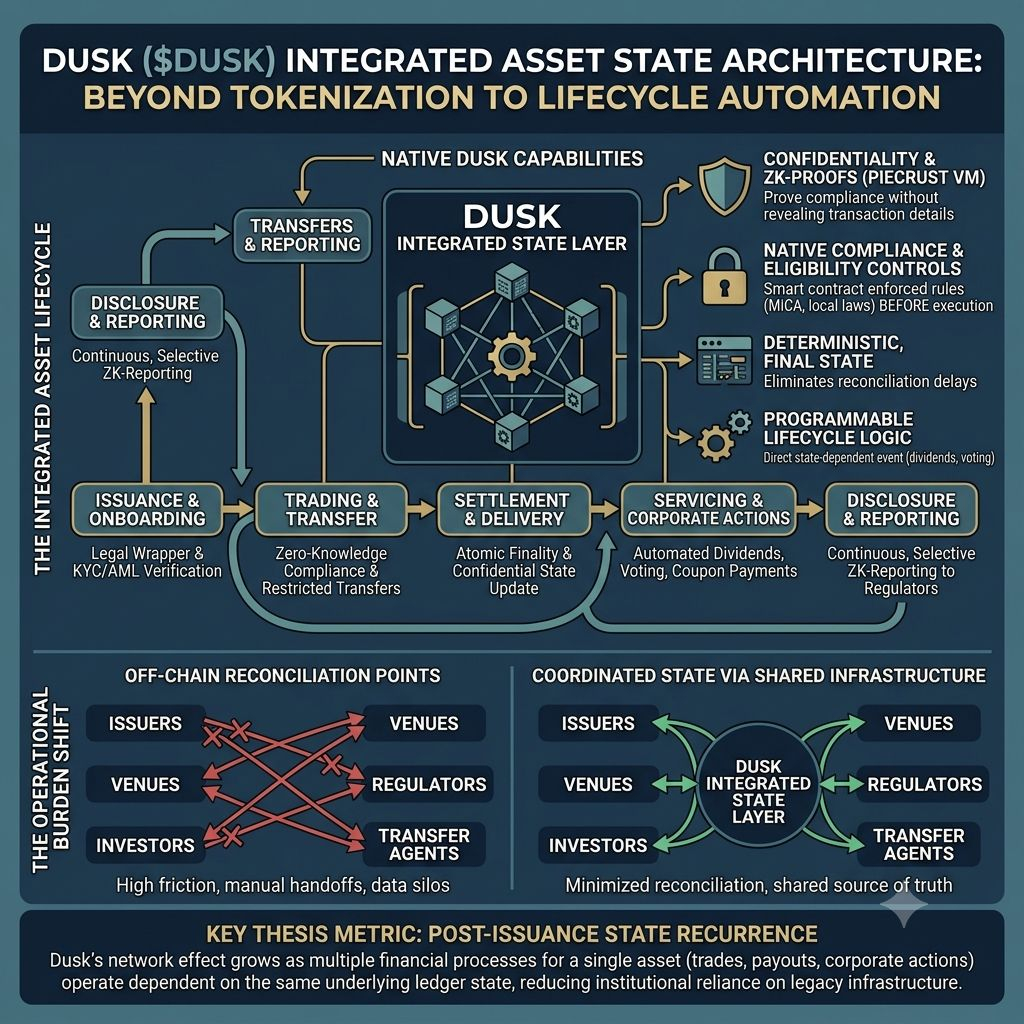
What interests me about Dusk is the attempt to place those constraints closer to the asset workflow itself. Its architecture combines access controls selective disclosure confidential transfers and deterministic settlement while its documentation explicitly treats servicing as part of the regulated asset lifecycle.
The second order possibility is fewer reconciliation points. If ownership, eligibility and settlement states can be coordinated on shared infrastructure, some of the operational burden between issuers venues and investors could potentially shrink.
But that only matters if institutions actually move recurring workflows onto the network. Existing financial systems are deeply entrenched and technical capability alone does not create a reason to migrate.
So I'd watch what happens after issuance whether the same assets generate repeated settlement servicing disclosure or corporate-action activity on Dusk.
If that pattern emerges, the network effect becomes less about how many assets are tokenized and more about how many financial processes become dependent on the same underlying state.
A blockchain can make ownership transparent without making a financial market operationally coherent.
That distinction matters because regulated markets are built from handoffs onboarding eligibility transfer restrictions settlement disclosure and servicing. Tokenizing the asset while leaving those processes fragmented can simply create a digital wrapper around an old system.
What interests me about Dusk is the attempt to place those constraints closer to the asset workflow itself. Its architecture combines access controls selective disclosure confidential transfers and deterministic settlement while its documentation explicitly treats servicing as part of the regulated asset lifecycle.
The second order possibility is fewer reconciliation points. If ownership, eligibility and settlement states can be coordinated on shared infrastructure, some of the operational burden between issuers venues and investors could potentially shrink.
But that only matters if institutions actually move recurring workflows onto the network. Existing financial systems are deeply entrenched and technical capability alone does not create a reason to migrate.
So I'd watch what happens after issuance whether the same assets generate repeated settlement servicing disclosure or corporate-action activity on Dusk.
If that pattern emerges, the network effect becomes less about how many assets are tokenized and more about how many financial processes become dependent on the same underlying state.