Recently someone in the group asked what annualized yield DUSK staking is. The replies in the row below are all calculating the returns. I chimed in, and you can tell—someone asked if you’ve seen the Slashing mechanism, and the group suddenly went quiet. Today I’ll lay it out clearly: staking is not “sleep and earn,” it’s taking responsibility.
DUSK uses the SBA consensus. Block proposing and validation are handled by Provisioner nodes. These nodes must stake at least 1000 DUSK to be allowed to work. Once they’re in service, they have responsibility—if they do harm or slack off, they’ll be penalized, with the penalties split into two tiers: soft and hard.
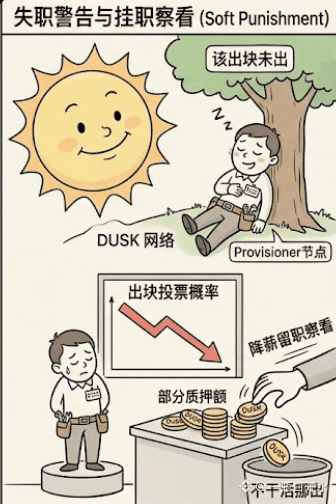
First, the soft penalties. If a node fails to propose blocks when it should, slowing down the network, it’s not considered malicious, but it is clearly dereliction of duty. The first time is a warning; if it happens again, part of the staked amount is moved out of the effective stake. Then its chance of being selected for block proposing and voting drops accordingly—effectively a pay cut and “on probation” status.
The key point is: the moved coins are not burned. They can be withdrawn at any time. The purpose of the punishment isn’t to take money—it’s to remove non-working nodes from the rotation schedule, so that online nodes can take on more tasks.
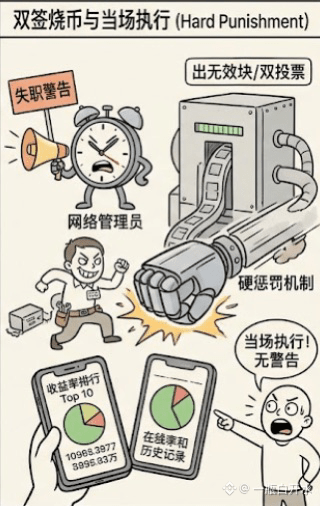
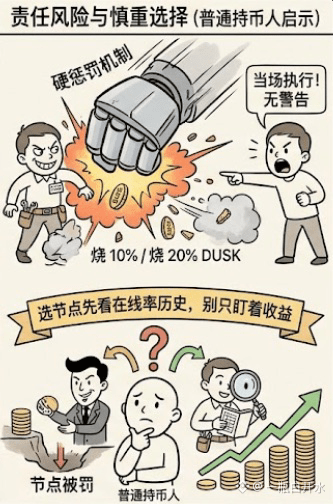
The hard penalties are completely different in nature. Producing invalid blocks burns 10%. Double voting, or producing two blocks in the same round, burns 20%—with no warning phase; it’s executed immediately.
Why is it so severe? Because double-signing isn’t a mistake—it’s an active attack on the network, attempting to make the chain have two versions. The cost of this behavior must be high enough that nobody dares to try.
The brilliance of this design lies in its sense of proportion. Being offline and suffering technical failure are different in nature from intentional wrongdoing. The former is a downgrade and observation; the latter is burning real money. Compared with some chains that punish heavily as soon as a node goes offline, DUSK leaves room for accidental faults, while being absolutely unforgiving toward deliberate attacks.
The lesson for ordinary token holders is very direct. Whether you run a node yourself or delegate your staking, the returns behind it are paired with responsibility. When selecting nodes, don’t just look at the annualized yield ranking—check their uptime rate and historical performance. Even if the annualized yield is higher, one slashing event and the node will give it back in full.
That said, it’s precisely this clear “rewards and penalties” mechanism that allows institutions to put real assets on this chain. I’ll keep an eye on every node’s uptime across the network and their slashing records. So, how much annualized yield do you think is enough to cover the risk of this responsibility? #dusk $DUSK @Dusk
DUSK uses the SBA consensus. Block proposing and validation are handled by Provisioner nodes. These nodes must stake at least 1000 DUSK to be allowed to work. Once they’re in service, they have responsibility—if they do harm or slack off, they’ll be penalized, with the penalties split into two tiers: soft and hard.
First, the soft penalties. If a node fails to propose blocks when it should, slowing down the network, it’s not considered malicious, but it is clearly dereliction of duty. The first time is a warning; if it happens again, part of the staked amount is moved out of the effective stake. Then its chance of being selected for block proposing and voting drops accordingly—effectively a pay cut and “on probation” status.
The key point is: the moved coins are not burned. They can be withdrawn at any time. The purpose of the punishment isn’t to take money—it’s to remove non-working nodes from the rotation schedule, so that online nodes can take on more tasks.
The hard penalties are completely different in nature. Producing invalid blocks burns 10%. Double voting, or producing two blocks in the same round, burns 20%—with no warning phase; it’s executed immediately.
Why is it so severe? Because double-signing isn’t a mistake—it’s an active attack on the network, attempting to make the chain have two versions. The cost of this behavior must be high enough that nobody dares to try.
The brilliance of this design lies in its sense of proportion. Being offline and suffering technical failure are different in nature from intentional wrongdoing. The former is a downgrade and observation; the latter is burning real money. Compared with some chains that punish heavily as soon as a node goes offline, DUSK leaves room for accidental faults, while being absolutely unforgiving toward deliberate attacks.
The lesson for ordinary token holders is very direct. Whether you run a node yourself or delegate your staking, the returns behind it are paired with responsibility. When selecting nodes, don’t just look at the annualized yield ranking—check their uptime rate and historical performance. Even if the annualized yield is higher, one slashing event and the node will give it back in full.
That said, it’s precisely this clear “rewards and penalties” mechanism that allows institutions to put real assets on this chain. I’ll keep an eye on every node’s uptime across the network and their slashing records. So, how much annualized yield do you think is enough to cover the risk of this responsibility? #dusk $DUSK @Dusk