Talk to a compliance-minded friend about DUSK, and their first reaction is that the term “selective disclosure” is too academic—like something pulled out of a paper. I gave them a few examples, and they immediately changed their tone, saying, “Isn’t this exactly what I do at work every day?”
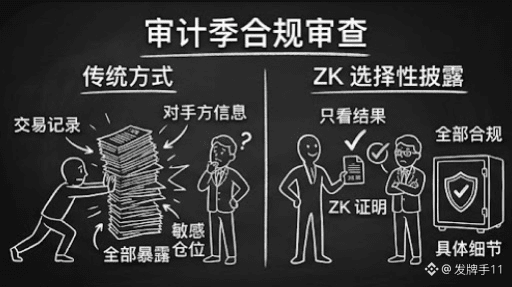
First, let’s talk about compliance review. Each audit season, institutions have to prove to the auditors that all transactions occurred between qualified investors. The old way was to bundle transaction records and send them over—sensitive positions and counterparty information were fully exposed. With ZK selective disclosure, the auditor only gets a single proof: the transactions are compliant, but the specific details can’t be seen. The parts that should be checked are checked; pages that shouldn’t be shown are not added.
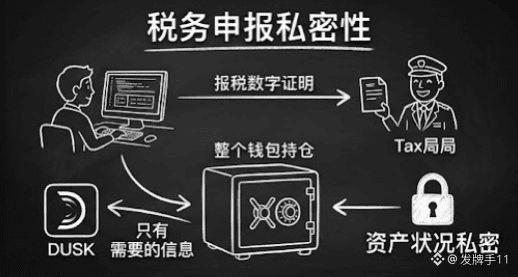
Next, tax reporting. When filing taxes, you need to prove the revenue numbers to the tax authority, but nobody is willing to hand over the wallet’s entire holdings structure along with it. Selective disclosure lets you present only the facts needed for tax filing, while the rest of your asset situation remains private.
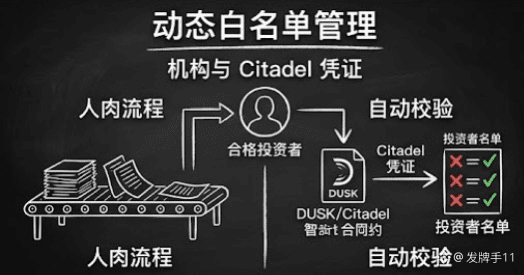
And then there’s whitelist management. Investor eligibility is dynamic. Institutions have to periodically—every few days or weeks—recollect materials and update the list. After you obtain Citadel credentials, the contract verifies in real time whether the credentials are still valid. What used to be a manual, people-driven process becomes automated validation.
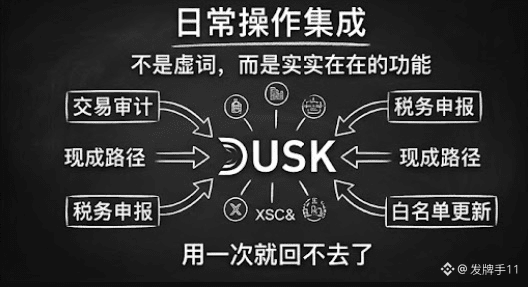
You see, none of this is really cutting-edge concepts. It’s everything institutions and users repeat every day, at a frequency so high that no one treats it as innovation. What’s impressive about DUSK is that it doesn’t treat selective disclosure as decorative wording in a whitepaper—it turns it into real functional modules within Citadel and XSC. For each daily operation, there are ready-made paths; once you use them, you can’t go back.
In plain terms, whether privacy tech can be deployed comes down to whether it can get down to real, everyday ground. I’ll keep tracking the actual usage data in these daily scenarios. Which scenario do you think will be the first to generate large-scale demand?#dusk $DUSK @Dusk
First, let’s talk about compliance review. Each audit season, institutions have to prove to the auditors that all transactions occurred between qualified investors. The old way was to bundle transaction records and send them over—sensitive positions and counterparty information were fully exposed. With ZK selective disclosure, the auditor only gets a single proof: the transactions are compliant, but the specific details can’t be seen. The parts that should be checked are checked; pages that shouldn’t be shown are not added.
Next, tax reporting. When filing taxes, you need to prove the revenue numbers to the tax authority, but nobody is willing to hand over the wallet’s entire holdings structure along with it. Selective disclosure lets you present only the facts needed for tax filing, while the rest of your asset situation remains private.
And then there’s whitelist management. Investor eligibility is dynamic. Institutions have to periodically—every few days or weeks—recollect materials and update the list. After you obtain Citadel credentials, the contract verifies in real time whether the credentials are still valid. What used to be a manual, people-driven process becomes automated validation.
You see, none of this is really cutting-edge concepts. It’s everything institutions and users repeat every day, at a frequency so high that no one treats it as innovation. What’s impressive about DUSK is that it doesn’t treat selective disclosure as decorative wording in a whitepaper—it turns it into real functional modules within Citadel and XSC. For each daily operation, there are ready-made paths; once you use them, you can’t go back.
In plain terms, whether privacy tech can be deployed comes down to whether it can get down to real, everyday ground. I’ll keep tracking the actual usage data in these daily scenarios. Which scenario do you think will be the first to generate large-scale demand?#dusk $DUSK @Dusk