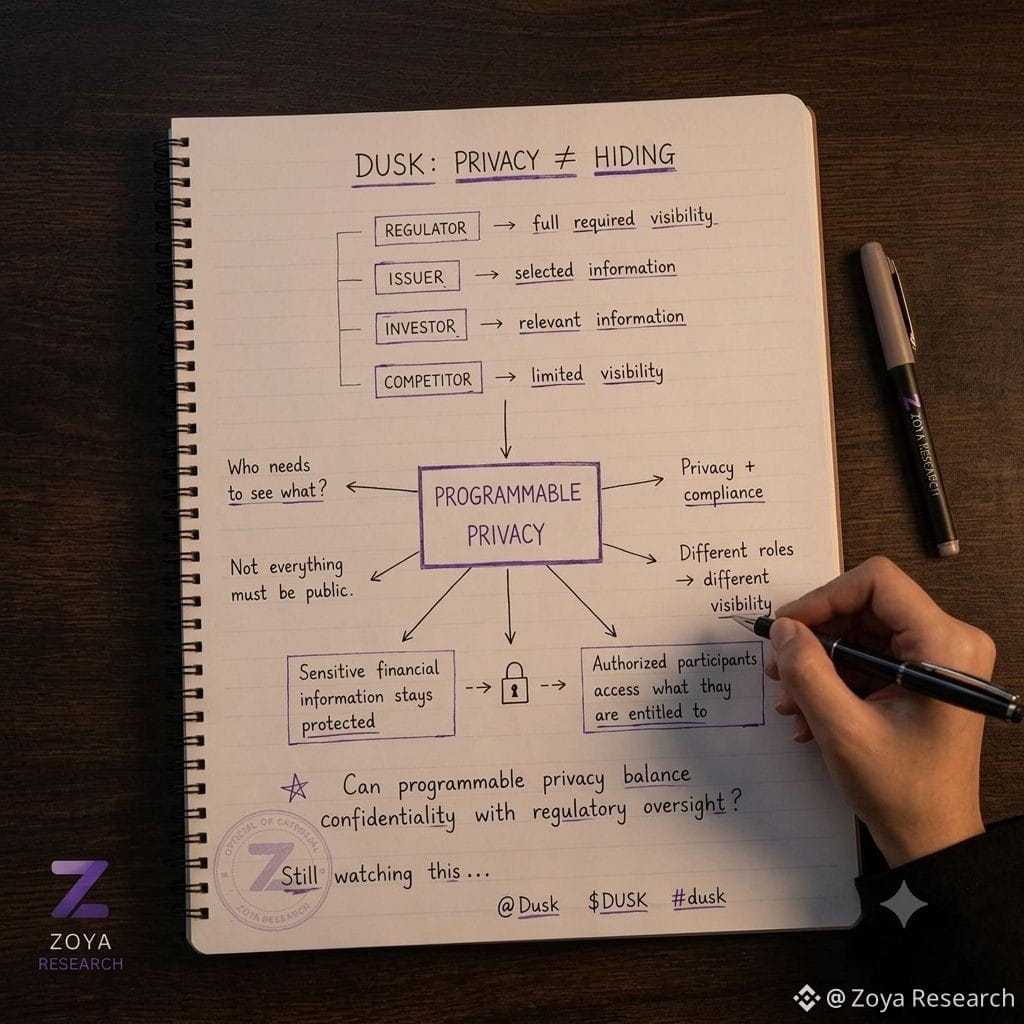
I went back through Dusk’s privacy model today because one question kept bothering me: if regulated markets still need visibility, what exactly is privacy protecting?
The more I looked at it, the less I think the answer is simply “hide the transaction.”
A financial institution may need to prove that something happened, while a competitor may have no reason to see the underlying position, balance, or other sensitive information.
That creates a different problem.
It’s not really privacy versus transparency. It’s about whether different participants can have different levels of access to the same financial workflow.
That’s where Dusk’s idea of programmable privacy caught my attention.
Sensitive information can remain protected while authorized parties can still receive what they need for review. For regulated finance, that distinction feels more useful than simply calling something a “private blockchain.”
The difficult part is deciding how those permissions should work across regulators, issuers, investors and other participants without turning every transaction into a fully public record.
That’s the part I’m still watching.
If different participants need different levels of visibility, can programmable privacy become a practical way to balance confidentiality with regulatory oversight?
@Dusk $DUSK #dusk
The more I looked at it, the less I think the answer is simply “hide the transaction.”
A financial institution may need to prove that something happened, while a competitor may have no reason to see the underlying position, balance, or other sensitive information.
That creates a different problem.
It’s not really privacy versus transparency. It’s about whether different participants can have different levels of access to the same financial workflow.
That’s where Dusk’s idea of programmable privacy caught my attention.
Sensitive information can remain protected while authorized parties can still receive what they need for review. For regulated finance, that distinction feels more useful than simply calling something a “private blockchain.”
The difficult part is deciding how those permissions should work across regulators, issuers, investors and other participants without turning every transaction into a fully public record.
That’s the part I’m still watching.
If different participants need different levels of visibility, can programmable privacy become a practical way to balance confidentiality with regulatory oversight?
@Dusk $DUSK #dusk