I kept thinking about a simple question:
How does a financial platform know I’m eligible without needing to see everything about me?
The obvious answer is to collect more information.
But the more I looked at regulated finance, the less that approach made sense. An institution may only need to know that someone meets a certain requirement — not their entire identity record.
That’s what made Citadel interesting to me.
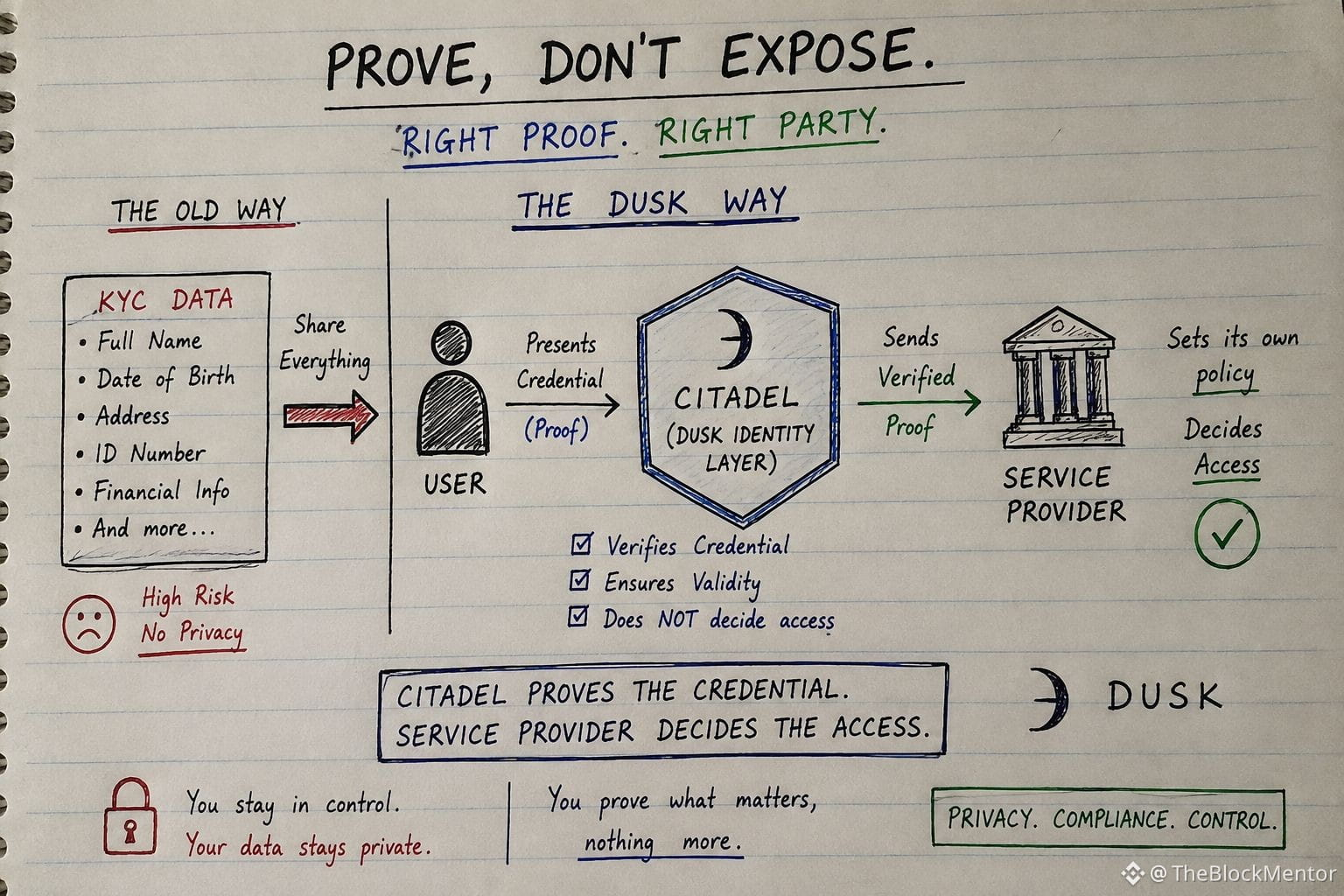
Dusk’s identity layer is built around verifiable credentials and selective disclosure. A user can prove they hold a valid credential without putting the underlying personal details onchain.
What I found even more interesting is the separation of responsibilities.
Citadel can prove that the credential is valid. It doesn’t decide whether the user should be accepted. The service provider still sets its own policy and decides which requirements it trusts.
That feels much closer to how regulated access actually works.
You don’t necessarily need to reveal everything to prove that you qualify.
You need to prove the right thing to the right party.
For me, that’s a more interesting way to think about onchain identity than simply putting KYC data on a blockchain.
@Dusk $DUSK #dusk
How does a financial platform know I’m eligible without needing to see everything about me?
The obvious answer is to collect more information.
But the more I looked at regulated finance, the less that approach made sense. An institution may only need to know that someone meets a certain requirement — not their entire identity record.
That’s what made Citadel interesting to me.
Dusk’s identity layer is built around verifiable credentials and selective disclosure. A user can prove they hold a valid credential without putting the underlying personal details onchain.
What I found even more interesting is the separation of responsibilities.
Citadel can prove that the credential is valid. It doesn’t decide whether the user should be accepted. The service provider still sets its own policy and decides which requirements it trusts.
That feels much closer to how regulated access actually works.
You don’t necessarily need to reveal everything to prove that you qualify.
You need to prove the right thing to the right party.
For me, that’s a more interesting way to think about onchain identity than simply putting KYC data on a blockchain.
@Dusk $DUSK #dusk