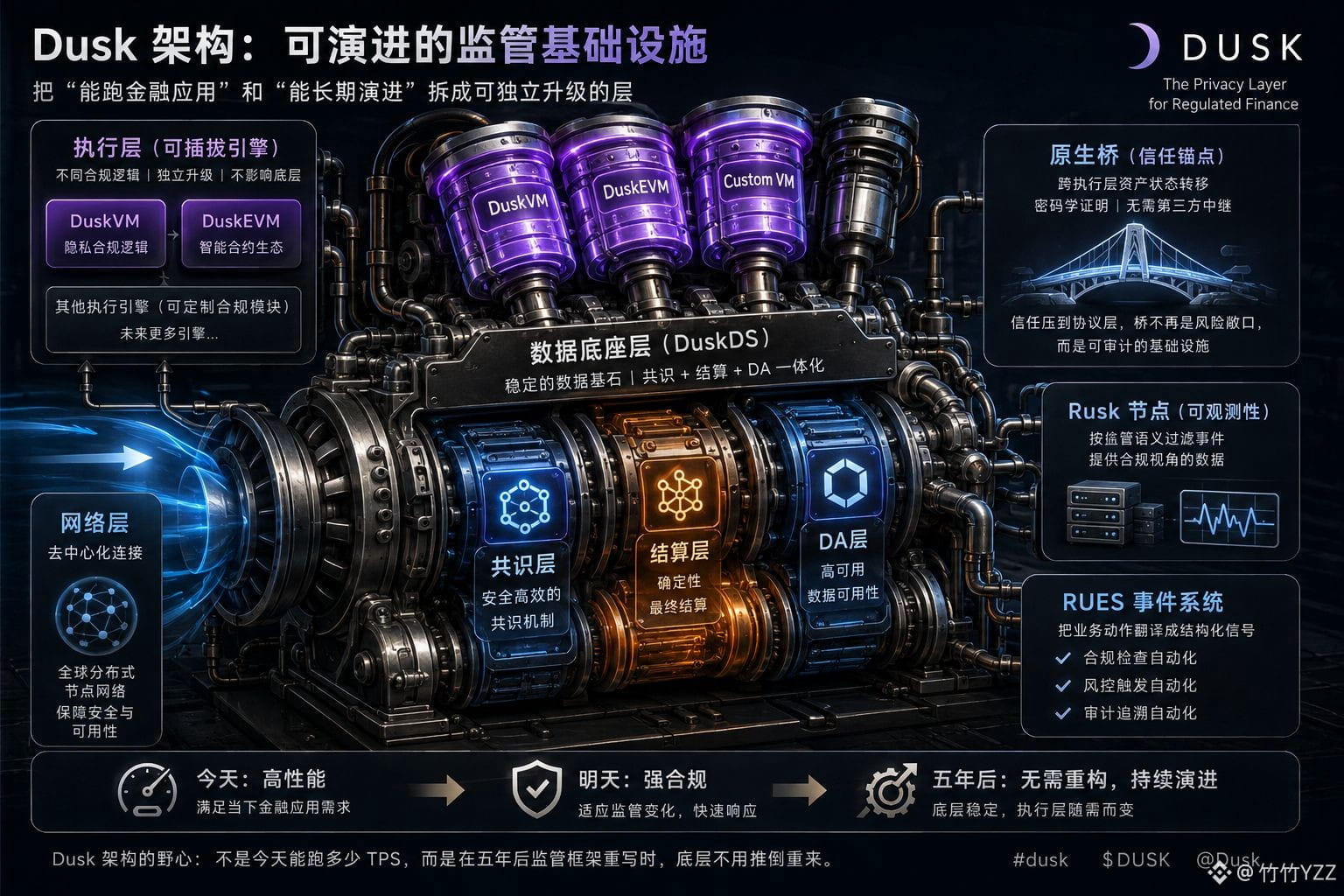
Many people treat modular architecture as a shortcut to scaling, yet overlook its true destructive force—splitting “being able to run financial applications” and “being able to evolve long-term” into layers that can be upgraded independently.
But Dusk’s approach is more aggressive. DuskDS bundles consensus, settlement, and DA into a stable data foundation, while the execution layer works like a plug-in engine. Running different compliance logics doesn’t affect the underlying layer. This decoupling is not a performance optimization; it’s a survival strategy for regulatory market infrastructure. Rules will change, execution needs to be replaced, but the ledger cannot collapse.
And the native bridge is the trust anchor for this architecture. It doesn’t “transport” assets across chains. Instead, between execution layers, it uses cryptographic proofs to verify that asset state transitions are completed, without relying on third-party relays. Trust is pushed down to the protocol layer. For operators, this means the bridge is no longer a risk exposure—it becomes an auditable infrastructure.
The Rusk nodes and the RUES event system provide developers and operators with a “observability foundation.” Nodes aren’t just about synchronizing data; they filter events according to regulatory semantics. RUES translates execution-layer business actions into structured signals, enabling compliance checks, risk-control triggers, and audit traceability to be automated.
And this architecture’s ambition isn’t about how many TPS it can run today, but about ensuring that when the supervisory framework is rewritten five years from now, the underlying layer won’t need to be torn down and rebuilt. Modularity isn’t a technology selection—it’s the gene of embedding “evolvability” into the infrastructure.
#dusk $DUSK @Dusk
But Dusk’s approach is more aggressive. DuskDS bundles consensus, settlement, and DA into a stable data foundation, while the execution layer works like a plug-in engine. Running different compliance logics doesn’t affect the underlying layer. This decoupling is not a performance optimization; it’s a survival strategy for regulatory market infrastructure. Rules will change, execution needs to be replaced, but the ledger cannot collapse.
And the native bridge is the trust anchor for this architecture. It doesn’t “transport” assets across chains. Instead, between execution layers, it uses cryptographic proofs to verify that asset state transitions are completed, without relying on third-party relays. Trust is pushed down to the protocol layer. For operators, this means the bridge is no longer a risk exposure—it becomes an auditable infrastructure.
The Rusk nodes and the RUES event system provide developers and operators with a “observability foundation.” Nodes aren’t just about synchronizing data; they filter events according to regulatory semantics. RUES translates execution-layer business actions into structured signals, enabling compliance checks, risk-control triggers, and audit traceability to be automated.
And this architecture’s ambition isn’t about how many TPS it can run today, but about ensuring that when the supervisory framework is rewritten five years from now, the underlying layer won’t need to be torn down and rebuilt. Modularity isn’t a technology selection—it’s the gene of embedding “evolvability” into the infrastructure.
#dusk $DUSK @Dusk