Today this one is to turn in the books.
Day 1: I said I’d publicly validate a hypothesis.
Day 2: I fixed an ops bug and restarted. Today the first real settlement data finally came out—this isn’t backtesting, not a PPT. It’s a bot running, trade by trade, using the simulation rules I set.
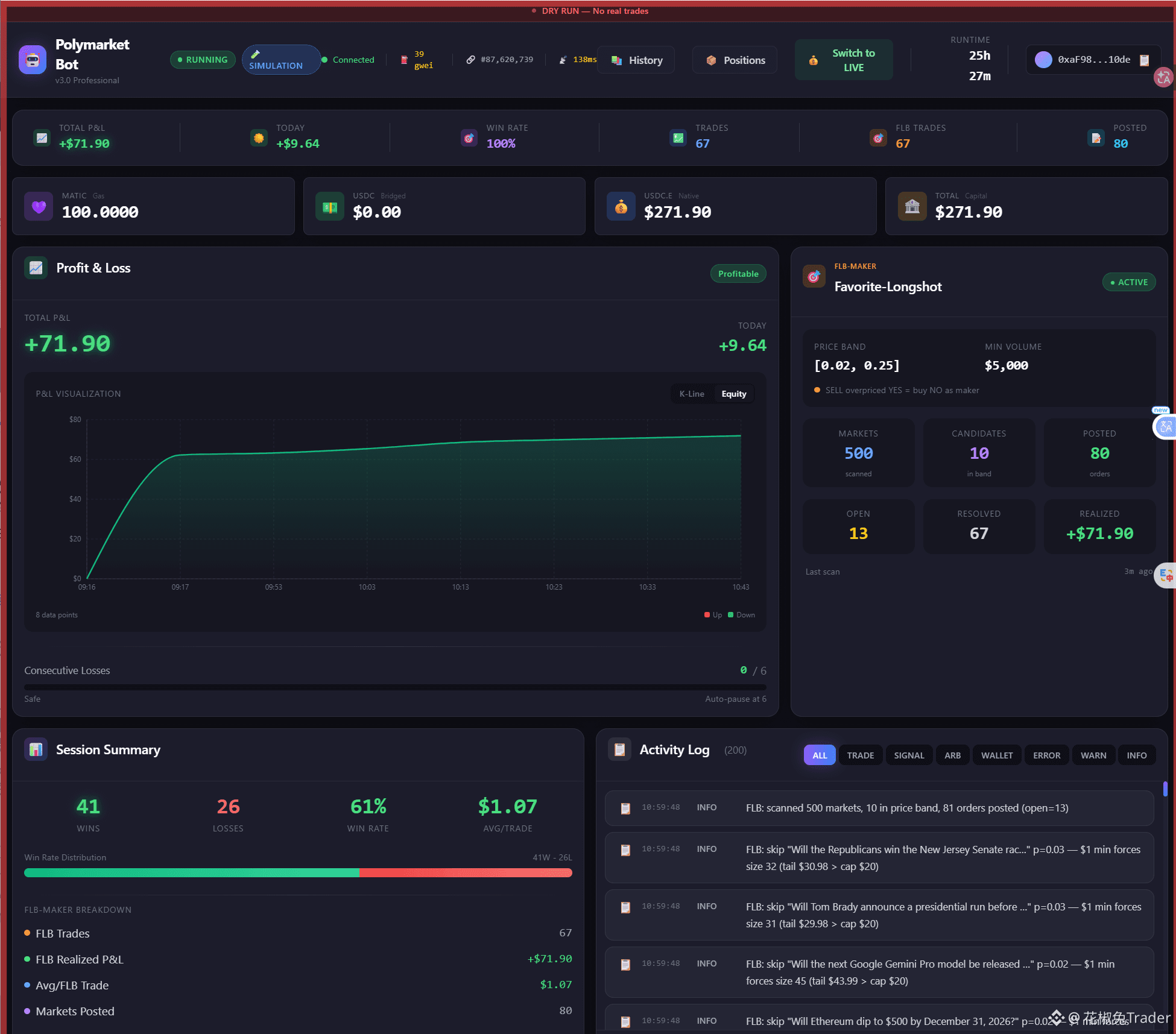
First, the numbers (paper warehouse $200, no real money touched):
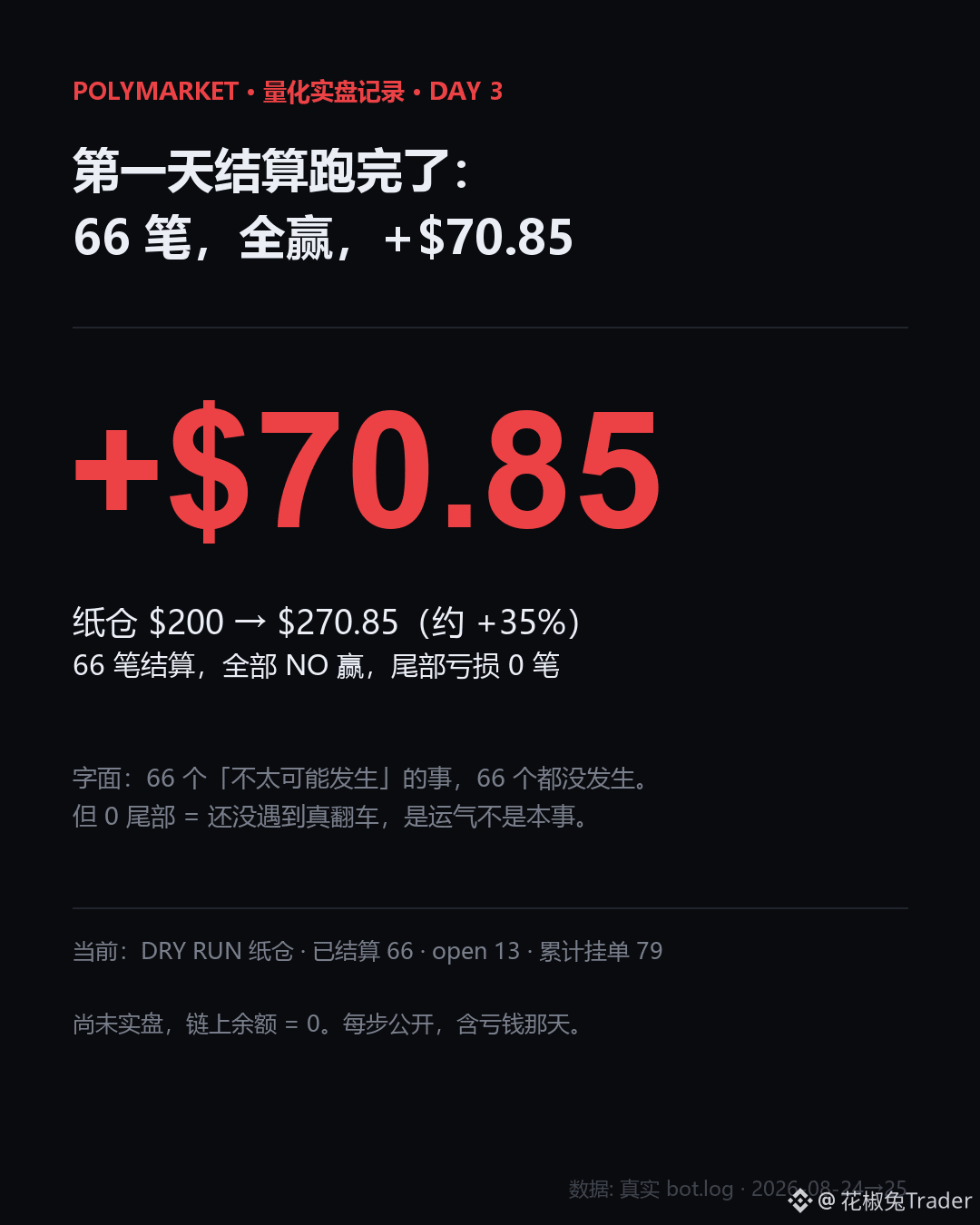
66 settlements, all NO won
Tail losses: 0 trades
Realized PnL: +$70.85
Capital: 200 → 270.85, about +35%
There are still 13 open positions waiting to settle, and in total 79 maker orders were posted.
Let’s translate this into plain language: 66 instances of “things the market thinks are unlikely to happen”—and all 66 did not happen.
Trump and Greenland sign an agreement? No.
Musk re-enters office? No.
Comey gets arrested? No.
Does SNL win an Emmy for it? No.
So I sold my “Yes,” and none of it got realized—meaning I just took the premium for free.
But I need to pour cold water on myself. Winning 66/66 sounds amazing, but it also shows one thing: during this period, there was basically no “tail”—the rare moment when the unlikely actually happens. In backtests, the tail probability is about 0.4%6%. With 66 trades, the expected tail losses are ≈ 0.54 trades. None happened—so this is luck, not skill.
The strategy’s underlying logic is like this: In rare markets, sell overvalued Yes (equivalent to buying No). Each trade you make a little premium (around 1). If you lose, you only take a big hit—up to the market cap limit (about -20) per market. As long as the probability that the “tail” doesn’t happen is high enough, the long-run total should be positive.
But the hard part is the word “long-run”—because the sample size is too small, and winning or losing money doesn’t really “mean” anything yet.
So my next step isn’t to add more positions. It’s to intentionally run enough sample size: 200–300 trades, until there are truly 12 tail-loss trades inside, and then we’ll see whether the overall ledger is still positive. Only then can this edge be considered real.
Finally, one more clarification: this is a public validation experiment, not stock-picking, not “let me help you make money.” What I’m earning is the money from Polymarket’s structural bias—“systematically overpricing low-probability events”—but that bias can fail, and especially with real money you also have execution frictions layered on top: fill rate, slippage, 502 errors, WebSocket disconnects, and all that ops stuff. +35% today could easily be -20% tomorrow. I’ll post every step.
I haven’t put real money on-chain yet. Until the simulation verification is solid, the on-chain balance is 0. You watch along—and please help me poke holes in it.
Day 1: I said I’d publicly validate a hypothesis.
Day 2: I fixed an ops bug and restarted. Today the first real settlement data finally came out—this isn’t backtesting, not a PPT. It’s a bot running, trade by trade, using the simulation rules I set.
First, the numbers (paper warehouse $200, no real money touched):
66 settlements, all NO won
Tail losses: 0 trades
Realized PnL: +$70.85
Capital: 200 → 270.85, about +35%
There are still 13 open positions waiting to settle, and in total 79 maker orders were posted.
Let’s translate this into plain language: 66 instances of “things the market thinks are unlikely to happen”—and all 66 did not happen.
Trump and Greenland sign an agreement? No.
Musk re-enters office? No.
Comey gets arrested? No.
Does SNL win an Emmy for it? No.
So I sold my “Yes,” and none of it got realized—meaning I just took the premium for free.
But I need to pour cold water on myself. Winning 66/66 sounds amazing, but it also shows one thing: during this period, there was basically no “tail”—the rare moment when the unlikely actually happens. In backtests, the tail probability is about 0.4%6%. With 66 trades, the expected tail losses are ≈ 0.54 trades. None happened—so this is luck, not skill.
The strategy’s underlying logic is like this: In rare markets, sell overvalued Yes (equivalent to buying No). Each trade you make a little premium (around 1). If you lose, you only take a big hit—up to the market cap limit (about -20) per market. As long as the probability that the “tail” doesn’t happen is high enough, the long-run total should be positive.
But the hard part is the word “long-run”—because the sample size is too small, and winning or losing money doesn’t really “mean” anything yet.
So my next step isn’t to add more positions. It’s to intentionally run enough sample size: 200–300 trades, until there are truly 12 tail-loss trades inside, and then we’ll see whether the overall ledger is still positive. Only then can this edge be considered real.
Finally, one more clarification: this is a public validation experiment, not stock-picking, not “let me help you make money.” What I’m earning is the money from Polymarket’s structural bias—“systematically overpricing low-probability events”—but that bias can fail, and especially with real money you also have execution frictions layered on top: fill rate, slippage, 502 errors, WebSocket disconnects, and all that ops stuff. +35% today could easily be -20% tomorrow. I’ll post every step.
I haven’t put real money on-chain yet. Until the simulation verification is solid, the on-chain balance is 0. You watch along—and please help me poke holes in it.