


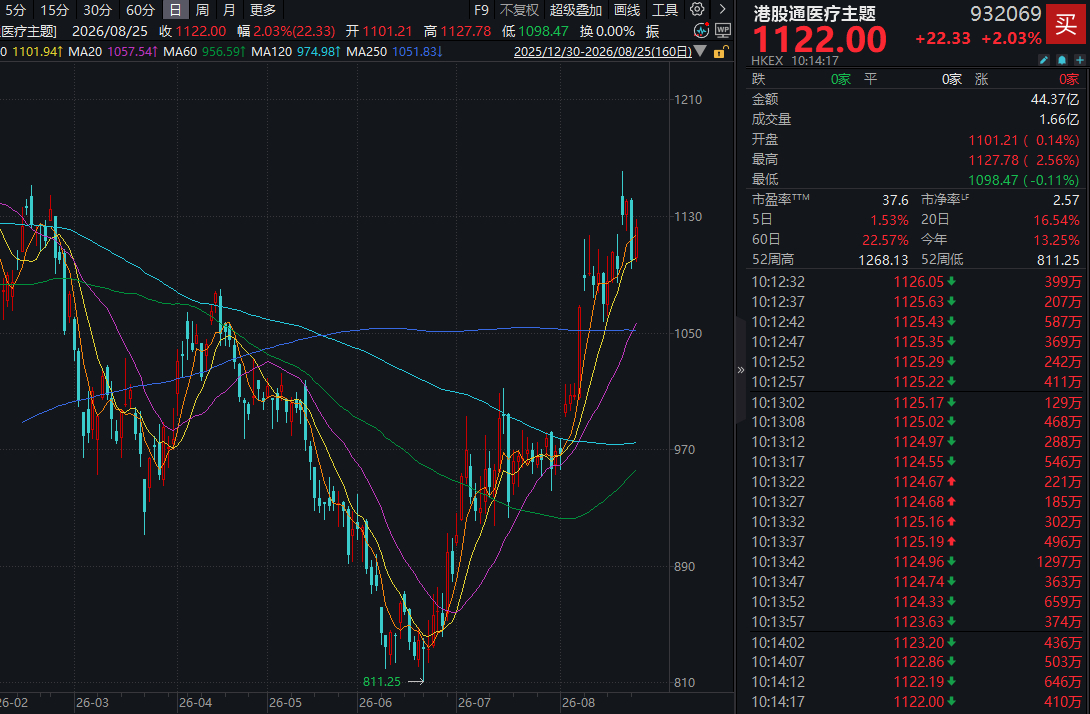
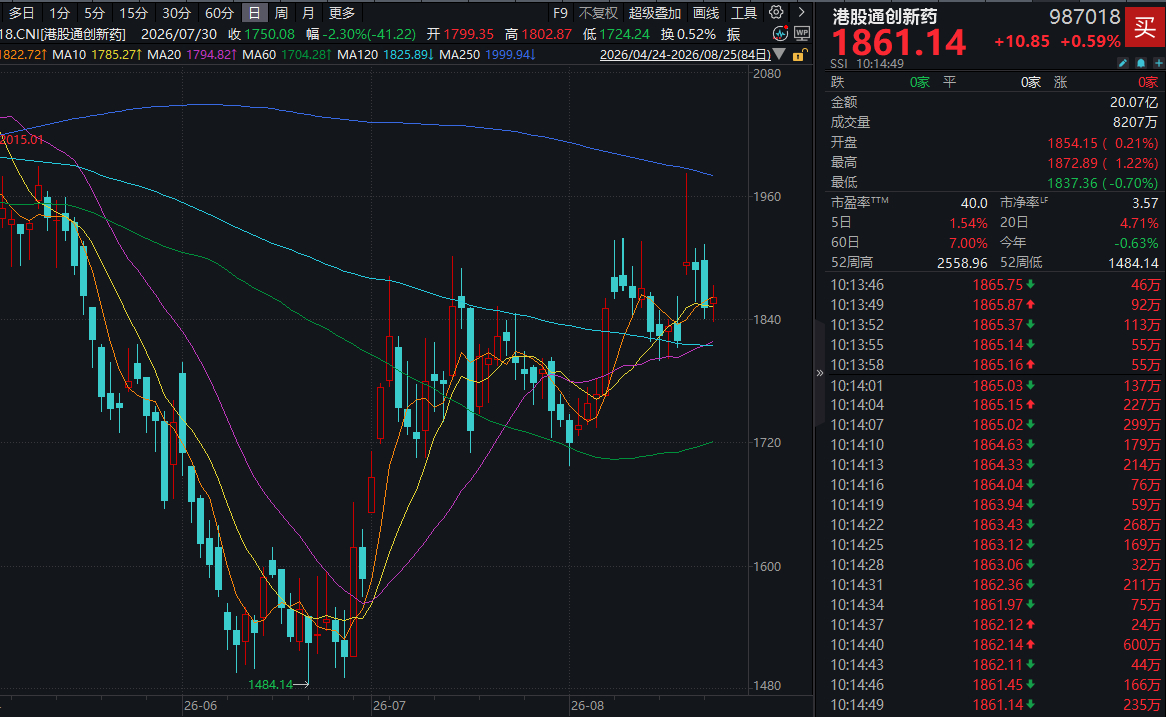
Today, although the broader market is under pressure, Hong Kong-listed pharmaceutical sector stocks are steadily trending higher. The Hang Seng Connect Medical ETF (Huixian? Capital? (526010))—an index with a “50% CXO allocation”—surged by more than 2%. The Hang Seng Connect Innovation Drug ETF (Huixian? Capital? (159570))—with “100% innovation-drug purity”—rose by nearly 1%. Its latest asset size exceeded RMB 24.3 billion, continuing to lead its peer group!
In terms of performance, WuXi Biology?Alliance has recently released its 2026 interim results. In the first half of the year, revenue was RMB 3.701 billion. On an actual exchange rate basis (AER), this represents a year-on-year increase of 37%; on a constant exchange rate basis (CER), it represents a year-on-year increase of 41.5%. Gross profit was RMB 1.371 billion, up 40.6% year on year. Adjusted net profit attributable to shareholders was RMB 1.027 billion, up 37.4% year on year. According to the financial report disclosure, by the end of the reporting period, outstanding service orders increased to USD 1.998 billion, up 50.4% year on year; outstanding total order value (including outstanding milestone payment orders) was USD 2.156 billion, up 62.2% year on year.
In the latest news, the EGFR?ADC of CSPC Pharmaceutical Group has achieved its 3rd breakthrough-therapy designation, for the treatment of head and neck cancer. On August 24, 2026, CSPC Pharmaceutical Group’s new drug SYS6010 is proposed to be included in the Breakthrough Therapy Drug program for treating recurrent or metastatic head and neck squamous cell carcinoma patients whose disease has progressed after immunotherapy and platinum-containing chemotherapy failure. SYS6010 uses TOP1i as the payload, with a DAR value of 8. Previously, SYS6010 had already secured breakthrough-therapy designations for two indications: EGFR-TKI and EGFR-mutant NSCLC after prior lines of platinum-containing chemotherapy, as well as advanced or metastatic esophageal cancer after immunotherapy and platinum-containing chemotherapy failure.
As for the conference schedule, the 2026 World Conference on Lung Cancer (WCLC) will be held in Seoul, South Korea from September 12 to 15, 2026.
[Hot constituent stocks of the Hang Seng Stock Connect Medical ETF—Additions (526010)]
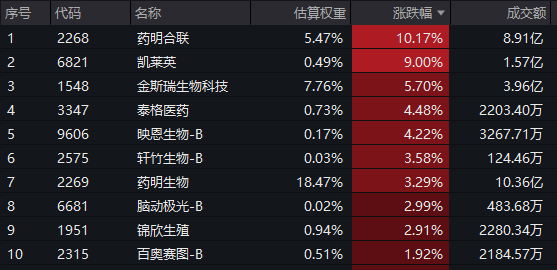
Most of the popular constituent stocks in the Hang Seng Stock Connect Medical ETF—Additions (526010) rose today: WuXi Helians (Wuhan/WuXi?) rose by more than 10%, Kyle? (Hengrui?) rose by 9%, Gens? (Gens? Biotech) rose by more than 5%, Tigermed and Ying? (Ying? Bio-B) rose by more than 4%, and WuXi Biologics rose by more than 3%.
Note: Constituent stocks are shown for display purposes only and do not constitute stock recommendations.
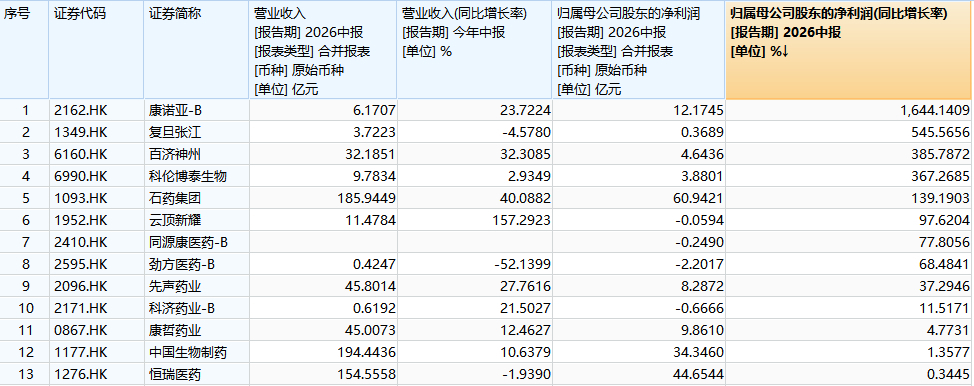
As of August 23, among the 36 constituent stocks of the Hang Seng Stock Connect Innovative Drug ETF—Additions (159570), 19 have released performance results, of which 13 have year-on-year positive net profit growth rates. In the first half of 2026, Cono? (Kang?—as provided: Canuo?) Nova’s attributable net profit surged by over 1,644% year-on-year.
Note: Constituent stocks are shown for display purposes only and do not constitute stock recommendations.
According to Zhongtai Securities, the biggest industry signal in this round of interim reports is not merely the high growth in profits, but that China’s innovative drug sector is forming two sustainable and realizable paths: “upgrading domestic commercialization pipeline + overseas BD.” This enables global value for Chinese innovative assets to begin showing up in current financial performance. Meanwhile, overseas innovative drugs continue to provide technical mapping; Moderna’s Phase III success further expands the clinical imagination space for AI + drug R&D. Personalized neoantigen vaccines are a representative area where AI deeply participates in drug design first and achieves late-stage clinical translation. This field naturally has a digital closed-loop: NGS data input → algorithm-based neoantigen screening → personalized drug manufacturing → human immune response and feedback. As AI’s deployment in innovative drug R&D progresses, real-world scenarios are expected to evolve from efficiency tools into direct participation in product design, and the accumulation of clinical data will also feed back to improve the value of algorithms and platforms.
(Zhongtai Securities 20260824 (Interim report cycle kicks off; Moderna’s personalized mRNA vaccine sings the song of silicon and carbon))
[Major event commentary: Phase III positivity for mRNA cancer vaccines; personalized tumor immunotherapy ushers in a new era]
On August 19, Moderna and Merck announced that the Phase III INTerpath-001 study evaluating the personalized mRNA neoantigen therapy intismeranautogene (V940/mRNA-4157) in combination with Keytruda for adjuvant treatment of patients with resected stage IIB–IV high-risk melanoma achieved the primary endpoint of recurrence-free survival (RFS) and the key secondary endpoint of distant metastasis-free survival (DMFS), and no new safety signals were observed.
According to China Merchants Securities, the Phase III positivity of V940 marks a new stage in which personalized neoantigen therapy moves from “frontier exploration” to a phase that could define clinical standards. In the INTerpath-001 study of 1,137 post-operative high-risk melanoma patients, V940 plus Keytruda was compared with Keytruda monotherapy. Both RFS and DMFS achieved the primary endpoints simultaneously, showing that a personalized mRNA neoantigen vaccine can further reduce the risk of recurrence and distant metastasis on top of standard PD-1 treatment. More importantly, Keytruda is already an important standard-of-care adjuvant therapy regimen after surgery. On this basis, V940 delivers incremental benefit, demonstrating that a personalized mRNA neoantigen vaccine can further translate into clinical improvements in recurrence and distant metastasis risk. In the previously reported KEYNOTE-942 Phase IIB follow-up of about five years, the hazard ratios (HR) versus Keytruda monotherapy for RFS were 0.51 and for DMFS were 0.41; the 5-year RFS rates were 68.8% versus 49.1%. The positive outcome in this Phase III continues the strong benefit trend observed in earlier studies, significantly enhancing the clinical and commercialization value of this treatment model.
This breakthrough result provides a new combination paradigm for next-generation cancer immunotherapy. This result represents the first time personalized neoantigen therapy and mRNA cancer therapy have completed key Phase III validation—its significance goes beyond a single indication of melanoma. The core of traditional PD-1 inhibitors is to release immune suppression of tumors against existing T cells, but their efficacy highly depends on whether patients already have a sufficiently strong anti-tumor immune response. V940, however, screens mutations from the patient’s tumor and encodes up to 34 neoantigens, using mRNA delivery to actively induce and expand T-cell responses targeting tumor-specific private mutations. When used together, it is akin to upgrading from “only releasing the immune brake” to “personalized generation of immune responses + releasing PD-1 immune suppression.” If this logic holds across more tumor types, personalized neoantigen vaccines may become a new immune-enhancement module on top of existing treatment foundations such as PD-1, chemotherapy, and ADC, further advancing cancer therapy toward precision and personalization.
From China’s mapping, companies laying out personalized neoantigen mRNA routes are expected to see a value reappraisal. Domestic direct developers include Ruihongdi (RGL-270 and HRXG-K-1939) under Hengrui, EVM16 from Everest? (Yun?—as provided: Yunding?) Innovative? (Yunding), AK154 from Kangfang, YKYY031 from Yuekang, and 3D125 from Sim? (Siru?); among them, RGL-270 has entered Phase II and is currently the most advanced direct mapping among China-listed companies. CSPC Pharmaceutical and Changchun High-tech also have broad mRNA cancer vaccine portfolios. The success of V940 first reduces the category risk of the entire technical path: “tumor sequencing—neoantigen screening—mRNA production—PD-(L)1 combination,” and also accelerates domestic companies’ investments and collaborations around neoantigen prediction algorithms, LNP delivery, personalized CMC, and IO combination strategies. Future disclosure of complete Phase III data, as well as advancing larger tumor types such as lung cancer, kidney cancer, and bladder cancer, is expected to continuously increase global and China investors’ attention to this area within the innovative drug segment.
(China Merchants Securities 20260820 (MRNA surged 177%; Phase III positivity for mRNA cancer vaccines; personalized tumor immunotherapy ushers in a new era))
[Leading pharmaceutical companies increase the share of innovative drugs; overseas expansion models are upgraded—remarkable innovation results]
Judging from the interim reports, the share of innovative-drug revenue among leading pharmaceutical companies has undergone a qualitative change. In recent years, driven by the booming development of China’s innovative-drug industry, domestic innovative-drug companies’ BD efforts overseas have set historical records. At the same time, the revenue structure of leading domestic pharmaceutical companies has also changed qualitatively, with innovative drugs becoming an important driver. According to each company’s annual reports and performance presentation materials, in 2025, Innovent? (Hengrui) innovative-drug revenue accounted for 58.34% of drug sales revenue; for Hansoh Pharmaceutical, innovative-drug and collaboration product revenue accounted for 82.2%; while pure-play innovative-drug companies such as BeiGene, Eli? and Innovent? (Alyves?) and Incyte? (Sorry—no, the list includes BeiGene, i? and Xin?; kept as provided) and others have surpassed 90%.
Of particular note is BeiGene as an overseas-expansion benchmark: BeiGene’s total operating revenue in 2025 was RMB 38.225 billion (+40.46%); attributable net profit was RMB 1.461 billion, marking the first time the company achieved full-year profitability. Its core product, ze?? (Zebutinib / Zeturbrutinib), generated U.S. market revenue of USD 2.831 billion in 2025 (+45%). Global commercialization rights are retained within the company. The valuation logic has shifted from a Biotech asset package to a globalized Biopharma platform.
From a collaboration-model perspective, overseas expansion models are evolving from License-out to Co-Co/NewCo. According to PharmaMagic (药皓?) and company announcements, in May 2026, Innovent Biologics? (Xin?—as provided: Xinda Biotech) and Pfizer reached a $10.5 billion Co-Co collaboration. In the same period, Hengrui Pharmaceutical and BMS reached a $15.2 billion collaboration for 13 early-stage projects; Hengrui retained rights to co-develop and options for global commercialization. Hengrui also established Kailera in the form of a NewCo and holds 19.9% of the shares. Thus, from the “guerilla warfare vs. stronghold” framework, Co-Co and NewCo are closer to the “stronghold” logic.
In addition, China’s innovative drug academic standing has been significantly improved. According to data from PharmaIntelligence (Yaotong) website, at the 2026 ASCO annual meeting, Chinese scholars contributed 94 oral presentations; 13 studies from 12 Chinese innovative drug companies were selected for LBA. Kangfang Bio secured a high-profile invite to the plenary/all-assembly meeting.
(Caitong Securities 20260824 (Innovation Drug Industry Chain: Redefining Value from Guerilla Warfare to a Stronghold))
Hang Seng Stock Connect medical theme—Additions Hang Seng Stock Connect Medical ETF (526010): the CXO weighting in the underlying index exceeds 50%, offering the whole market an even higher allocation! Multi-sector layout across CXO, innovative drugs, biologics, and more. The underlying assets are Hang Seng stocks, and you can trade T+0!
Pay attention to China’s hard-core innovative drug strength—this is a new form of productive forces. Pick the Hang Seng Stock Connect Innovative Drug ETF—Additions (159570), with 100% innovative-drug exposure. Over-the-counter linkage (Class A: 021030; Class C: 021031)!
Risk warning: Funds involve risk; investors should be prudent. The individual stocks mentioned in this article are only objectively shown as index constituent stocks and do not represent any investment advice. Any viewpoints, analyses, and forecasts in this article do not constitute any form of investment advice to the reader. The above funds all belong to medium-to-high risk products (R4), suitable for investors who, after their client risk profiling results, are categorized as growth-oriented (C4) and above. Please pay attention to the risks of index-based investing and the risk of concentrating holdings in constituent stocks of the CSRC Biomedicine Index. Please also pay attention to the risks that some index constituent stocks have relatively large weights and higher concentration levels. Please pay attention to risks specific to index-based investing, ETF operational risks, and the unique risks of investing in particular types of securities. The individual stocks mentioned in the text are only listed for objective display as index constituents; any information appearing in this article is for reference only, and investors must take responsibility for any investment decisions made independently. Any viewpoints, analyses, and forecasts in this article do not constitute any form of investment advice to the reader. The fund’s investment scope includes Hong Kong stocks, which may involve unique risks arising from differences in the investment environment, underlying investment targets, market systems, and trading rules. When investors apply for subscriptions/redemptions of ETF fund units, the subscription/redemption agent brokers may charge a commission of no more than 0.50%, which includes relevant fees charged by the stock exchanges, registration institutions, and so on. For sales fees of other funds, please refer to the relevant legal documents such as the fund prospectus and product summary.