


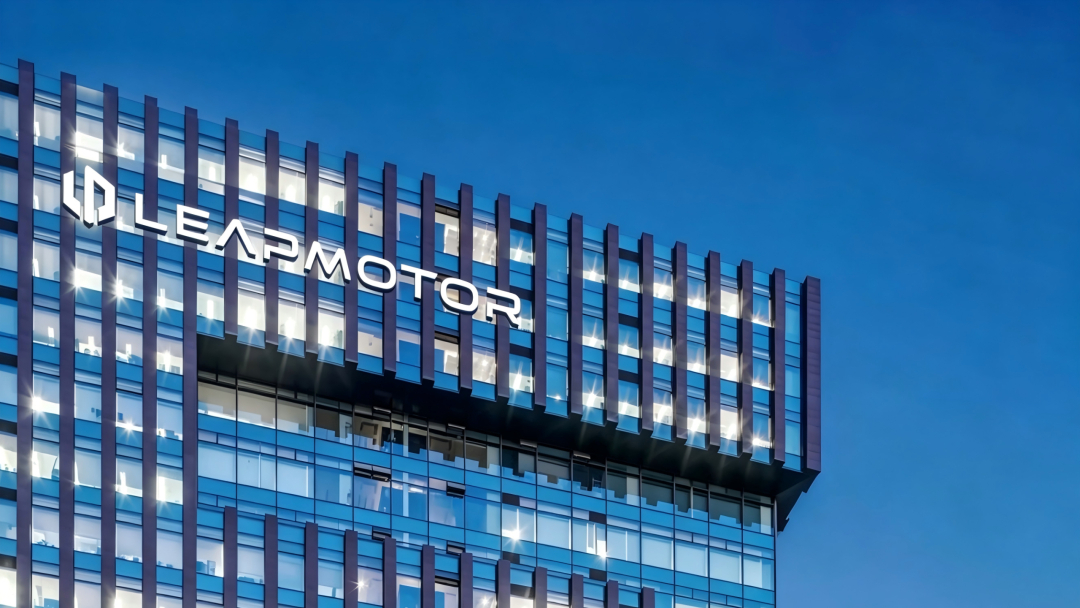
Zhu Jiangming called for at least RMB 200 billion, yet the market only gave him HKD 60 billion.
By | Wang Hanxing
Editor | Wei Jia
At a personal annual speech in 2021, Lei Jun recalled Xiaomi from two years earlier and posed a soul-searching question. Back then, Xiaomi’s smartphone revenue and market share were both growing rapidly, but its market value kept falling to nearly half the issue price. “Why doesn’t the capital market recognize us?”
Years later, the founder and chairman of Leapmotor, Zhu Jiangming, had the same question.
On August 24, after the Hong Kong stock market closed, Leapmotor released its 2026 Q2 and interim performance results. In the first half of 2026, the company’s total deliveries were 356,487 units, up 60.8% year over year from the same period in 2025, ranking first among China’s new energy vehicle (NEV) brands by sales volume. In July, Leapmotor set another record for monthly deliveries, reaching 101,267 units, up 102.0% year over year, becoming the first domestic NEV brand to break the 100,000-unit mark in a single month. On the profitability front, the company’s gross margin in Q2 rebounded to 12.6%, improving markedly from Q1. In the first half of the year, Leapmotor recorded net profit of RMB 210 million, achieving profitability for consecutive half-year periods.
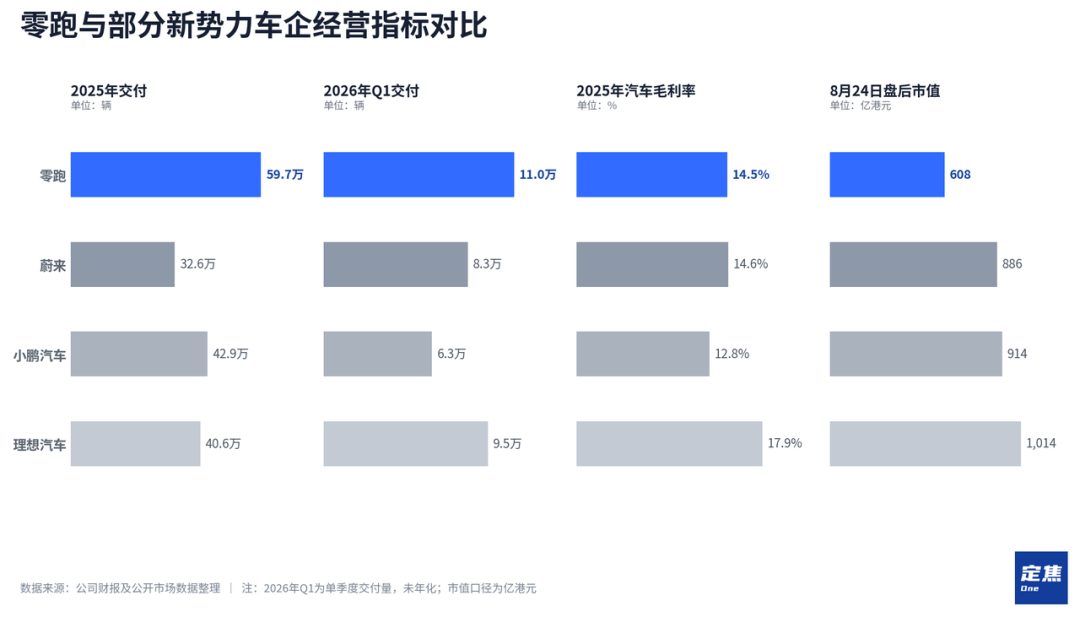
Impressive delivery figures did not win favor from capital markets. From the beginning of the year to now, Leapmotor’s share price has cumulatively fallen 12.05%. As of the close on August 24, its market cap was HK$60.8 billion. In the same period, NIO’s market cap was HK$88.6 billion, XPeng’s was HK$91.36 billion, and Li Auto’s was HK$101.4 billion. Among these three, even the one with the highest Q2 delivery volume is still less than half of Leapmotor’s.
Recently, Zhu Jiangming publicly stated that Leapmotor’s current market value of several hundred billion is severely undervalued. Its four business segments—batteries, drive systems, electronic/electrical architecture, and the complete vehicle—each taken separately are worth between RMB 50 billion and RMB 100 billion. Based on this calculation, Leapmotor should be worth at least RMB 200 billion.
Monthly deliveries broke 100,000 units—Leapmotor has crossed the threshold of large-scale vehicle manufacturing. But between sales and capital pricing, there’s a gap of more than RMB 100 billion hanging sideways. Where exactly is it falling short?
01. The return of scale effects—there’s still a slope to climb for the million-unit target
Overall, this quarter Leapmotor’s performance largely fell within the guidance previously given. Deliveries remain the biggest highlight. Its stable profitability and overseas business are the two other points of focus besides deliveries.
First, look at the revenue scale.
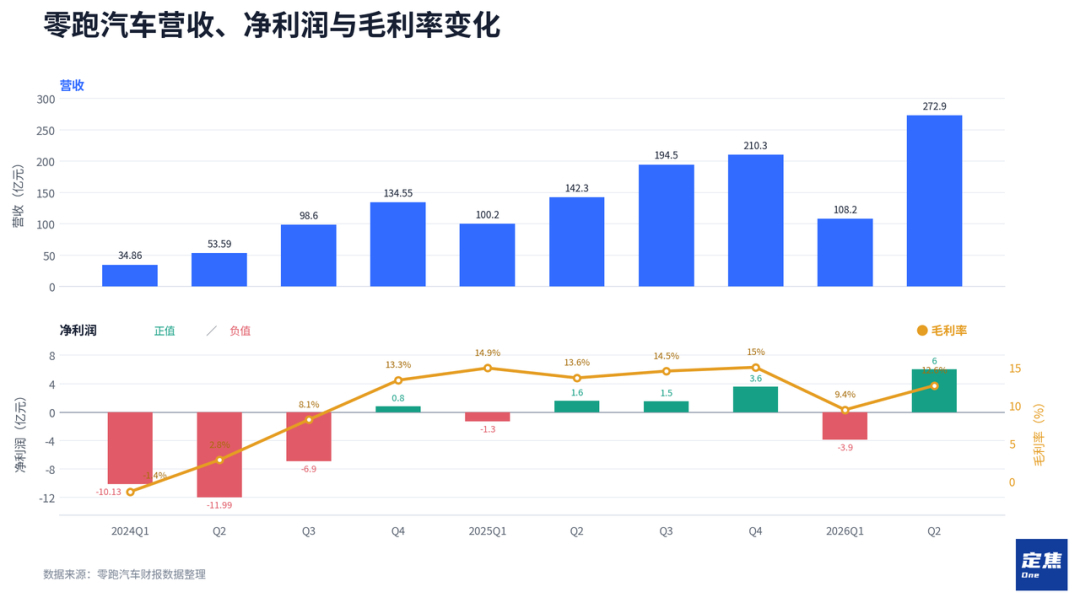
Leapmotor’s Q2 revenue reached RMB 27.29 billion, up 91.78% year over year. For comparison, in Q1 this year, Leapmotor’s revenue growth had once been only 8%. The main reason was that in Q1, the sales share of the company’s three low-priced series—A, B and T—continued to rise. These models cover the RMB 60,000–130,000 price band, which pulled down the average selling price significantly.
This trend improved in Q2. According to data from Bitauto, in June 2026, among Leapmotor models, the A10 covering the RMB 60,000–90,000 price band remained the best-selling, with monthly sales of 24,865 units. Meanwhile, higher-priced models C10 and D19 saw rapid growth, with monthly sales reaching 15,097 units and 8,034 units respectively, ranking second and third.
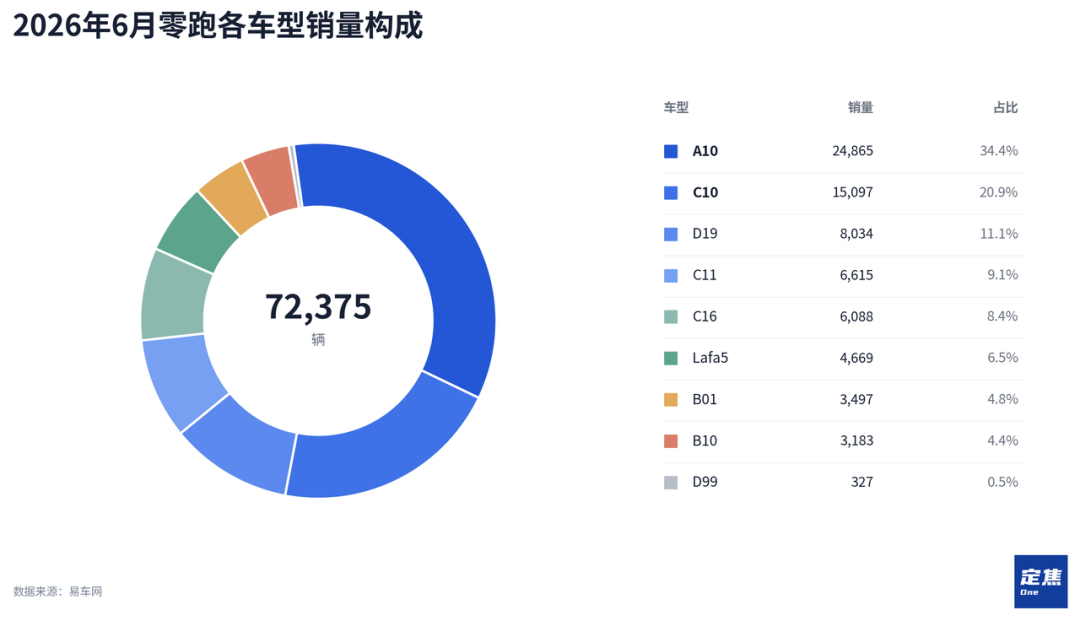
The higher proportion of models priced at higher levels lifted Leapmotor’s average selling price, and revenue growth was correspondingly restored.
Because Leapmotor discloses the composition of revenue in detail only in its semiannual and annual reports, it is difficult for a standalone quarterly report to break out revenue from vehicle sales. If we approximate total revenue as vehicle sales revenue, the average selling price per vehicle in Q2 is about RMB 110,000, up by RMB 12,000 quarter over quarter.
The delivery ramp curve is also clear. In April this year, Leapmotor delivered 71,387 vehicles in a single month, up 73.9% year over year, breaking the company’s single-month delivery record. It then kept rising: deliveries surpassed 80,000 units and 90,000 units in May and June respectively, and in July it officially crossed the 100,000-unit threshold.
Looking at the model timeline, the A10 launched at the end of March covered the entire Q2 delivery cycle and was the top-volume model during the period. The D19, priced from RMB 220,000 to RMB 270,000, was also launched on April 16. The entire second quarter can be seen as the first quarter in which Leapmotor’s four series—A, B, C and D—synchronized in contributing to delivery volume, as well as the starting point for the delivery volume boom.
Leapmotor’s sales target for 2026 is 1.05 million vehicles. In the first half, deliveries were 356,000 units, achieving roughly 34%. This means to hit the full-year target, over the remaining six months it needs an average of 115,000 deliveries per month. After achieving more than 100,000 deliveries in July, this target does not currently look out of reach.
Another line supporting Leapmotor’s rapid sales growth is overseas expansion. In the first half of 2026, the company’s export volume reached 96,000 units, up 372.6% year over year. This already exceeded the total export volume for all of 2025, accounting for 27% of total deliveries in the first half.
Leapmotor International, founded with Stellantis, has already entered more than 45 overseas markets and established over 1,000 sales and service outlets. At performance meetings, management raised its 2026 overseas sales expectation to about 200,000 vehicles. Overseas business is evolving from a supplementary item into a second growth curve. However, the company also says that at this stage it places more emphasis on market share and volume, and that localized production will not significantly improve profit per vehicle in the short term.
In terms of profitability, as the proportion of higher-priced models increases, Leapmotor’s gross margin rose from 9.4% in Q1 to 12.6% in Q2 this year. However, it is still about one percentage point lower than in the same period last year. Besides product-mix factors, rising costs of auto parts this year is also a major driver compressing automakers’ gross margins.
In addition, Leapmotor’s net profit in Q2 was RMB 600 million. After deducting the RMB 390 million loss in the first quarter, its net profit in the first half was RMB 210 million. Q1 is typically the off-season for automakers’ sales, and in past years Leapmotor’s profits in Q1 were relatively low, then climbed quarter by quarter. In 2025, the company achieved full-year profitability for the first time. The pattern was similar—loss in Q1, and turning profitable starting in Q2.
Changes on the expense side are worth paying attention to. During the period, the company’s R&D expenses and selling expenses were RMB 1.28 billion and RMB 1.31 billion respectively. This was the second time since last year’s Q4 that selling expenses exceeded R&D expenses, showing that the company’s力度 in advertising and channel spending is increasing.
02. 100,000 units of monthly sales—worth only HK$60 billion?
If you look only at book figures and delivery volumes, there’s no doubt that Leapmotor is the best off among the new forces. But this is reflected in absolutely nothing on its market cap.
Zhu Jiangming used to talk very rarely about market value in public. The image of Leapmotor he has consistently built externally is that of a cost-performance brand: 65% of parts are developed and manufactured in-house, with extreme cost control and cost-based pricing. It excels in manufacturing, and most of the technology stories it tells are focused on cost reduction and efficiency improvement.
But recently his tune has changed. After its monthly sales surpassed 100,000 units, he has repeatedly publicly said that Leapmotor has been undervalued by the capital market. He also emphasized that over the past year, the company has increased its holdings of HK$1.9 billion worth of stocks, and this year’s first half it has also increased by HK$900 million, using this to convey confidence to the market.
So why is Leapmotor’s market cap not moving up?
First, although Leapmotor is also promoting a “right to equal autonomy,” pushing assisted-driving functions down to models priced below RMB 100,000, in terms of accumulation of autonomous-driving technology, Leapmotor does not have a clear advantage. For a long time, Leapmotor has followed a “wait-and-see” strategy in autonomous driving: once a technology is validated by the market, it chooses to follow.
This strategy leaves Leapmotor less room than NIO, Li Auto, and XPeng to tell a compelling story.

XPeng has its self-developed Turing AI chip and has already entered formal mass production for use in vehicles. It also released a second-generation VLA large model in March. Its Robotaxi production vehicles have already rolled off the line. In addition, it has human-shaped robots and flying car businesses in development. Li Auto has an end-to-end + VLA large-model autonomous driving system, and the relevant technology products it has released include the Mach VLA large model and the self-developed Mach M100 chip. NIO’s self-developed autonomous-driving chip, Nebula NX9031, has also entered mass production. The chip business main entity, Anhui Nebula Technology, completed its first round of financing of more than RMB 2.2 billion in February this year, and the post-investment valuation is close to RMB 10 billion.
Autonomous driving, chips, AI, and robots—these are the concepts that the current capital market is willing to assign a premium to. Judging from most sell-side research reports, Leapmotor is still regarded as a manufacturing company, lacking a strong technology narrative, so the valuation framework naturally gravitates toward traditional automakers. Even if sales double, it would only bring linear growth in performance and cannot trigger a re-rating of the valuation system.
The financing environment is also unfavorable for Leapmotor. Leapmotor is listed only in Hong Kong, which inherently lacks the type of liquidity premium that the U.S. market provides to tech stocks. Meanwhile, the entire Hong Kong new forces sector is experiencing valuation compression. When the “water level” in the sector declines, even if Leapmotor leads in sales, it still can’t avoid the trend on its own.
Second, Leapmotor has high sales, but its average selling price per vehicle isn’t high, and its gross margin isn’t superior either. NIO and Li Auto’s average selling prices per vehicle are both above RMB 200,000; XPeng’s is about RMB 165,000; Leapmotor’s is just a bit above RMB 110,000. Measured by sales revenue, Leapmotor’s market share is far less eye-catching than its delivery ranking.
For gross margin, using the Q1 data that each company has published: NIO and XPeng’s automotive gross margins were 19% and above 12% respectively; Ideal’s gross margin dropped to the single digits due to product mix adjustments. Leapmotor’s gross margin of 9.4% places it in the middle-to-lower range among these four companies.
Low gross margin combined with low pricing has the most direct impact of producing thin net profit. In Leapmotor’s Q2 revenue of RMB 27.29 billion, net profit was only RMB 600 million, and the net margin was 2%. On the surface, the absolute value of a market cap of more than HK$60 billion may not look high, but based on the closing price on August 24, the corresponding trailing P/E (TTM) exceeds 70x. For manufacturing companies with the same profitability quality, this P/E multiple is actually not low.
Finally, Leapmotor’s R&D spending is not aggressive. In Q2, R&D expenses as a proportion of revenue were 4.7%. According to statistics from Huachuang Securities, dividing R&D spending by the number of vehicle models can represent a company’s R&D intensity per model. In the past few years, Leapmotor’s per-vehicle R&D spending has mostly been around RMB 200 million to RMB 300 million. NIO, Li Auto and XPeng are around RMB 1 billion each. Some high-end traditional brand automakers can even reach RMB 2 billion or more.
A relatively low R&D intensity is the prerequisite for Leapmotor’s cost control and low-price strategy to be viable. At the same time, it also means the company has difficulty closing the gap with leading competitors in terms of reserves of intelligentization technologies.
The market has worked out the numbers very clearly.
Just like seven years ago when Lei Jun questioned why the capital market wouldn’t give a higher valuation to a company with strong growth momentum. Maybe the answer to Lei Jun’s and Zhu Jiangming’s questions is the same: at this stage, this company is worth that much money right now.
Zhu Jiangming once said that in his view, the most successful company in the smartphone industry is Samsung, and in the auto industry it is Toyota. But Samsung’s market cap is not as high as Apple’s, and Toyota’s is not as high as Tesla’s—high market value does not necessarily mean greater success.
Right now, for Leapmotor’s market cap to move up, the market wants to see first: higher gross margin and average selling price per vehicle, and a story that is not only about manufacturing.