
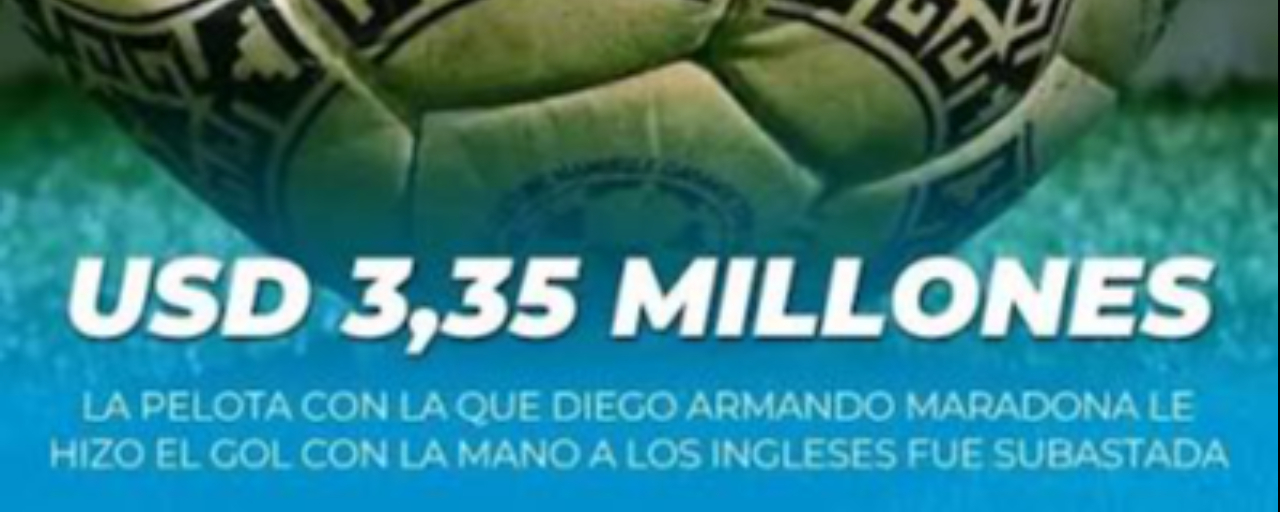

The ball with which Diego Maradona scored the controversial Hand of God against England at the 1986 World Cup was sold in the United States for USD $3.35 million—a millionaire sum that came in far below the initial estimate.
Heritage Auctions sold the Adidas Azteca ball for USD $3.35 million in the United States.
The figure was USD $6.7 million below the estimated USD $10 million.
Maradona scored with that ball the Hand of God and then the so-called Goal of the Century against England in 1986.
The ball with which Diego Maradona scored the Hand of God goal against England at the 1986 World Cup reached USD $3.35 million at an auction held in the United States. The sale turned the Adidas Azteca ball into an exceptionally valuable sports item, although the result was considerably below the expectation set by the auction house.
Heritage Auctions, based in Dallas, had estimated that the item could reach USD $10 million and set an opening price of USD $2.5 million. The final amount ended up USD $6.7 million below that projection, but it surpassed the opening level and confirmed the commercial appeal of one of the most recognizable episodes in football history.
A ball linked to two historic goals
The ball was used on June 22, 1986, during the quarterfinal match between Argentina and England played at the Azteca Stadium in Mexico City. Maradona scored two goals in Argentina’s victory, a performance that became associated both with the controversy and with one of the sport’s most admired individual plays.
The first goal came when the Argentine attacking midfielder rose in front of the English goalkeeper Peter Shilton and struck the ball with his fist, beating him despite the fact that the rules prohibited that action. The referee allowed the goal, and the episode sparked a discussion that continues to be part of the World Cup’s football memory from 1986.
Maradona later described that goal with a phrase that combined irony, challenge, and sports mysticism: he said it was scored “a little with Maradona’s head and a little with the hand of God.” The expression ended up giving its name to the play and reinforced the connection between the ball, the player’s personality, and an international rivalry full of meaning.
Minutes later, the Argentine scored again after an extraordinary individual play in which he advanced from his own half and left several rivals behind before finishing. That action was later voted the “Goal of the Century,” so the same ball became linked to two goals of opposite nature: one remembered for the controversy and the other for its virtuosity.
The value of an unrepeatable sports item
The auction shows how certain sports objects transcend their original purpose and become cultural symbols capable of drawing sums in the millions. In this case, the value does not depend only on the fact that it is a ball used in a match, but on its direct connection to a date, an opponent, a tournament, and two moments that defined Maradona’s public image.
The gap between the estimate and the final price also reflects the uncertainty inherent in auctions of historical pieces. Although Heritage Auctions calculated a possible outcome of USD $10 million, buyers ultimately set the value at USD $3.35 million—a figure that shows that an object’s emotional relevance does not always automatically translate into the highest expected valuation.
The initial price of USD $2.5 million served as a reference point to open the bidding and established from the start the extraordinary nature of the piece. The final result added USD $850,000 to that level, although the figure did not reach the target that would have placed the ball among the most expensive sports items ever offered at an auction.
The Adidas Azteca brand is also part of the story, because it identifies the model used in the World Cup setting and helps connect the memory to the material reality of the match. For collectors, that combination of authenticity, provenance, and historical prominence can be as important as the item’s physical rarity.
Maradona’s legacy after his death
Diego Maradona died in November 2020, at age 60, but his figure continues to generate interest both inside and outside Argentina. The sale of the ball shows how his legacy remains active in the market for historical objects, where each element related to his performances can take on its own symbolic charge.
Maradona was not only the author of the goals from that match, but also the protagonist of a narrative that blends talent, controversy, and national pride. Argentina beat England in a context shaped by rivalry between the two countries, and the player’s performance was incorporated into a shared memory that goes beyond the sporting result.
The auctioned ball concentrates that history into a single object: the illicit gesture that opened the scoring, the extraordinary play that came next, and the celebration of a win in the World Cup quarterfinals. For that reason, its sale can’t be interpreted as merely a memorabilia transaction, but as the commercialization of a recognizable fragment of popular culture.
The denouement also offers a particular reading for the collectibles market: even a piece surrounded by worldwide fame can sell for below the most ambitious estimate. Even so, USD $3.35 million was enough to confirm that the Hand of God retains a unique power, decades after Maradona raised his hand in front of Shilton at the Azteca Stadium.