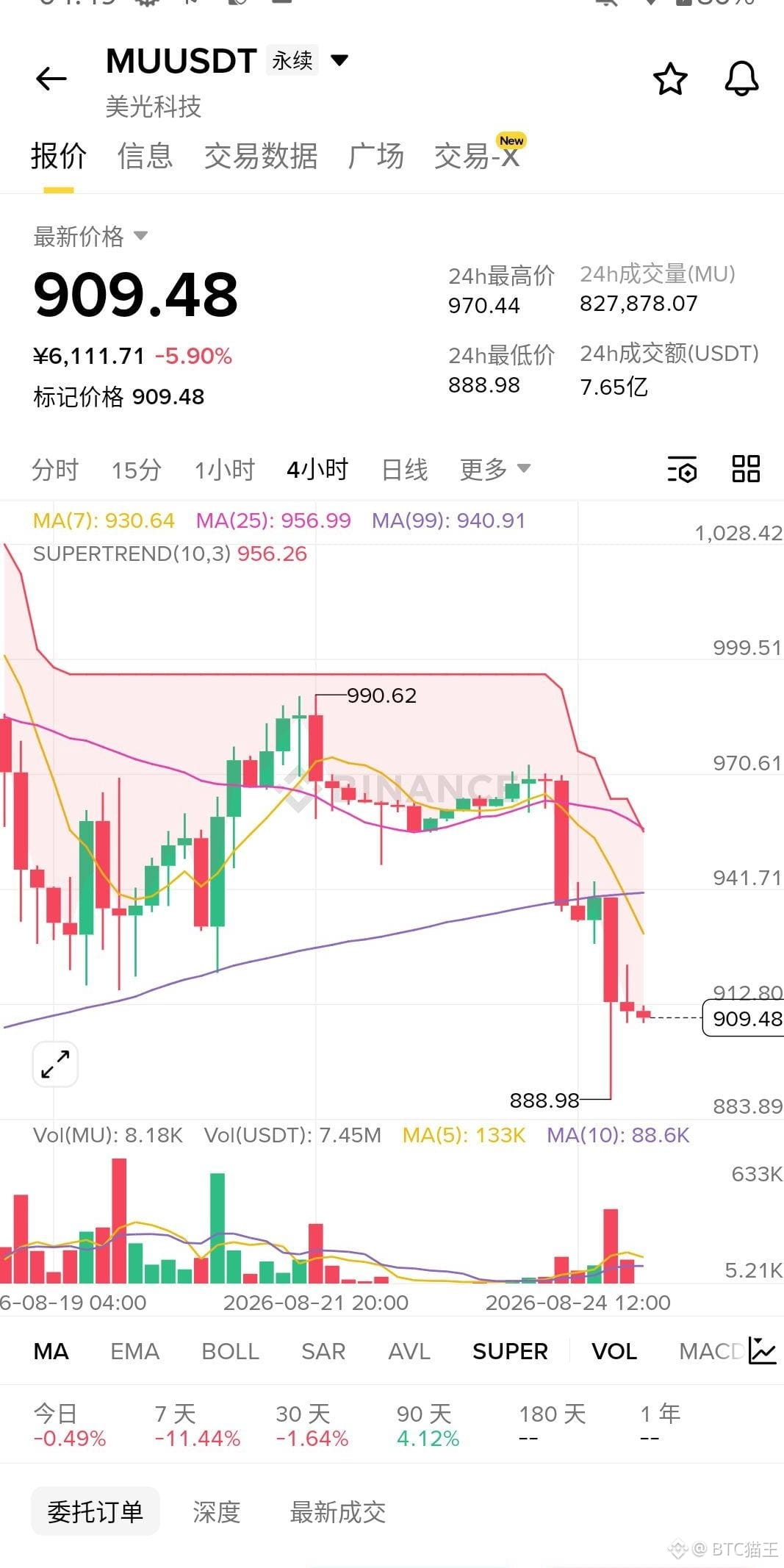
The amount of positions surged 7.6% in a day, but the price still dropped nearly 6 points within 24 hours—those long positions that just entered with MU are all sitting in water now. In four hours there were six K-lines, five of them bearish; the 20- and 50-day moving averages are pressing down hard. The more it falls, the more people pick it up; the more they pick it up, the deeper it goes.
Why am I saying this? Because the ones “buying the dip” are all leveraged money. The active buy side has spiked 50% over seven hours, and the whales’ accounts’ long exposure ratio is also rising—so it looks like big players are taking over, right? But the price won’t give it any face and is still sliding below 909. With such fierce buying, they still can’t hold the price back. The sell wall above is thicker than you think—every one of those buy orders gets gobbled up completely.
Translate this: this isn’t called “support,” it’s called “catching a falling knife.” Spot net inflow for large orders is zero—no real money at all, not even a dime comes in. It’s all long positions added inside the derivatives contracts. The funding rate is almost zero, with those eight sampling points nearly at zero—there isn’t even the cost needed to force a squeeze. The higher the longs pile up, the more it looks like fuel being stacked to be thrown into the down-slam reservoir.
So I don’t care about anything like “it’s fallen far enough to be cheap.” From this level, I look short and trade short. The price is grinding just above the 24-hour low of 888; once it breaks below 888, it will most likely enter an accelerated selloff. Below there’s no data showing any solid floor—how far it drops won’t be surprising. If you’re holding longs, don’t keep holding on. And if you’re spot traders, don’t rush to buy the dip yet.
The only condition for a viewpoint reversal is one line: once the price is back above 913 and holds, spot net inflows for large orders turn positive and the funding rate lifts accordingly—then it counts that the whales add longs. I’ll change my mind. Until then, the shorts’ pace stays the same. #mu $MU
Why am I saying this? Because the ones “buying the dip” are all leveraged money. The active buy side has spiked 50% over seven hours, and the whales’ accounts’ long exposure ratio is also rising—so it looks like big players are taking over, right? But the price won’t give it any face and is still sliding below 909. With such fierce buying, they still can’t hold the price back. The sell wall above is thicker than you think—every one of those buy orders gets gobbled up completely.
Translate this: this isn’t called “support,” it’s called “catching a falling knife.” Spot net inflow for large orders is zero—no real money at all, not even a dime comes in. It’s all long positions added inside the derivatives contracts. The funding rate is almost zero, with those eight sampling points nearly at zero—there isn’t even the cost needed to force a squeeze. The higher the longs pile up, the more it looks like fuel being stacked to be thrown into the down-slam reservoir.
So I don’t care about anything like “it’s fallen far enough to be cheap.” From this level, I look short and trade short. The price is grinding just above the 24-hour low of 888; once it breaks below 888, it will most likely enter an accelerated selloff. Below there’s no data showing any solid floor—how far it drops won’t be surprising. If you’re holding longs, don’t keep holding on. And if you’re spot traders, don’t rush to buy the dip yet.
The only condition for a viewpoint reversal is one line: once the price is back above 913 and holds, spot net inflows for large orders turn positive and the funding rate lifts accordingly—then it counts that the whales add longs. I’ll change my mind. Until then, the shorts’ pace stays the same. #mu $MU