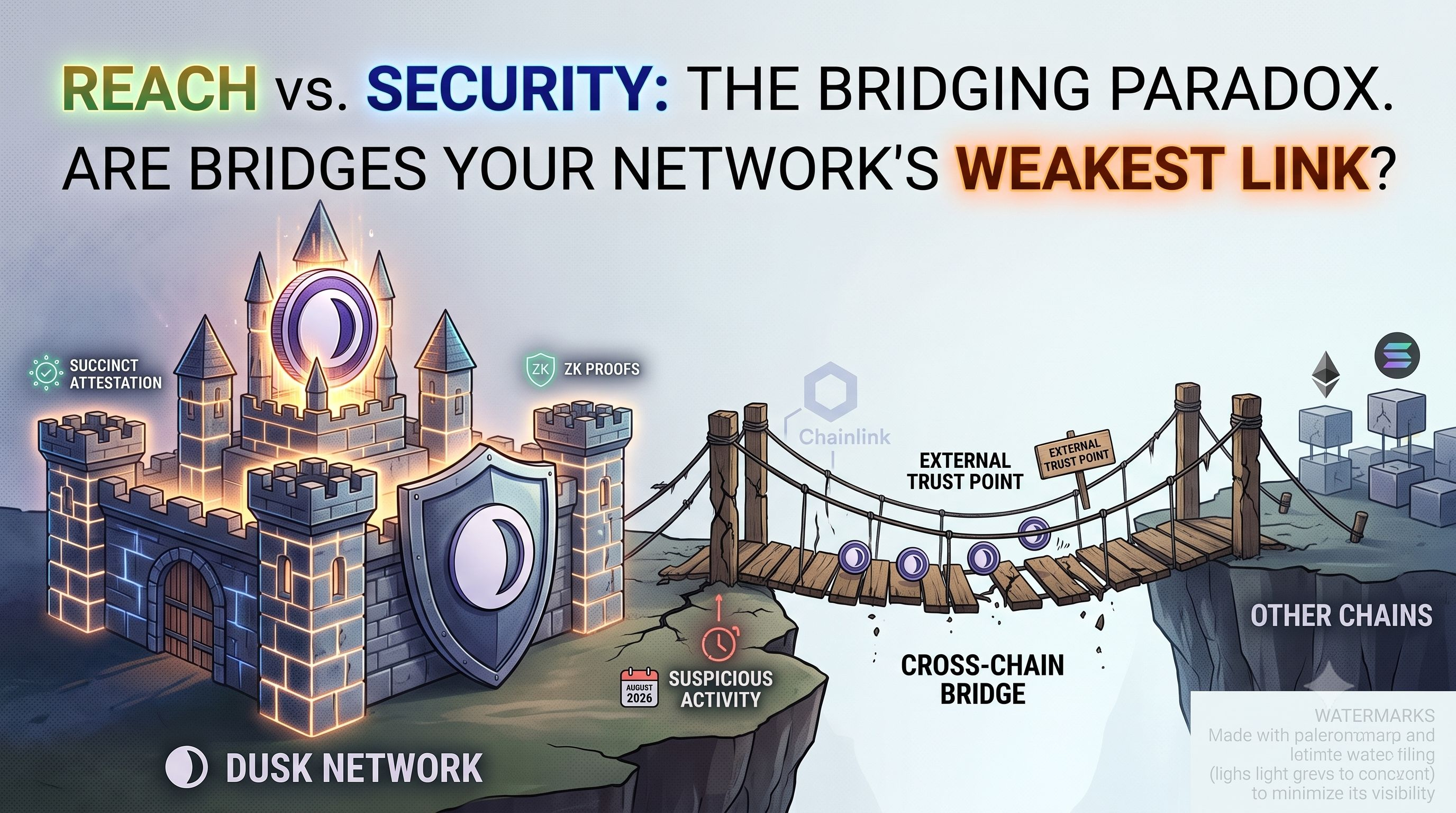
Every cross chain bridge in this industry carries the same uncomfortable truth: it is usually the least secure part of an otherwise secure system, because it has to trust something outside the system it is bridging into. Dusk Network's own base layer, Succinct Attestation for deterministic finality, zero knowledge proofs for confidential transactions, is genuinely hard to attack directly. The bridges connecting it outward, including the infrastructure recently paused after suspicious wallet activity in August 2026, are a different category of risk entirely, and I do not think that risk is unique to Dusk so much as it is unavoidable for any chain trying to be interoperable at all. The irony is hard to miss: the same bridge infrastructure now under review was meant to help carry the DuskEVM launch forward, tying the project's next milestone to a trust problem the rest of the industry has never fully solved either.
The Chainlink integration illustrates the tension well. Using CCIP to let DUSK move natively between Ethereum and Solana, and to eventually let NPEX settle a stated EUR 300 million or more of tokenized securities across chains, genuinely expands what the network can reach. It also means Dusk's security now partially depends on infrastructure it does not fully control, audited and reputable as Chainlink's design is. That is simply what interoperability costs. No bridge architecture in the industry today has a clean record proving this cost can be engineered away entirely rather than just reduced.
So is bridging fundamentally at odds with a security first brand, or just an honest trade every chain accepts once it wants reach beyond its own base layer? I lean toward the second answer, with a caveat: a project whose entire value proposition rests on trust has less room for error here than a general purpose chain does, and the August incident is a reminder of how thin that margin actually is.
@Dusk $DUSK #dusk
The Chainlink integration illustrates the tension well. Using CCIP to let DUSK move natively between Ethereum and Solana, and to eventually let NPEX settle a stated EUR 300 million or more of tokenized securities across chains, genuinely expands what the network can reach. It also means Dusk's security now partially depends on infrastructure it does not fully control, audited and reputable as Chainlink's design is. That is simply what interoperability costs. No bridge architecture in the industry today has a clean record proving this cost can be engineered away entirely rather than just reduced.
So is bridging fundamentally at odds with a security first brand, or just an honest trade every chain accepts once it wants reach beyond its own base layer? I lean toward the second answer, with a caveat: a project whose entire value proposition rests on trust has less room for error here than a general purpose chain does, and the August incident is a reminder of how thin that margin actually is.
@Dusk $DUSK #dusk