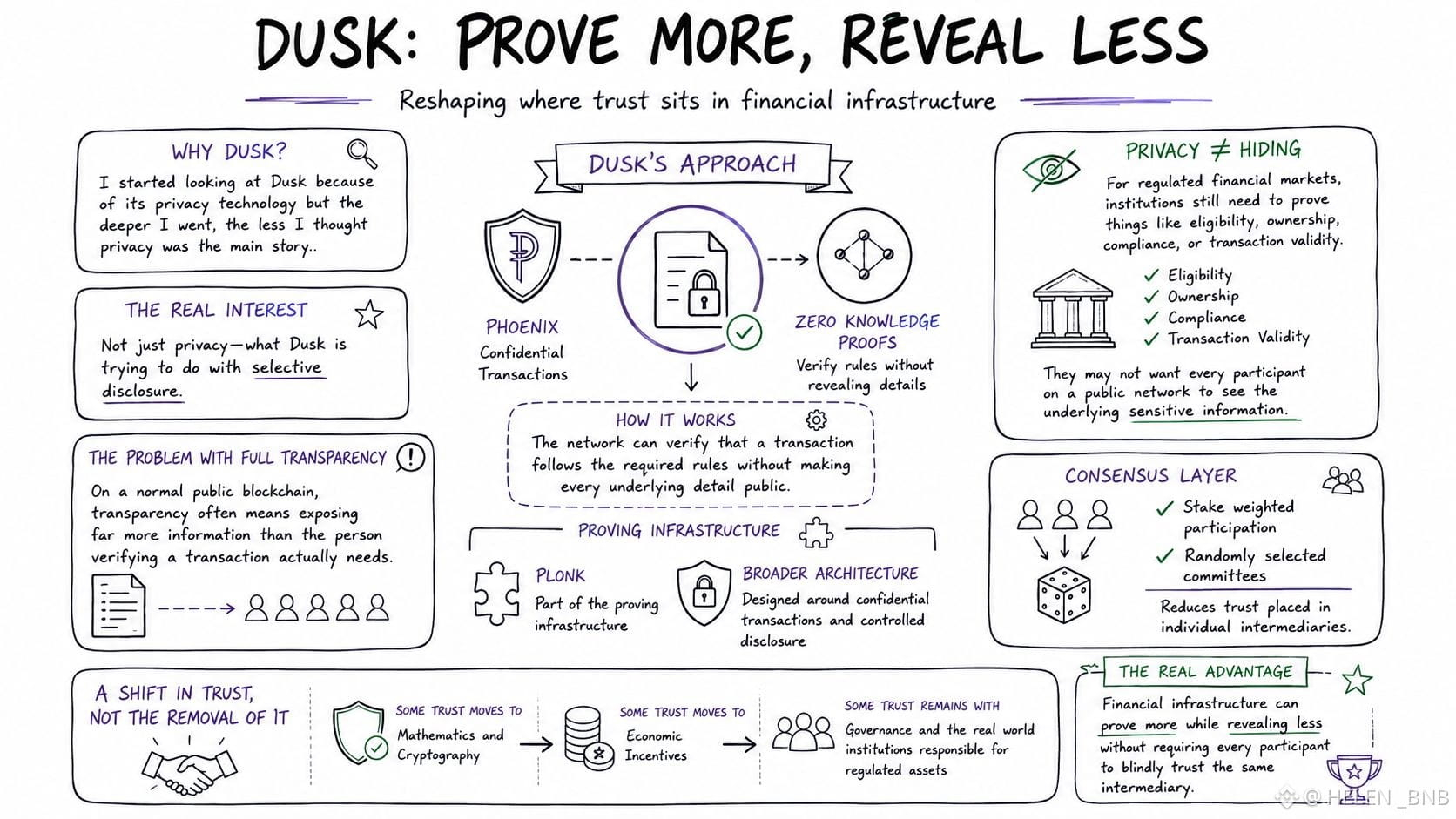
#dusk $DUSK @Dusk I started looking at Dusk because of its privacy technology but the deeper I went the less I thought privacy was the main story..
The interesting part is what Dusk is trying to do with selective disclosure.
On a normal public blockchain transparency often means exposing far more information than the person verifying a transaction actually needs.
Dusk takes a different approach.
With Phoenix and zero knowledge proofs the network can verify that a transaction follows the required rules without making every underlying detail public. PLONK is part of that proving infrastructure while the broader architecture is designed around confidential transactions and controlled disclosure.
But this is where I think the distinction matters.
Privacy is not the same thing as hiding.
For regulated financial markets institutions still need to prove things like eligibility ownership compliance or transaction validity. They simply may not want every participant on a public network to see the underlying sensitive information.
That makes selective disclosure much more interesting than simply saying “Dusk is private.”
Then there is the consensus layer.
Dusk uses stake weighted participation and randomly selected committees rather than relying on one institution to decide which transactions are valid. That reduces the amount of trust placed in individual intermediaries but it doesn’t eliminate assumptions around software cryptography economic incentives and governance.
So I am starting to see Dusk less as a blockchain trying to remove trust completely.
It is trying to reshape where trust sits.
Some trust moves from institutions toward mathematics and cryptography.
Some moves toward economic incentives.
Some remains with governance and the real world institutions responsible for regulated assets.
That feels like the more important experiment.
If Dusk succeeds the advantage won’t simply be that financial data becomes private.
$STORJ $PROM
The interesting part is what Dusk is trying to do with selective disclosure.
On a normal public blockchain transparency often means exposing far more information than the person verifying a transaction actually needs.
Dusk takes a different approach.
With Phoenix and zero knowledge proofs the network can verify that a transaction follows the required rules without making every underlying detail public. PLONK is part of that proving infrastructure while the broader architecture is designed around confidential transactions and controlled disclosure.
But this is where I think the distinction matters.
Privacy is not the same thing as hiding.
For regulated financial markets institutions still need to prove things like eligibility ownership compliance or transaction validity. They simply may not want every participant on a public network to see the underlying sensitive information.
That makes selective disclosure much more interesting than simply saying “Dusk is private.”
Then there is the consensus layer.
Dusk uses stake weighted participation and randomly selected committees rather than relying on one institution to decide which transactions are valid. That reduces the amount of trust placed in individual intermediaries but it doesn’t eliminate assumptions around software cryptography economic incentives and governance.
So I am starting to see Dusk less as a blockchain trying to remove trust completely.
It is trying to reshape where trust sits.
Some trust moves from institutions toward mathematics and cryptography.
Some moves toward economic incentives.
Some remains with governance and the real world institutions responsible for regulated assets.
That feels like the more important experiment.
If Dusk succeeds the advantage won’t simply be that financial data becomes private.
$STORJ $PROM