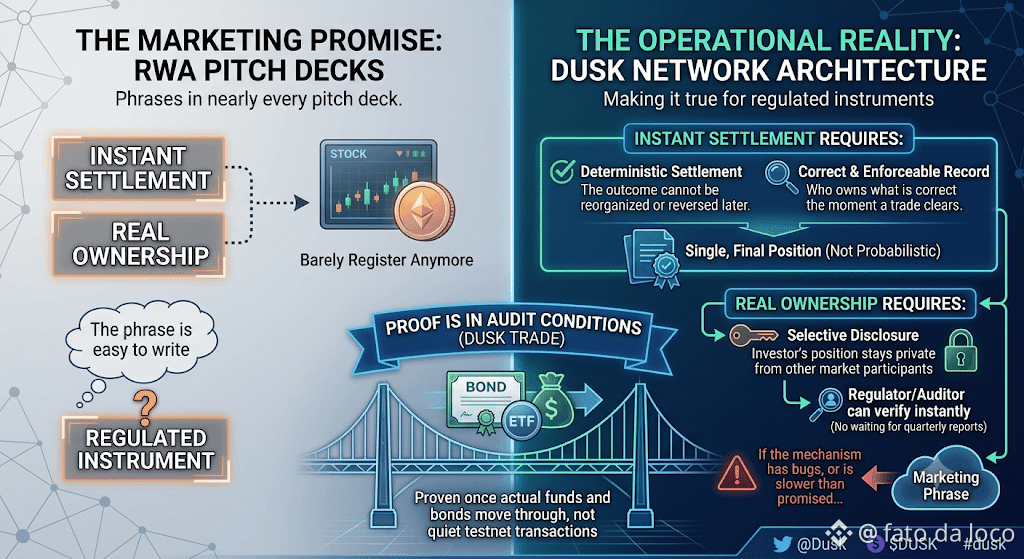
Most blockchains ask you to wait. Bitcoin's security model gets stronger with every additional confirmation, which is a polite way of saying no single block is ever really final, only increasingly unlikely to be reversed. For a securities settlement layer, increasingly unlikely is not good enough, and that gap is exactly what Dusk Network's Succinct Attestation was designed to close. Dusk's own founder, Emanuele Francioni, has described the mechanism as a complete overhaul of consensus rather than an incremental tweak, a bold claim worth weighing against how few other chains have adopted anything similar since.
Succinct Attestation replaces probabilistic confirmation with a committee based voting process. Provisioners staking DUSK are selected through deterministic sortition into a small committee for each block, that committee proposes and votes using aggregated signatures, and once a block clears the agreement phase it is attested, not merely likely. That deterministic settlement is one half of what Dusk calls programmable privacy, the other being the confidential transactions layered on top of it. There is no reorg risk hanging over a transaction an hour later the way there is on longer, probabilistic chains. For anyone trying to settle a bond trade or a tokenized equity transfer, that difference is not academic, it is the entire reason a traditional institution could sign off on using a public chain at all.
The trade-off is one Dusk rarely advertises as loudly as the speed benefit. Small, rotating committees are more efficient than requiring broad simultaneous participation across the whole validator set, but efficiency and decentralization tend to pull in opposite directions in any consensus design. Dusk's own team frames the design as resilient with a fraction of the participation other chains need, and that may well be true. That concentration is still the price paid for finality institutions actually need.
#dusk $DUSK @Dusk
Succinct Attestation replaces probabilistic confirmation with a committee based voting process. Provisioners staking DUSK are selected through deterministic sortition into a small committee for each block, that committee proposes and votes using aggregated signatures, and once a block clears the agreement phase it is attested, not merely likely. That deterministic settlement is one half of what Dusk calls programmable privacy, the other being the confidential transactions layered on top of it. There is no reorg risk hanging over a transaction an hour later the way there is on longer, probabilistic chains. For anyone trying to settle a bond trade or a tokenized equity transfer, that difference is not academic, it is the entire reason a traditional institution could sign off on using a public chain at all.
The trade-off is one Dusk rarely advertises as loudly as the speed benefit. Small, rotating committees are more efficient than requiring broad simultaneous participation across the whole validator set, but efficiency and decentralization tend to pull in opposite directions in any consensus design. Dusk's own team frames the design as resilient with a fraction of the participation other chains need, and that may well be true. That concentration is still the price paid for finality institutions actually need.
#dusk $DUSK @Dusk