

When it comes to stock trading, rely on Golden Qilin’s analyst reports—authoritative, professional, timely, and comprehensive—to help you uncover potential themes and opportunities!
(Source: CarNewsChina)
CarNewsChina (WeChat official account: chedongxi)
By | Janson
Edit | Zhihao
Xpeng VLA to go overseas; the company’s comprehensive gross margin exceeds 20%.
On August 24, CarNewsChina reported that just now, Xpeng Motors released its 2026 Q2 earnings report. Afterwards, Xpeng’s Chairman and CEO He Xiaopeng, Xpeng’s Vice Chairman and Co-President Gu Hong and other management attended Xpeng’s 2026 Q2 earnings conference call.
During the call, XPeng’s management mainly answered questions about taking VLA overseas, humanoid robot technology and commercialization, among others, with a focus on four key questions:
1. Taking VLA overseas: XPeng is advancing VLA overseas regulatory preparation and localization testing, and is exploring a software subscription model. At present, multiple partners are discussing taking technologies such as VLA to global markets.
2. Robot gross margin: He Xiaopeng expects that IRON’s hardware gross margin will be far higher than XPeng’s current automotive business, and that AI models, software services, and subscriptions will also bring in additional revenue.
3. Synergy of embodied intelligence technologies: Most capabilities of models such as XPeng’s VLA and VLM can be shared with robots, and the robot’s thinking models and other technologies in the future can also feed back into cars.
4. Robotics business may operate independently: XPeng expects that after the robotics business completes scale ramp-up, it may achieve profitability faster than the automotive business. In the future, the robotics business may gradually operate independently, but it will still be included in XPeng Group’s consolidated financial statements.
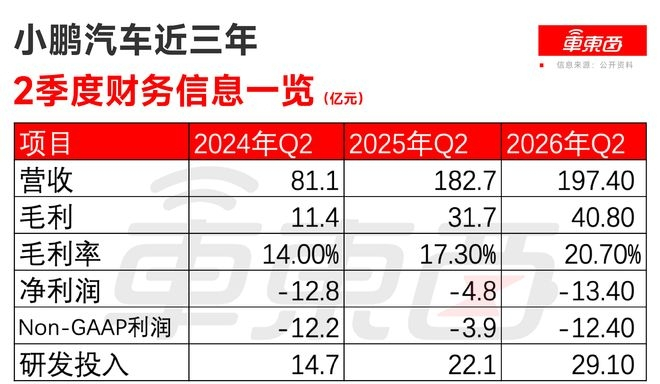
In the second quarter of 2026, XPeng delivered 103.3 thousand vehicles, up 0.1% year over year and up 64.8% quarter over quarter; total revenue was RMB 19.74 billion, up 8.0% year over year and up 51.5% quarter over quarter.
In terms of profitability, XPeng Automobile’s gross profit in the second quarter was RMB 4.08 billion, up 28.9% year over year; the overall gross margin was 20.7%, up 3.4 percentage points year over year, exceeding 20% for two consecutive quarters.
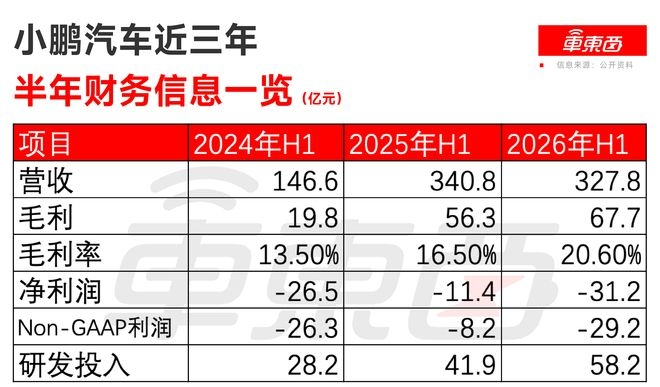
Over the entire first half of the year, XPeng delivered 1.66 million vehicles in total, down 15.8% year over year; cumulative total revenue was about RMB 32.78 billion, down 3.8% year over year; net loss was about RMB 3.12 billion, versus net loss of about RMB 1.14 billion in the same period last year.
Overall, in the second quarter, XPeng Automobile’s delivery volume and revenue both achieved a substantial quarter-over-quarter increase, and its overall gross margin has also exceeded 20% for two consecutive quarters.
1. Robot hardware gross margin will be higher than that of cars: VLA explores overseas subscription models
During the earnings call, XPeng Automobile’s management focused on responding to issues including IRON’s costs and gross margin, technical synergy between robots and the automotive business, data closed-looping, taking VLA overseas, and profitability of the robotics business.
As can be seen, the market’s current focus on XPeng Automobile is mainly on embodied intelligence, and the questions are mostly concentrated in this area. Based on the contents of this earnings call, Car News China has compiled the following five key Q&As:
1. How does IRON price itself? After mass production, what levels are expected for costs and gross margin?
He Xiaopeng, Chairman and CEO of XPeng Automobile, said that to balance innovation, quality, and production capacity, XPeng designed and developed IRON’s native hardware platform and software system in-house.
At present, more than 85% of IRON’s supply-chain partners overlap with XPeng’s automotive business, so XPeng believes IRON’s cost competitiveness will be at an industry-leading level.
On pricing, the selling price of robot products in China is typically about 2.5 to 3 times the cost of hiring a nanny. IRON is positioned as a general-purpose humanoid robot with broad application scenarios, and its initial supply is relatively scarce, giving it significant room for pricing.
He Xiaopeng expects IRON hardware gross margin to be significantly higher than XPeng’s current automotive business. In addition to selling robot hardware, XPeng will also generate revenue through AI models, software services, and subscriptions, further improving the overall revenue and profit level of the robotics business.
2. Which models can be shared between robotics and intelligent driving? Which capabilities need to be developed independently?
He Xiaopeng believes that, at this stage, it is not realistic to solve all robot problems by relying on a single large model. A robot at least needs three types of models with different speeds: one kind is an ultra-fast model running 100 frames per second to several hundred frames per second; another runs at a medium speed—10 to 20 frames per second, for example an autonomous-driving model; and the third is a slow thinking model running at about 1 frame per second.
Most capabilities of models such as XPeng’s VLA and VLM can be shared with robots.
For example, XPeng is developing a vehicle feature such as roaming in non-navigation roads like underground parking lots, which is similar to the underlying logic of robots’ autonomous roaming in indoor scenarios in the future.
Meanwhile, robotics technology can also feed back into cars. Capabilities such as robot thinking models, VOT models, and open-platform functions may also be applied to XPeng vehicles in the future.
However, the robot still needs to independently develop models for whole-body motion control, data privacy protection, anti-fall protection, low-battery protection, and more.
The car and robotics businesses will jointly develop underlying capabilities such as world-model simulation and generative models, and will share AI infrastructure, data management, and organizational systems.
3. Compared with robotics startups, what advantages does XPeng have in data collection and closed-loop iteration?
He Xiaopeng said that data will be the core for physical AI to form differentiated capabilities, but having enough data is only a necessary condition, not a sufficient one. Data quality, diversity management, and training capabilities are even more important.
XPeng has about 10 years of experience in autonomous-driving R&D and data usage, and has built a complete closed-loop from data collection, management, and training to application.
At present, XPeng’s robotics and automotive businesses basically share the same data management, model training, and application system; the main differences are in the data-collection methods and collection hardware.
As IRON is the first to enter mass production and real-world scenarios, XPeng can collect more real-world data and human demonstration data. XPeng hopes to form a “data—model—application” flywheel with high-quality data, accelerating IRON’s iteration in the real world.
He Xiaopeng also mentioned that low-quality data may reduce model accuracy, so XPeng will not simply pursue data scale; it will place more emphasis on data quality and actual application value.
4. When will VLA land overseas? Will it adopt a subscription model?
He Xiaopeng said that the MONA L03 equipped with the Turing AI chip has already been launched overseas.
After that, XPeng will plan overseas versions for all newly released models; hardware with VLA capabilities will cover the MONA L03 and subsequent models and markets.
At present, XPeng’s VLA overseas rollout is progressing smoothly, and the company is pushing ahead with regulatory preparation and localization testing.
In terms of business model, XPeng is exploring a software subscription model and will release specific plans at an appropriate time.
In addition, XPeng has already set up a related BD team, and multiple partners are currently discussing with XPeng how to take VLA and other technology capabilities to global markets.
5. When will the robotics business become profitable? Will it be disclosed separately from the automotive business in the future?
XPeng Automobile’s vice chairman and co-CEO, Gu Haotong, said that it is still too early to determine the specific timeline for when the robotics business will become profitable and the break-even sales volume.
At this stage, XPeng Group’s focus is to build mass-production capability for robots by the end of 2026—deploying first in the company’s internal scenarios, and then gradually selling to external customers.
XPeng Group expects that the gross margin of humanoid robot hardware will be significantly higher than that of its automotive business, and that the gross margin of related revenues such as software will be even higher.
At the same time, the investments and capital expenditures required for the robotics business are less than those for the automotive business, so after completing scale ramp-up, the speed to reach profitability may be faster than that of the automotive business.
In terms of business relationship, XPeng Automobile and the robotics business are still jointly operated and have not completed separation. According to related financing arrangements, XPeng has about 18 months to gradually build the robotics business’s independent operating capability.
Gu Haotong said that as the robotics business gradually matures in areas such as AI, advanced manufacturing, power systems, supply chain, mass production, and commercialization, the company will further consider a more suitable approach to separating businesses.
II. Second-quarter revenue of RMB 19.7 billion; gross margin above 20%
In the second quarter this year, XPeng Automobile’s total revenue was RMB 19.74 billion, up 8.0% year over year, and up 51.5% quarter over quarter.
Among them, automotive sales revenue was RMB 17.05 billion, up 1.0% year over year and up 55.0% quarter over quarter; services and other revenue was RMB 2.70 billion, up 93.9% year over year and up 32.6% quarter over quarter.
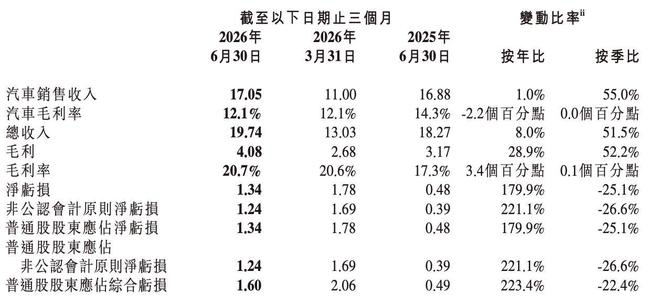
XPeng Automobile said that growth in services and other revenue is mainly because the company provides technology R&D services to automakers and reached several important milestones in the second quarter, while revenue from parts and accessories sales also increased.
In the second quarter, XPeng Automobile’s gross profit was RMB 4.08 billion, up 28.9% year over year; the overall gross margin reached 20.7%, higher than 17.3% in the same period last year and 20.6% in the first quarter.
Regarding automotive gross margin, XPeng Automobile’s automotive gross margin in the second quarter was 12.1%, lower than 14.3% in the same period last year and flat versus the first quarter.
XPeng said that the year-over-year decline in automotive gross margin was mainly due to product-generation transition.
Compared with the automotive business, XPeng’s profit margin from services and other businesses reached 75.1%, higher than 53.6% in the same period last year and 66.5% in the first quarter.
Based on financial-report data, XPeng’s automotive business gross profit in the second quarter was approximately RMB 2.06 billion, and gross profit from services and other businesses was approximately RMB 2.03 billion; the two are basically on par.
This means that, although services and other businesses account for only about 13.7% of total revenue, they contribute nearly half of gross profit, becoming a key factor behind XPeng’s overall gross margin rising above 20%.
In the second quarter this year, XPeng Automobile’s operating loss was RMB 1.14 billion, larger than RMB 930 million in the same period last year, but clearly narrowed compared with RMB 1.87 billion in the first quarter.
On net profit, XPeng Automobile reported a net loss of RMB 1.34 billion in the second quarter, compared with a net loss of RMB 480 million in the same period last year; its net loss was RMB 1.78 billion in the first quarter.
After deducting the fair value gain from share-based payment expenses and contingent consideration derivative liabilities, XPeng Automobile’s non-GAAP net loss in the second quarter was RMB 1.24 billion.
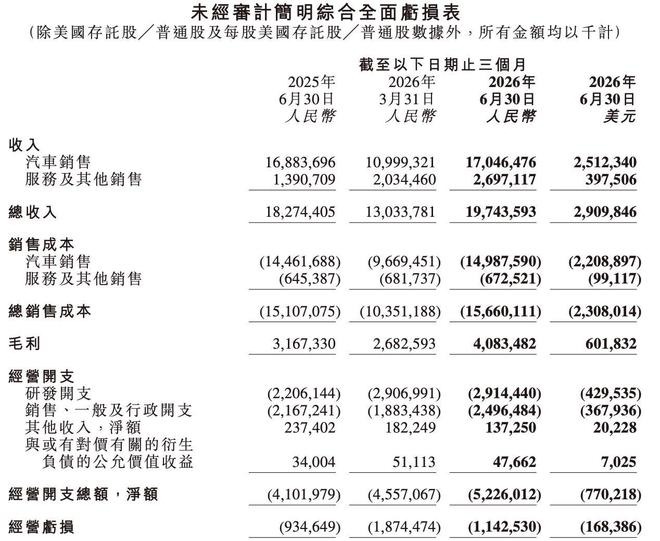
On R&D expenses, XPeng Automobile’s R&D spending in the second quarter was RMB 2.91 billion, up 32.1% year over year, mainly due to higher spending on new model and AI-related technology development.
In the first half of 2026, XPeng Automobile’s total revenue was approximately RMB 32.78 billion, down about 3.8% year over year; gross profit was about RMB 6.77 billion, up 20.2% year over year; the overall gross margin was about 20.6%, up about 4.1 percentage points compared with the same period last year.
For the same period, XPeng Automobile’s R&D spending was about RMB 5.82 billion, up about 39% year over year; operating loss was about RMB 3.02 billion, net loss was about RMB 3.12 billion, and net loss in the same period last year was RMB 1.14 billion.
Note: Semi-annual revenue, gross profit, net profit, adjusted net profit, and R&D expenditure are all calculated by summing XPeng’s quarterly data from its first and second-quarter reports for each year; the semi-annual gross margin is calculated as semi-annual gross profit divided by semi-annual revenue.
III. 166,000 new cars delivered in the first half of the year; gearing up further for the robotics business
This year’s second quarter, XPeng delivered 103,295 vehicles in total, up slightly by 0.1% year over year; compared with 62,682 vehicles in the first quarter, deliveries increased 64.8% quarter over quarter.
In the first half of 2026, XPeng Automobile delivered 165,977 vehicles in total, down about 15.8% from 197,189 vehicles in the same period last year.
In July this year, XPeng Automobile delivered 38,027 vehicles, and累计 deliveries for the first seven months reached 204,004 vehicles.
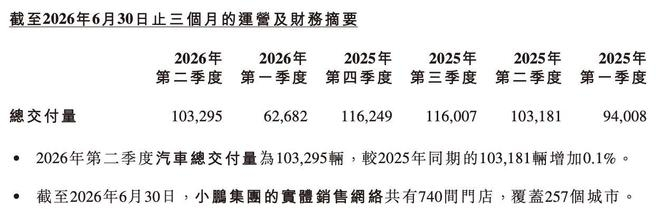
As of June 30, 2026, XPeng Automobile had 740 physical sales stores covering 257 cities. Its self-operated charging stations totaled 3,780, including 2,720 XPeng super-fast charging stations.
For the third quarter, XPeng Automobile expects to deliver 115,000 to 121,000 vehicles, a year-over-year change of approximately -0.87% to +4.30%, and quarter-over-quarter growth of about +11.33% to +17.14%.
XPeng Automobile expects total revenue in the third quarter to be RMB 21.7 billion to RMB 23.4 billion, up about 6.47% to 14.81% year over year, with quarter-over-quarter growth of about 9.91% to 18.52%.
As of June 30, 2026, XPeng Automobile had cash on hand of RMB 40.48 billion, down RMB 1.61 billion from the end of the first quarter’s RMB 42.09 billion.
On new business, the financial report shows that XPeng Robotics’ R&D for the mass-production version has recently achieved multiple important milestones.

On August 24, XPeng’s robotics business entity Dogotix entered into a share purchase agreement with multiple subscribing parties. The relevant subscribers conditionally agreed to subscribe for newly issued shares of Dogotix, with a total consideration of USD 900 million (approximately RMB 6.12 billion).
He Xiaopeng, Chairman and CEO of XPeng Automobile, said that XPeng hopes to become a global leading physical AI company, promoting large-scale application and commercialization of high-level general-purpose humanoid robotics and autonomous driving technology in both domestic and overseas markets.
Conclusion: Beyond automobiles, XPeng is betting on multiple businesses
In the second quarter, XPeng’s delivery volume and revenue both achieved a substantial quarter-over-quarter increase; its net loss narrowed quarter over quarter, and its overall gross margin has exceeded 20% for two consecutive quarters.
However, in the first half of the year, XPeng’s delivery volume and revenue still declined year over year. Meanwhile, technology R&D services and parts/accessories sales have been growing rapidly. Services and other businesses contributed nearly half of quarterly gross profit, becoming an important driver of XPeng’s rise in overall gross margin.
Next, whether XPeng can rely on new models to increase sales and vehicle-level gross margin, and also drive commercialization of technology services, overseas business, and physical AI business, will be key to narrowing losses and moving toward profitability.