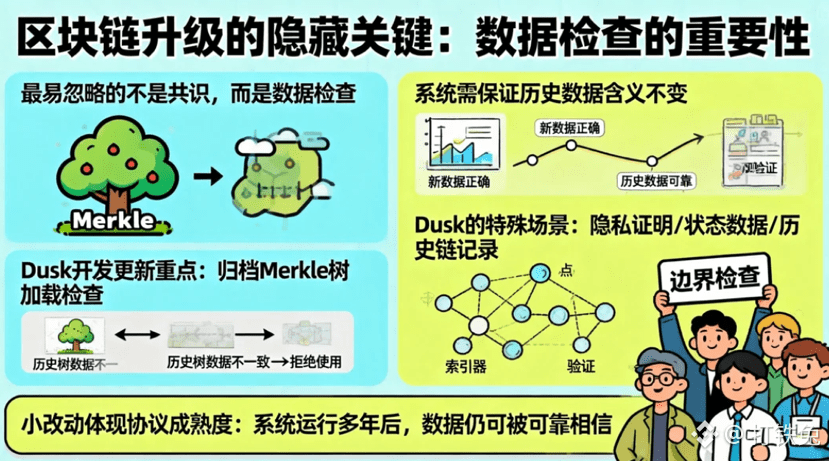
When I watched blockchain upgrades before, what I was most likely to overlook wasn’t consensus—it was those seemingly boring data integrity checks.
This time, when I was looking at Dusk’s recent development updates, I paused at the Merkle part.
The official team recently specifically strengthened the load-time checks for archived Merkle trees:
If the historical tree data is inconsistent, the system simply refuses to continue using it.
At first glance, it really doesn’t have much of a “narrative.”
But I actually think this kind of change is worth studying more than adding yet another new feature.
Because one of the biggest headaches in blockchains is that the system can’t just ensure that “new data is correct.”
It also has to ensure that:
**the meaning of data that was written in the past must not silently change when it’s read again today.**
Especially for a network like Dusk, which needs to handle privacy proofs, state data, and historical on-chain records—archived data isn’t just a simple file.
It may continue to be used by nodes, indexers, and validation processes.
Once historical data has a problem, the truly troublesome part isn’t a specific interface throwing an error.
Instead, it’s that different components may start believing different versions of the state.
In the past, I was more accustomed to judging a chain based on big metrics like TPS, finality, or ZK.
But now I feel that what can truly show protocol maturity—sometimes—is this kind of small change that nobody wants to use for marketing.
Because it shows the development team has started addressing a very real problem:
**It’s not “whether the system can run,” but “whether, after the system runs for years, the past data can still be relied on.”**
This is also the kind of update I’ve come to like when I recently revisited Dusk.
No grand narrative.
No flashy data.
Just adding stricter boundary checks to a historical Merkle tree.
But if this kind of thing is done poorly, everything built on top of historical state could become a mess later.
So when I judge a chain now, I don’t pay attention only to how many new features it has released.
I also look at whether it’s willing to spend time dealing with problems that nobody will clap for at a press conference.
For infrastructure, real reliability often hides in details like this.
#dusk $DUSK @Dusk