Recently watching Dusk, I started to feel that what the next phase of RWA truly needs to solve may not be “how to issue assets,” but rather how those assets circulate after they are issued.
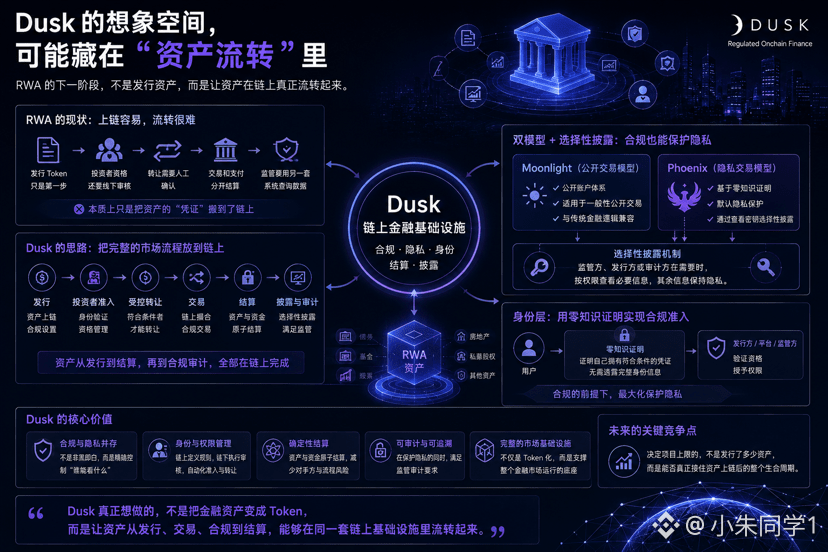
Right now, many projects that talk about RWA focus mainly on turning bonds, funds, stocks, and even real estate into tokens. But tokenization is only the first step. If an asset is put on-chain, investors still need offline eligibility checks; transfers still require manual confirmations; trading and payments are settled separately; and regulators need yet another system to query data—then, at its core, all that’s really happening is moving the asset’s “certificate” onto the blockchain. What’s genuinely interesting about Dusk is that it begins to shift attention to the complete market lifecycle. Who can hold the asset, who can transfer it, which information is public and which is confidential, and how the asset and funds complete settlement—all of these can become on-chain rules. Dusk’s official documentation even puts issuance, investor eligibility, controlled transfer, trading, settlement, and disclosure into a single workflow. (DOCS) This is also why I’ve been valuing Dusk more and more.
It hasn’t treated privacy and compliance as two mutually conflicting directions. Moonlight handles public trading, Phoenix handles privacy trading, and then—through selective disclosure—allows regulators, issuers, or auditors to obtain the necessary information when needed. (DOCS) Even for identity, Dusk is trying to solve it with zero-knowledge proofs: users can prove that they hold credentials that meet the conditions without directly writing their full identity information onto the chain. (DOCS)
So now I feel that what Dusk truly wants to do isn’t “turn financial assets into tokens.” Instead, it wants assets to run end-to-end—from issuance, to trading, to compliance, to final settlement—on a single set of on-chain infrastructure. If, in the future, RWA truly enters mass adoption, what will determine a project’s ceiling may not be how many assets it can issue.
It will be who can truly handle the entire lifecycle after an asset is put on-chain. That’s what I think makes Dusk most worth continuing to watch.
#dusk $DUSK @Dusk
Right now, many projects that talk about RWA focus mainly on turning bonds, funds, stocks, and even real estate into tokens. But tokenization is only the first step. If an asset is put on-chain, investors still need offline eligibility checks; transfers still require manual confirmations; trading and payments are settled separately; and regulators need yet another system to query data—then, at its core, all that’s really happening is moving the asset’s “certificate” onto the blockchain. What’s genuinely interesting about Dusk is that it begins to shift attention to the complete market lifecycle. Who can hold the asset, who can transfer it, which information is public and which is confidential, and how the asset and funds complete settlement—all of these can become on-chain rules. Dusk’s official documentation even puts issuance, investor eligibility, controlled transfer, trading, settlement, and disclosure into a single workflow. (DOCS) This is also why I’ve been valuing Dusk more and more.
It hasn’t treated privacy and compliance as two mutually conflicting directions. Moonlight handles public trading, Phoenix handles privacy trading, and then—through selective disclosure—allows regulators, issuers, or auditors to obtain the necessary information when needed. (DOCS) Even for identity, Dusk is trying to solve it with zero-knowledge proofs: users can prove that they hold credentials that meet the conditions without directly writing their full identity information onto the chain. (DOCS)
So now I feel that what Dusk truly wants to do isn’t “turn financial assets into tokens.” Instead, it wants assets to run end-to-end—from issuance, to trading, to compliance, to final settlement—on a single set of on-chain infrastructure. If, in the future, RWA truly enters mass adoption, what will determine a project’s ceiling may not be how many assets it can issue.
It will be who can truly handle the entire lifecycle after an asset is put on-chain. That’s what I think makes Dusk most worth continuing to watch.
#dusk $DUSK @Dusk