The concept of RWA has been talked about for a full three years, with whitepapers piled up like mountains—but only a handful of projects have truly gotten running. While researching Dusk, I finally understood something: this track isn’t lacking narrative; it’s being pinned down by three big mountains, and on each mountain there are countless bodies left behind by those who came before.
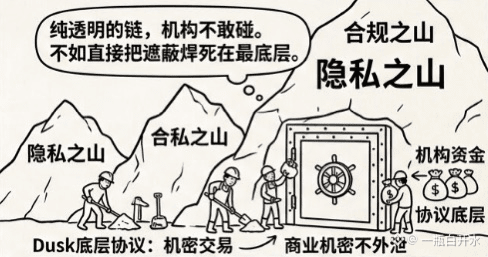
The first mountain is privacy. Institutions don’t want to be on-chain, they’re afraid to. Once positions and strategies are made public, competitors can front-run, customer flows disappear, and trade secrets are wiped out. That’s why Dusk embeds confidential transactions into the protocol’s underlying layer—it doesn’t expect institutions to change their habits; instead, it directly “welds in” the concealment that institutions demand into the base infrastructure.
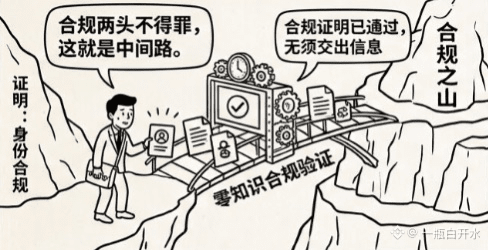
When you flip past privacy comes compliance. How many RWA projects have died at the checkpoints of licensing and KYC? If the issuance isn’t compliant, they don’t dare to touch institutional funds. If they are compliant, they end up excluding crypto users. Dusk’s zero-knowledge compliance provides a middle path: using cryptographic proofs instead of identity materials, fulfilling compliance obligations as required, and not sharing identity information—so neither side is offended.
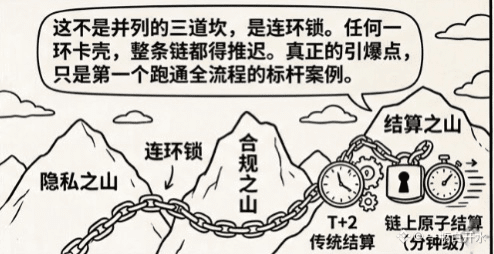
What crushes everything at the end is settlement. Traditional finance settlement starts at T+2, and cross-border is even slower—every intermediary charges fees. On-chain atomic settlement can compress days into the minutes-level, but only if privacy and compliance are already cleared. Otherwise, no matter how efficient it is, nobody will dare to use it. This is the real relationship among the three mountains—not three parallel hurdles, but a chain lock. If you can’t get past the first one, the next two simply won’t even get to be faced.
The solution set is logically coherent and self-consistent. But the other side of a chain lock is chain risk: if any link in the implementation stalls, the entire chain’s value realization gets pushed back as a whole. A track that hasn’t exploded in three years won’t suddenly take off just because of a beautifully drawn architecture diagram. The true ignition point will only be the first benchmark case that successfully runs the entire flow end to end.
So I don’t predict when RWA will explode. I only recognize signals. Until the first institutional case that fully runs from issuance through settlement appears, any “it’s about to explode” narrative is just fortune-telling. Where do you think the final straw that breaks the camel’s back will loosen first?” #dusk $DUSK @Dusk
The first mountain is privacy. Institutions don’t want to be on-chain, they’re afraid to. Once positions and strategies are made public, competitors can front-run, customer flows disappear, and trade secrets are wiped out. That’s why Dusk embeds confidential transactions into the protocol’s underlying layer—it doesn’t expect institutions to change their habits; instead, it directly “welds in” the concealment that institutions demand into the base infrastructure.
When you flip past privacy comes compliance. How many RWA projects have died at the checkpoints of licensing and KYC? If the issuance isn’t compliant, they don’t dare to touch institutional funds. If they are compliant, they end up excluding crypto users. Dusk’s zero-knowledge compliance provides a middle path: using cryptographic proofs instead of identity materials, fulfilling compliance obligations as required, and not sharing identity information—so neither side is offended.
What crushes everything at the end is settlement. Traditional finance settlement starts at T+2, and cross-border is even slower—every intermediary charges fees. On-chain atomic settlement can compress days into the minutes-level, but only if privacy and compliance are already cleared. Otherwise, no matter how efficient it is, nobody will dare to use it. This is the real relationship among the three mountains—not three parallel hurdles, but a chain lock. If you can’t get past the first one, the next two simply won’t even get to be faced.
The solution set is logically coherent and self-consistent. But the other side of a chain lock is chain risk: if any link in the implementation stalls, the entire chain’s value realization gets pushed back as a whole. A track that hasn’t exploded in three years won’t suddenly take off just because of a beautifully drawn architecture diagram. The true ignition point will only be the first benchmark case that successfully runs the entire flow end to end.
So I don’t predict when RWA will explode. I only recognize signals. Until the first institutional case that fully runs from issuance through settlement appears, any “it’s about to explode” narrative is just fortune-telling. Where do you think the final straw that breaks the camel’s back will loosen first?” #dusk $DUSK @Dusk