


459 days ago, Xiaomi released the SUANJIE O1, returning to the table of flagship phone SoCs. 459 days later, not only has the SUANJIE O3 arrived, it has also brought along more “brothers.”
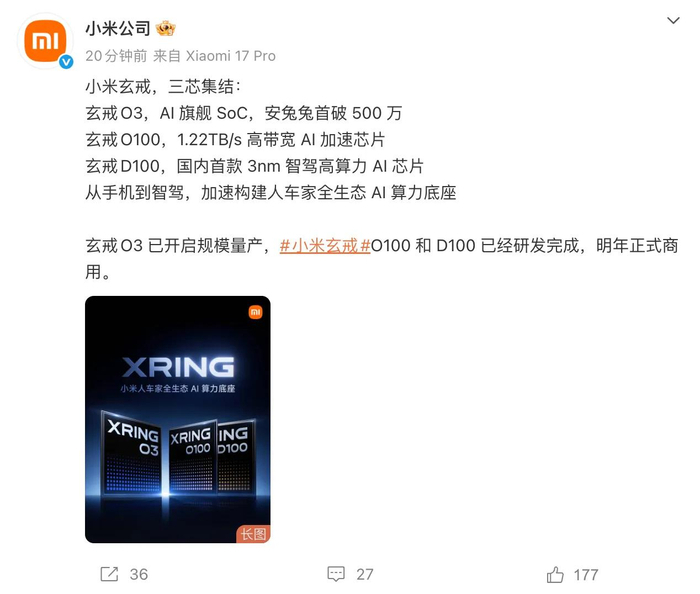
On the afternoon of August 24, Xiaomi held a technology communication meeting on its SUANJIE chips. The负责人 of the SUANJIE chip, Zhu Dan, announced three self-developed chips in one go: the SUANJIE O3 for flagship smartphones, the SUANJIE O100 AI acceleration chip designed for on-device large models, and the SUANJIE D100 high-compute intelligent driving chip for automobiles.
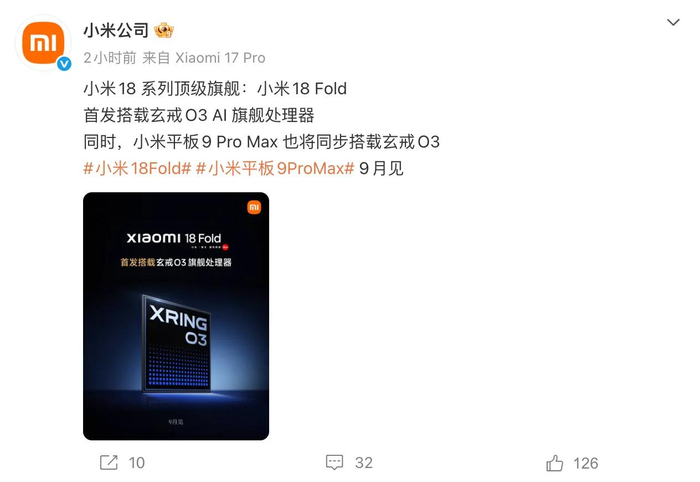
Among them, the SUANJIE O3 will be launched first on Xiaomi’s new-generation wide-folding 18 Fold, and will be officially released in September. As for the other two, their development has already been completed, and they are planned for official commercial use next year.
According to Lu Weibing’s previous disclosure, the Zepon O1 has cumulative shipments of over one million units across three terminals, and the Zepon will maintain an iteration speed of one generation per year. Lei Jun has also said that since Xiaomi restarted big-chip development in 2021, it plans to invest at least ten years and at least RMB 50 billion (or 50 billion yuan). As of April 2025, Xiaomi’s cumulative R&D investment in the Zepon has already exceeded RMB 13.5 billion.
The appearance of O3, O100, and D100 clearly shows that Xiaomi is still firmly investing in developing its own chips. On the other hand, clearly one O3 can’t solve all these issues; it needs a more flexible roadmap and more Zepon chips. Especially in the context of “Xiaomi Zepon” becoming the AI compute-power foundation for Xiaomi’s “people-car-home” full ecosystem.
But for users, and for Xiaomi, the Zepon O3 is still the most important chip today—and the focus of this Leitech (ID: leitech) article.
The upgrade of the Zepon O3: not just bigger or faster
Based on the published specifications, the Zepon O3 is still a highly aggressive flagship SoC. It continues to use a 3nm process, with transistor count increasing from 19 billion in O1 to 24 billion, and the chip area reaching about 133mm².
Xiaomi isn’t rushing to squeeze down area and cost. It still chooses to leave plenty of room for performance.
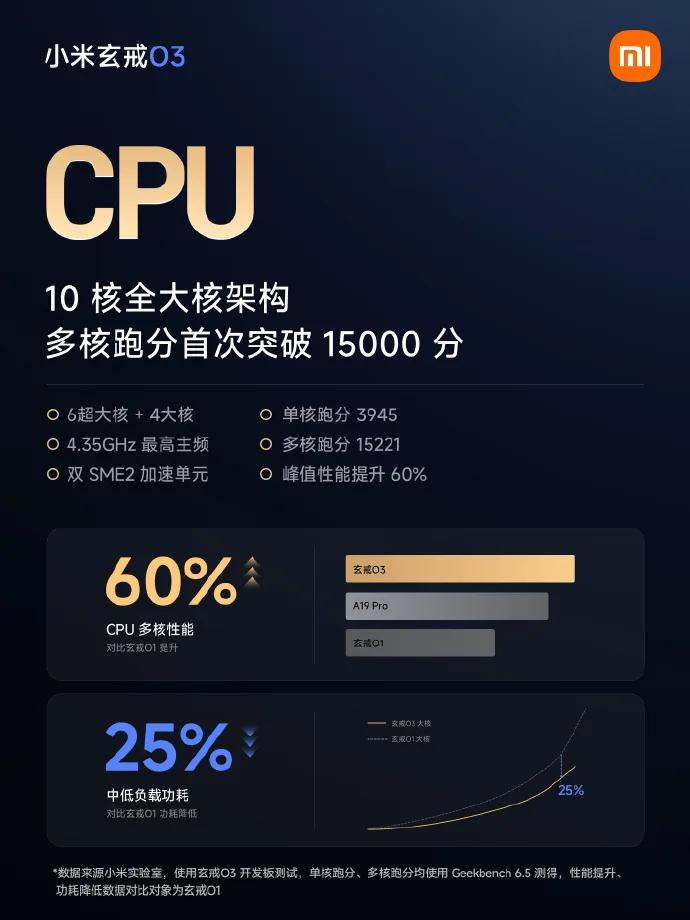
The CPU changes are even more obvious. The Zepon O1 uses a 10-core quad-cluster design, including a Cortex-X925 super-big core, A725 performance cores, and A520 small cores. By the time of O3, Xiaomi redesigned the entire CPU cluster combination, adopting Arm’s new-generation C1-series IP, forming a 10-core all-big-core architecture with 6 super-big cores and 4 big cores, with a maximum clock frequency up to 4.35GHz.
According to Xiaomi’s provided data, the Zepon O3’s CPU performance is up 60% compared with O1, while power consumption at mid-to-low loads is reduced by 25%.
In the past, the common approach for phone SoCs was to have small cores handle background tasks and light workloads, then gradually take over heavier jobs through big cores and super-big cores. But from Arm’s C1 to recent generations of Dimensity chipsets, mobile processors have been trying to cover a wider performance range with more energy-efficient big cores.
Xiaomi clearly made its own choice. The code dug out from Mi Code beforehand already exposed things early. Codenamed “lhasa,” the Zepon O3 will change from O1’s four-cluster design to a three-cluster setup, and its core frequencies are also comprehensively increased. Looking back now, those codes already left outlines of O3.
The O3’s GPU is also significantly upgraded. At launch it features a 16-core G2-Ultra NX graphics processor. Compared with the Zepon O1, performance is up 85%, while power consumption is reduced by 64%.
However, the peak figures at launch are still only a reference. Xiaomi’s published AnTuTu v11 score reached 5,228,014 points, and the test environment is clearly labeled as a low-temperature laboratory. For a phone SoC, how fast it can ultimately run depends on how much performance it can sustain under normal temperatures, normal power limits, and continuous workloads after being installed in the phone.
All of this still needs to wait for real-world testing after the release of Xiaomi 18 Fold and Xiaomi Pad 9 Pro Max.
There is another upgrade on the Zepon O3 that is very easy for CPU benchmark scores to overshadow—memory.
As an industry-first SoC supporting LPDDR6, the Zepon O3 reaches 10,667Mbps. It uses a memory bit-width design of 4×24bit, totaling 96bit, with bandwidth of 113.8GB/s — a 48% improvement over the Zepon O1.
For today’s flagship SoCs, the CPU needs data, the GPU needs data, the imaging ISP needs data, and large models are especially notorious for consuming memory bandwidth. If you pack more compute units into the chip, but the memory and on-chip interconnect can’t keep up, you end up with compute power waiting for data.
So O3 also redesigned a whole “unified integrated bus architecture.” According to Xiaomi, this protocol can connect internal data paths within the chip, and the overhead from protocol conversion can be reduced by up to 75%.
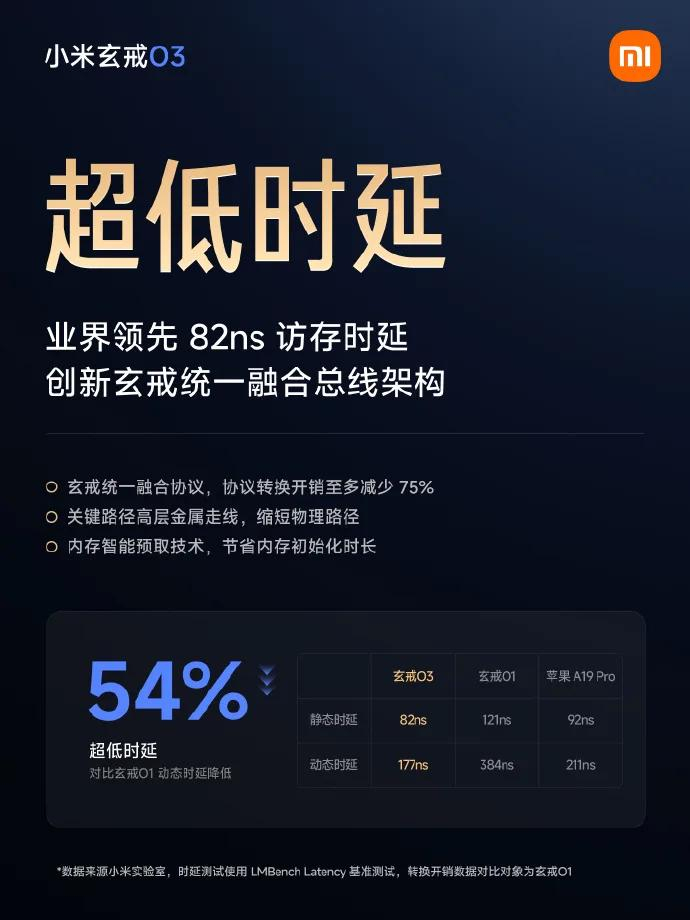
Compute IPs like CPU and GPU can come from Arm, but connecting dozens of different modules so that the CPU, GPU, NPU, ISP, and memory controller exchange data efficiently within limited power and area requires the chip vendor to handle NoC, cache, QoS, scheduling, and bus design themselves.
The Zepon made it to a second generation, and Xiaomi has started putting more effort into this. And this upgrade is a snapshot of how the shift from O1 to O3 exceeded conventional performance upgrades.
O3 has a brand-new name: AI flagship SoC
At this technical communication meeting, Xiaomi’s official positioning for the Zepon O3 was “AI flagship SoC,” and the stated directions for the chip evolution were also very direct:
High energy efficiency, high bandwidth, and high compute power.
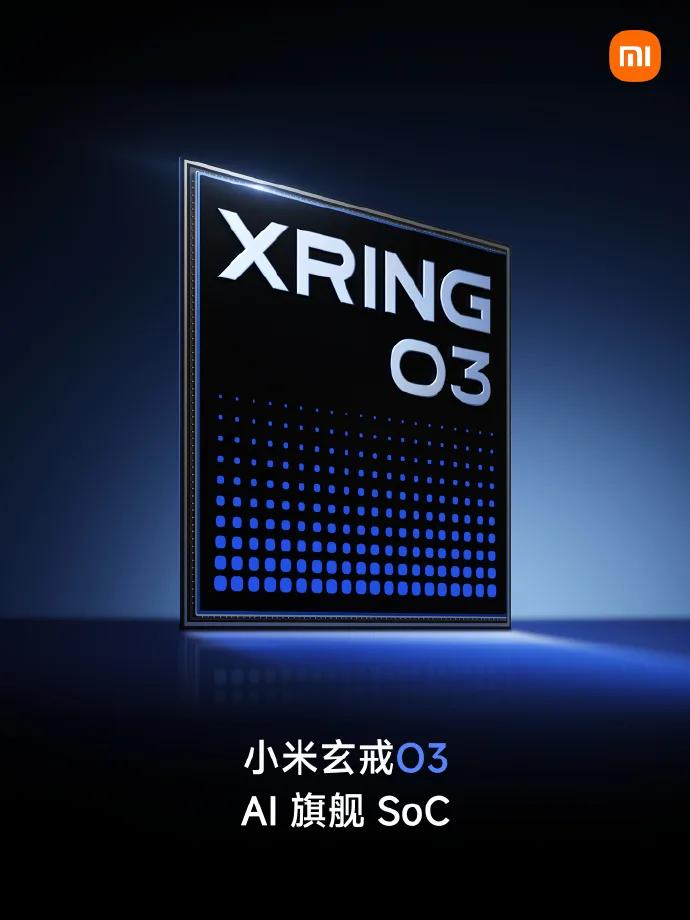
Tracing it back further, the Zepon O3 ultimately points to building an “AI compute-power foundation” for Xiaomi’s people-car-home full-ecosystem terminals.
When the O1 was released, the most discussed topics were 3nm, the CPU and GPU, and whether Xiaomi could make a flagship phone processor again. With O3, Xiaomi started placing the Zepon into a much larger technology blueprint.
This roadmap—Xiaomi has actually been laying it out for over a year already.
As early as March 2025, Lu Weibing made it clear that AI, OS, and chips are Xiaomi’s three core long-term technologies. At that time, Xiaomi planned to invest about one-quarter of its R&D budget—RMB 7 to 8 billion—into AI, covering AI infrastructure, language models, multimodal models, Super Xiao Ai, intelligent cockpits, intelligent driving, and other directions.
In January this year, Lei Jun laid out a more specific goal:
In 2026, Xiaomi is expected to bring together its in-house chips, in-house OS, and in-house AI large model—“the grand assembly”—on a single terminal. Today, all three lines are already moving forward substantially. The chip line is the newly announced O3; the operating system has reached the Paur OS 4; and the large model is the MiMo series.
At Xiaomi’s Q2 earnings call a few days ago, Lu Weibing explained the matter even more clearly. He said Xiaomi’s current AI layout is divided into several lines: the bottom layer is the foundation model MiMo, and from there it extends to phones, the home, cars, and robots.
On the phone line, he clearly stated that Xiaomi wants to comprehensively restructure traditional Android with AI, ultimately evolving toward an “AIOS.” Paur OS 4 is already a step in that direction, as intelligent agents begin to gain execution capabilities.
Xiaomi’s CFO, Lin Shiwei, also disclosed that the token call volume of MiMo-V2.5 reached first globally in weekly and monthly rankings at one point in July this year. Xiaomi is also training a new model and preparing to bring MiMo to PCs. At this stage, Xiaomi is not in a rush to require the AI business to make money. The direction given by management is still to keep investing—so that AI can reshape the “people-car-home full ecosystem.”
Looking back at the Zepon O3, you can understand why Xiaomi now places special emphasis on “high bandwidth” and an “AI compute-power foundation.” Once large models enter terminals, the problems posed to phone chips go far beyond how many TOPS the NPU has.
Running a model involves memory bandwidth, caches, operator support, quantization precision, and power scheduling. Agents also run for a long time, which further involves system permissions, background mechanisms, and calls between different applications. If the chip, system, and model come from different companies, each layer must adapt within the boundaries set by others.
When the Zepon, Paur OS, and MiMo are all in Xiaomi’s own hands, Xiaomi has the opportunity to do genuine autonomous design in return:
What operators does MiMo need, so the NPU can optimize specifically for them;
On-device models need higher bandwidth, so the memory subsystem can be adjusted;
Agents need to run for a long time, so the scheduling can be updated from the chip’s low-power scheduling all the way to the OS backend mechanisms.
This is also a path that Apple has repeatedly proven effective over the past decade or more: keeping chips, operating systems, software, and hardware under the same R&D ecosystem allows product teams to solve problems from the ground up.
Xiaomi’s situation is, of course, somewhat different. Besides phones, there are also tablets, smartwatches, home appliances, cars, and robots that are currently being invested in. One Zepon O3 obviously can’t solve everything, so there are also O100 and D100.
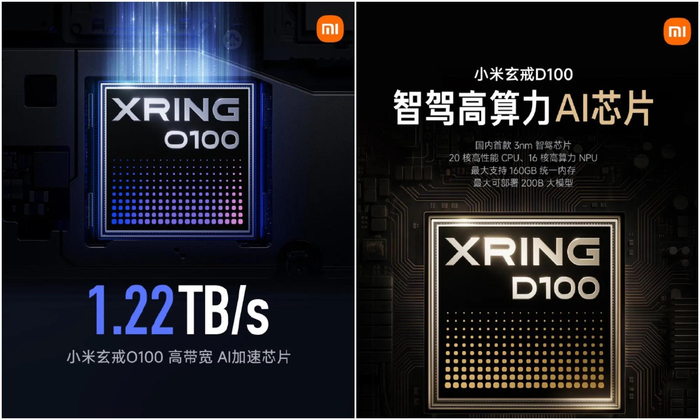
The Zepon O100 is Xiaomi’s first high-bandwidth AI acceleration chip specifically designed for on-device large models. By using 6nm wafer-level vertical stacking and Hybrid Bonding, computation and storage are brought closer together. It achieves 1.22TB/s of memory bandwidth—about 16 times that of traditional flagship mobile phones—and on-device large-model inference speed can reach up to 330 TPS.
The Zepon D100 is the first domestically developed 3nm automotive-driving AI chip, equipped with a 20-core high-performance CPU, a 16-core high-compute NPU, supports up to 160GB of memory, and can deploy on-device large models with up to 200B parameters.
The three chips handle three different workloads, but in the end they all point to the same thing: Xiaomi wants to hold more and more of the AI compute power for “people, cars, and home” in its own hands.
Xiaomi even built an AI Cube engineering machine, in which it installs three chips—the O3, O100, and D100—so it can deploy 120B/3B large models locally. There is currently no plan for it to be sold; it’s more like a “showcase field” Xiaomi uses to validate how the three compute platforms cooperate.
Written at the end
When the Zepon O1 was launched, everyone’s focus was on one thing: Xiaomi has remade a flagship SoC.
A year later, the Xiaomi 15S Pro and two Xiaomi Pad 7 series models have already enabled the Zepon O1 to reach shipments of over one million units. For Apple, Qualcomm, and MediaTek, that’s just a small number. But for Xiaomi, which has only just returned to flagship SoCs, it is truly significant.
But when the new-generation in-house Zepon chips like O3, O100, and D100, along with Paur OS and the MiMo large model, are about to officially “meet up,” Xiaomi is facing an entirely different set of questions—an ultimate interrogation centered on the “people-car-home full ecosystem.”
Today we won’t have an answer. At least we need to wait until Xiaomi brings the Zepon to a much wider range of terminals across the whole ecosystem, so we can, to a certain extent, assess the “quality” of Xiaomi’s long-term technology strategy. But Xiaomi has already brought plenty of surprises—I don’t mind holding even more expectations for them, like Lei Jun’s brand slogan for Xiaomi:
Always believe that wonderful things are about to happen.