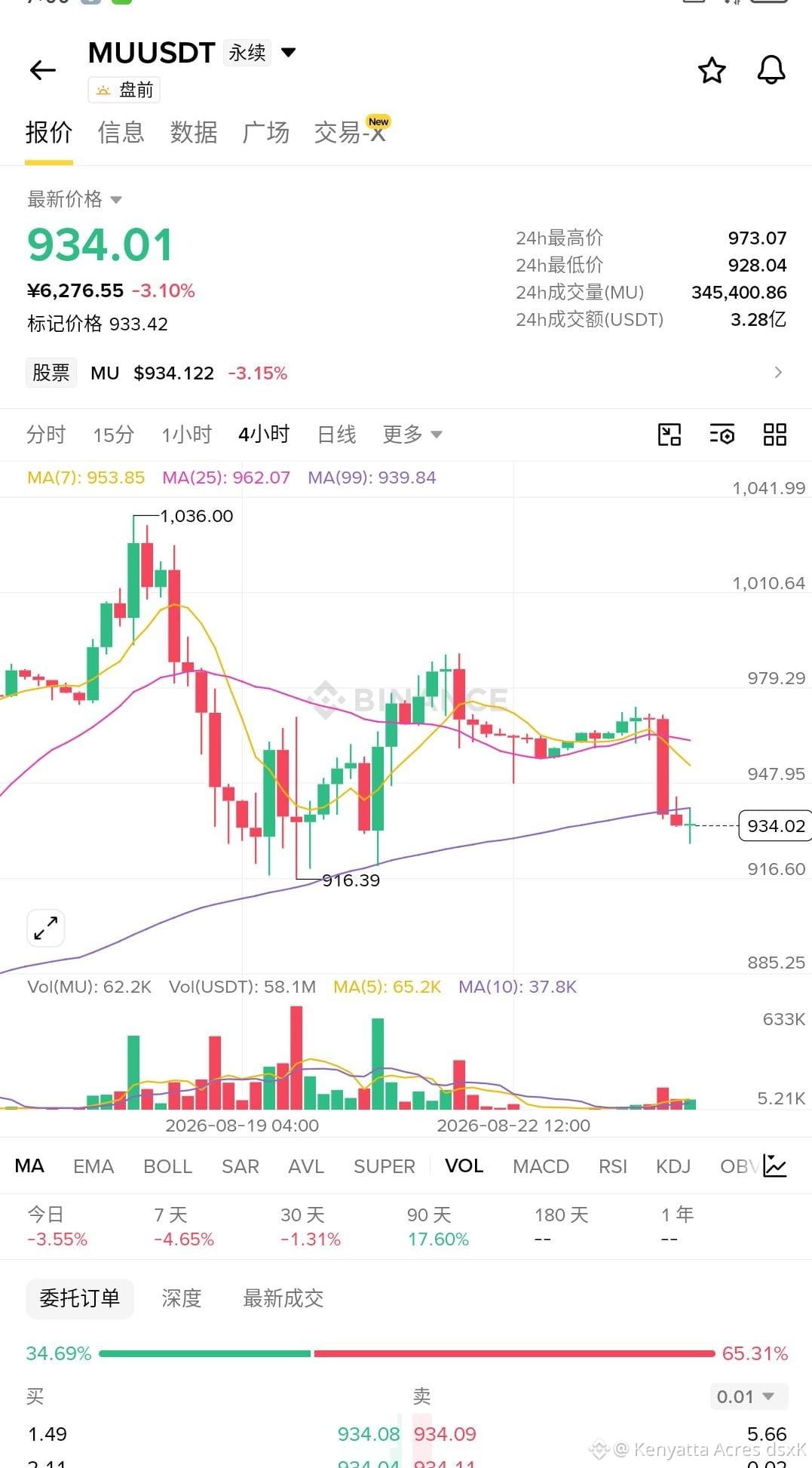
MU on the current chart: the money is going against the price. In the past 24 hours, the price is down 3%. In the four-hour timeframe, there are five bearish candles and one bullish candle; it’s grinding right along the low around 928. Meanwhile, contract open interest is not falling but rising—up 7.6% in a day. The funding rate is still zero. With a drop this deep, the shorts weren’t built by a single sell-off; they were accumulated slowly—not crushed by liquidation. No one is paying to keep the shorts alive.
What’s even more striking is the spot order book: the thickness of a bid order is 2.8 times that of the ask, and the bid-ask spread is only 0.001%. The price keeps slipping lower in a steady downtrend, yet at the low level there’s a buy wall standing firm. Over on the “whale” side, there’s also a disagreement: by number of accounts, small traders are slightly more bearish, but by position size, the larger whales are net long by 57%. These are shorts that are looking to sell into the breakdown from this spot level—while across the way, big money is standing at the lower range ready to receive.
Translate it into trading language: the engine driving this selloff is newly opened leveraged short positions; the fuel is zero funding; and the shorts aren’t crowded at all. Spot bids are thick and the whale positioning is net long, squeezing the downside space from both sides. Shorting at the lower level is exactly running into a wall.
So I’m bullish. As long as 928 isn’t broken, and the price reclaims and holds back above the 20-MA near 936, what gets “squeezed” will be the shorts that have been trapped. Their covering will push the rebound. Going long: below 928 is the line in the sand.
Conditions for a thesis reversal: if there’s a volume expansion and the price breaks down through 928 while open interest continues to rise, it would mean the shorts are truly winning and the buy wall is being eaten. Then I would flip to bearish. #mu $MU
What’s even more striking is the spot order book: the thickness of a bid order is 2.8 times that of the ask, and the bid-ask spread is only 0.001%. The price keeps slipping lower in a steady downtrend, yet at the low level there’s a buy wall standing firm. Over on the “whale” side, there’s also a disagreement: by number of accounts, small traders are slightly more bearish, but by position size, the larger whales are net long by 57%. These are shorts that are looking to sell into the breakdown from this spot level—while across the way, big money is standing at the lower range ready to receive.
Translate it into trading language: the engine driving this selloff is newly opened leveraged short positions; the fuel is zero funding; and the shorts aren’t crowded at all. Spot bids are thick and the whale positioning is net long, squeezing the downside space from both sides. Shorting at the lower level is exactly running into a wall.
So I’m bullish. As long as 928 isn’t broken, and the price reclaims and holds back above the 20-MA near 936, what gets “squeezed” will be the shorts that have been trapped. Their covering will push the rebound. Going long: below 928 is the line in the sand.
Conditions for a thesis reversal: if there’s a volume expansion and the price breaks down through 928 while open interest continues to rise, it would mean the shorts are truly winning and the buy wall is being eaten. Then I would flip to bearish. #mu $MU