I’ve been thinking about a problem with tokenization that doesn’t get enough attention.
Putting an asset on-chain is actually the easy part.
The harder question is: how much of the financial workflow still lives somewhere else?
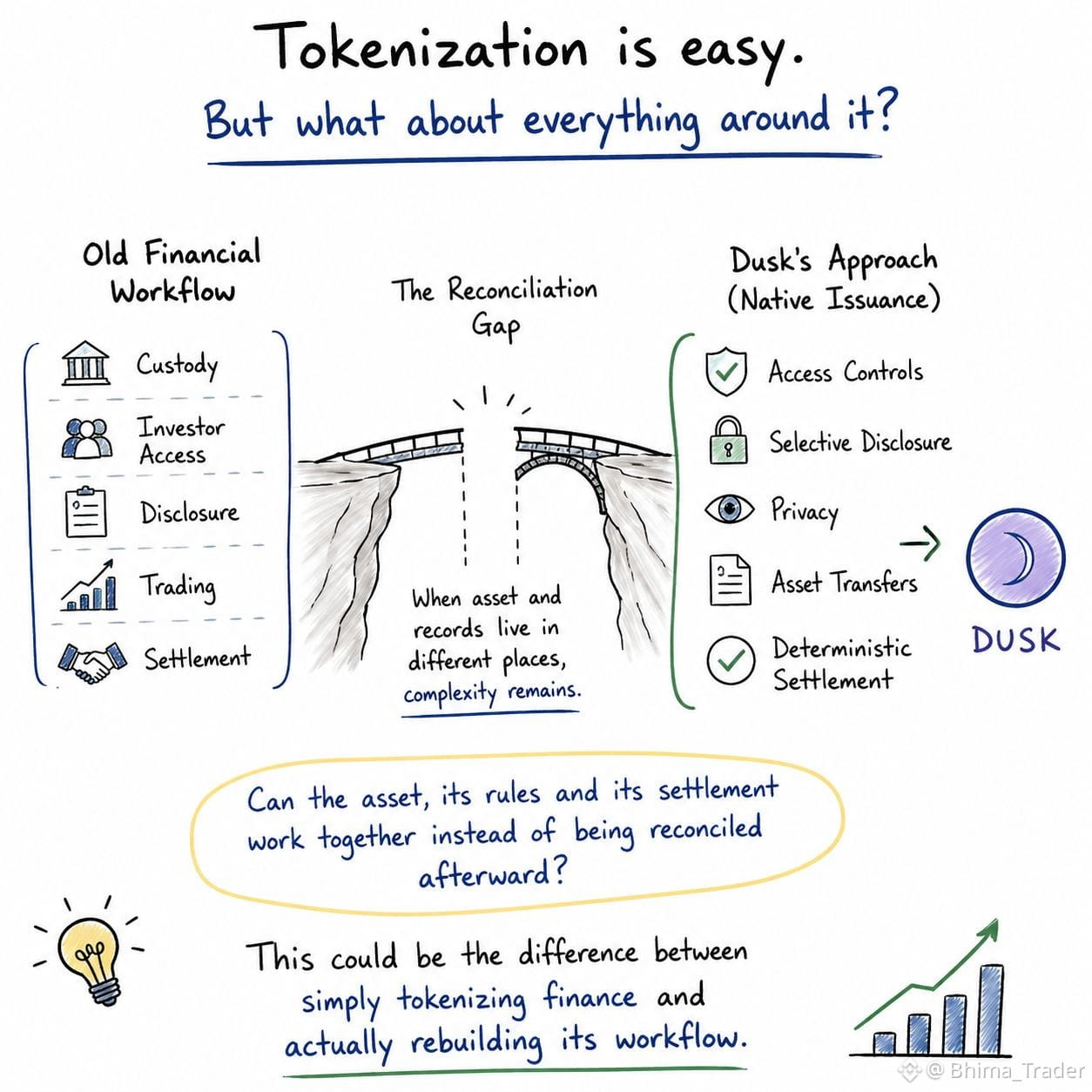
You can tokenize a security, but if custody, eligibility, disclosure, trading and settlement still depend on separate systems, the old complexity hasn’t really disappeared.
That’s where Dusk gets interesting to me.
Its architecture is being built around regulated assets as a workflow, with privacy, access controls, selective disclosure and deterministic settlement working together.
And here’s the contradiction I find interesting:
Tokenization is supposed to simplify finance.
But if the asset and its surrounding financial records live in different places, you can create another reconciliation problem.
Dusk’s native-issuance approach is designed to tackle that gap by bringing more of the asset lifecycle into the same on-chain environment.
So maybe the bigger question isn’t:
“Can we put securities on-chain?”
It’s:
“Can the asset, its rules and its settlement finally work together instead of being reconciled afterward?”
That’s the part of @DuskFoundation I’m watching most closely.
Could that be the difference between simply tokenizing finance and actually rebuilding the workflow around it?
$DUSK #dusk @Dusk
Putting an asset on-chain is actually the easy part.
The harder question is: how much of the financial workflow still lives somewhere else?
You can tokenize a security, but if custody, eligibility, disclosure, trading and settlement still depend on separate systems, the old complexity hasn’t really disappeared.
That’s where Dusk gets interesting to me.
Its architecture is being built around regulated assets as a workflow, with privacy, access controls, selective disclosure and deterministic settlement working together.
And here’s the contradiction I find interesting:
Tokenization is supposed to simplify finance.
But if the asset and its surrounding financial records live in different places, you can create another reconciliation problem.
Dusk’s native-issuance approach is designed to tackle that gap by bringing more of the asset lifecycle into the same on-chain environment.
So maybe the bigger question isn’t:
“Can we put securities on-chain?”
It’s:
“Can the asset, its rules and its settlement finally work together instead of being reconciled afterward?”
That’s the part of @DuskFoundation I’m watching most closely.
Could that be the difference between simply tokenizing finance and actually rebuilding the workflow around it?
$DUSK #dusk @Dusk