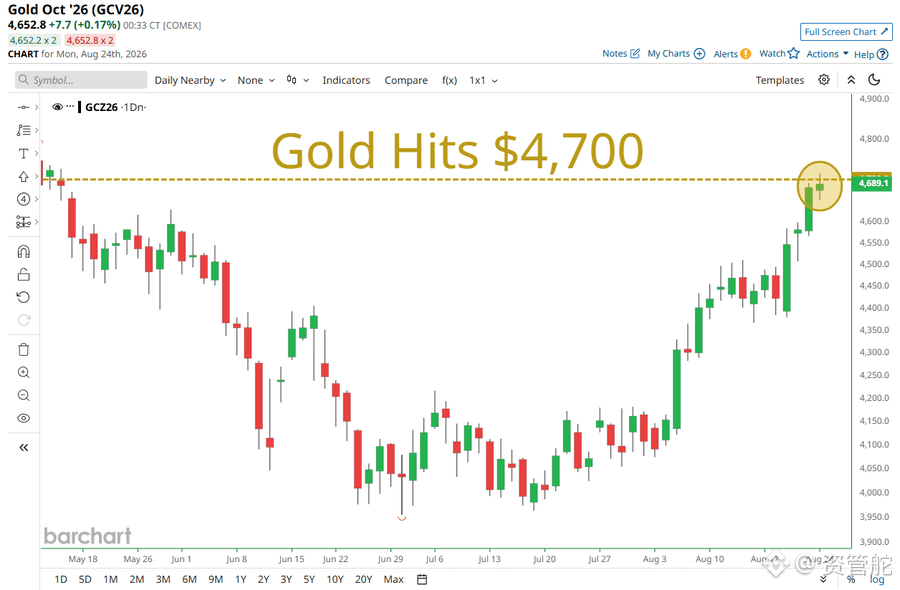
Gold futures GCZ26 has climbed above 4700.
This daily chart from May to August clearly draws a very distinct line. In early May, gold was hovering around 4900. Then it kept falling, and by the end of June it smashed below 3950, with a drop of nearly 20%. A lot of people at that time said the gold bull market was over.
But starting in July, a series of bullish candles—one after another—pulled the price back. In mid-August it broke above 4500, and now it’s directly pushing up to 4700. In just two months, it fully recovered all the losses from the previous two months and even made a new high.
A few points worth noting
1) The V-shaped reversal is very clean. After the low at the end of June, there was no second attempt lower, which suggests the bears couldn’t push it down anymore and the bulls’ willingness to take over is strong. This kind of price action usually isn’t something retail traders can drive—it’s typically institutions covering positions.
2) 4700 has psychological significance. It’s an integer level plus the zone of prior highs. The first time price hits it, you’re likely to see consolidation to digest the move. Whether it can hold up firmly and stay above it depends on the trading volume over the coming days.
3) Impact on the crypto market. The relationship between gold and BTC isn’t simply positive or negative correlation. But gold continuing to make new highs tells you one thing: funds are looking for inflation-hedging and safe-haven assets. When traditional safe-haven asset prices keep rising, some capital may spill over into the crypto space in search of risk assets with higher returns. This isn’t a guaranteed transmission chain, but it’s directionally favorable.
4) The daily-level trend has already turned bullish. Whether or not you trade gold, this signal is worth paying attention to, because it reflects a change in the macro-level pricing logic. Central bank gold purchases, geopolitical risks, and declining real interest rates—these factors won’t disappear in the short term.
From an execution standpoint, if you already hold positions, there’s no need to rush to exit. If you have no position, chasing highs is risky—wait for a pullback and confirmation before acting.
This daily chart from May to August clearly draws a very distinct line. In early May, gold was hovering around 4900. Then it kept falling, and by the end of June it smashed below 3950, with a drop of nearly 20%. A lot of people at that time said the gold bull market was over.
But starting in July, a series of bullish candles—one after another—pulled the price back. In mid-August it broke above 4500, and now it’s directly pushing up to 4700. In just two months, it fully recovered all the losses from the previous two months and even made a new high.
A few points worth noting
1) The V-shaped reversal is very clean. After the low at the end of June, there was no second attempt lower, which suggests the bears couldn’t push it down anymore and the bulls’ willingness to take over is strong. This kind of price action usually isn’t something retail traders can drive—it’s typically institutions covering positions.
2) 4700 has psychological significance. It’s an integer level plus the zone of prior highs. The first time price hits it, you’re likely to see consolidation to digest the move. Whether it can hold up firmly and stay above it depends on the trading volume over the coming days.
3) Impact on the crypto market. The relationship between gold and BTC isn’t simply positive or negative correlation. But gold continuing to make new highs tells you one thing: funds are looking for inflation-hedging and safe-haven assets. When traditional safe-haven asset prices keep rising, some capital may spill over into the crypto space in search of risk assets with higher returns. This isn’t a guaranteed transmission chain, but it’s directionally favorable.
4) The daily-level trend has already turned bullish. Whether or not you trade gold, this signal is worth paying attention to, because it reflects a change in the macro-level pricing logic. Central bank gold purchases, geopolitical risks, and declining real interest rates—these factors won’t disappear in the short term.
From an execution standpoint, if you already hold positions, there’s no need to rush to exit. If you have no position, chasing highs is risky—wait for a pullback and confirmation before acting.