#dusk $DUSK @Dusk
Last night a friend and I were splitting our joint expenses. She said something simple: "everything between us stays transparent, but neither of us explains our personal spending to the other."
That line stuck with me longer than it should have.
We tend to treat privacy and transparency as opposites in finance — either everything is visible, or nothing is. Looking closer at @dusk, that split doesn't hold up as cleanly as it seems.
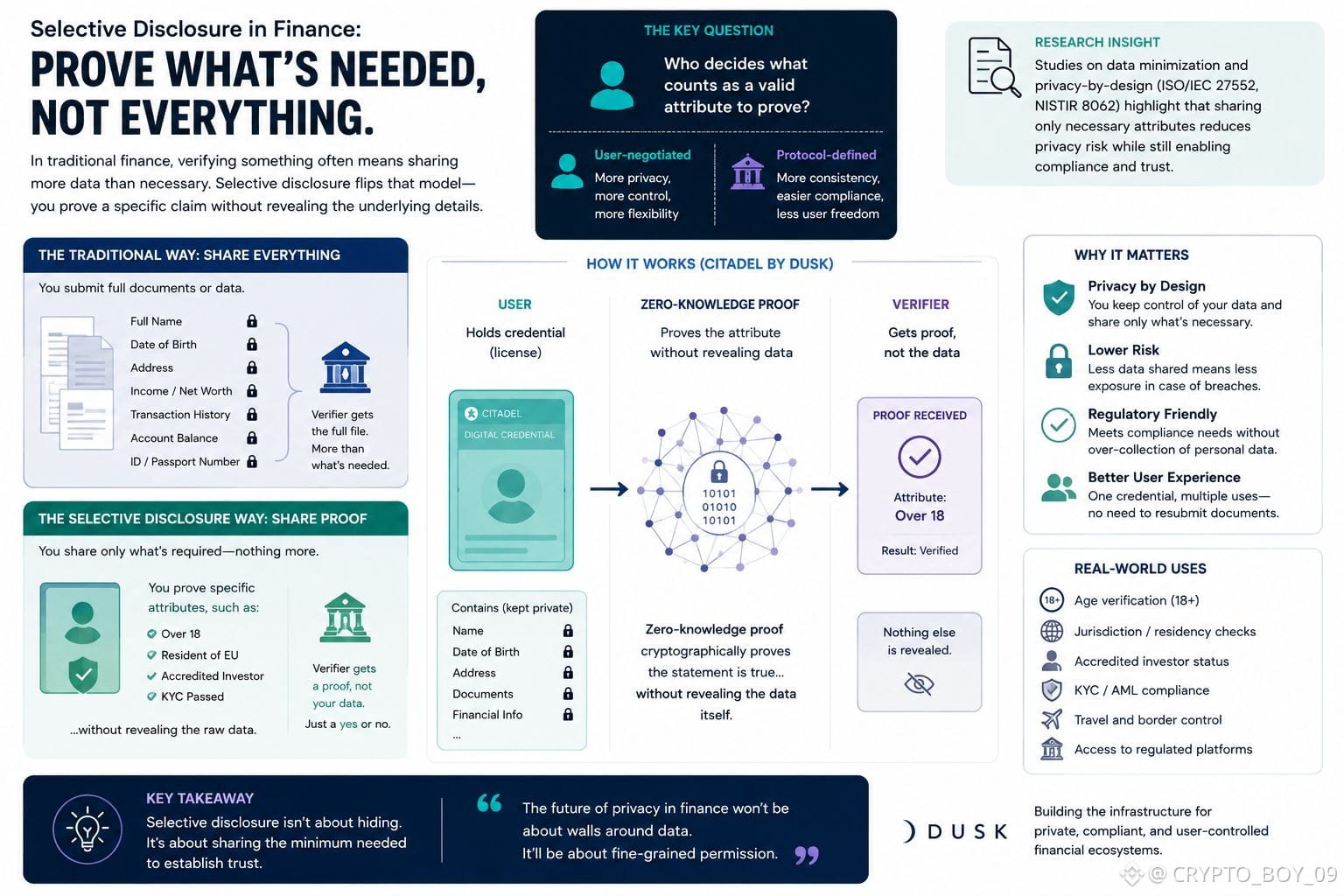
Take Citadel, Dusk's identity layer. A user requests a license once, then uses it to prove a specific attribute — say, meeting an age threshold or falling under a certain jurisdiction — without handing over the underlying documents each time. The verifier gets a proof, not a file.
That's a different kind of privacy than just hiding balances. It's deciding, attribute by attribute, what actually needs to leave your hands.
Which raises the real question for me — who defines what counts as a valid attribute to prove in the first place? Is that negotiated by the user, or fixed before the user ever gets a say?
That answer matters more than whether data is hidden or shown. It decides whether "selective disclosure" is actually selective, or just permission dressed up as one.
$TUT $CATI
Last night a friend and I were splitting our joint expenses. She said something simple: "everything between us stays transparent, but neither of us explains our personal spending to the other."
That line stuck with me longer than it should have.
We tend to treat privacy and transparency as opposites in finance — either everything is visible, or nothing is. Looking closer at @dusk, that split doesn't hold up as cleanly as it seems.
Take Citadel, Dusk's identity layer. A user requests a license once, then uses it to prove a specific attribute — say, meeting an age threshold or falling under a certain jurisdiction — without handing over the underlying documents each time. The verifier gets a proof, not a file.
That's a different kind of privacy than just hiding balances. It's deciding, attribute by attribute, what actually needs to leave your hands.
Which raises the real question for me — who defines what counts as a valid attribute to prove in the first place? Is that negotiated by the user, or fixed before the user ever gets a say?
That answer matters more than whether data is hidden or shown. It decides whether "selective disclosure" is actually selective, or just permission dressed up as one.
$TUT $CATI