


As for the actions in the prior market rally’s initiation phase, I’m unwilling to keep overthinking it again and again. At that time, the incorrect timing, my own trading condition, the market environment, and the way I responded—these factors compounded and ultimately led to an unsatisfactory result. I’m not blaming anyone; I’ve already taken on the bitter consequence myself.
Let go of past gains and losses, and return to the market itself. Try to strip away subjective emotions and objectively examine the current trend.
Reviewing the previous analytical framework remains effective: in the large 6.2W BTC, the mid-chip range serves as an important long-term reference anchor, and combined with stage trend support, the current upward move itself has structural logic.
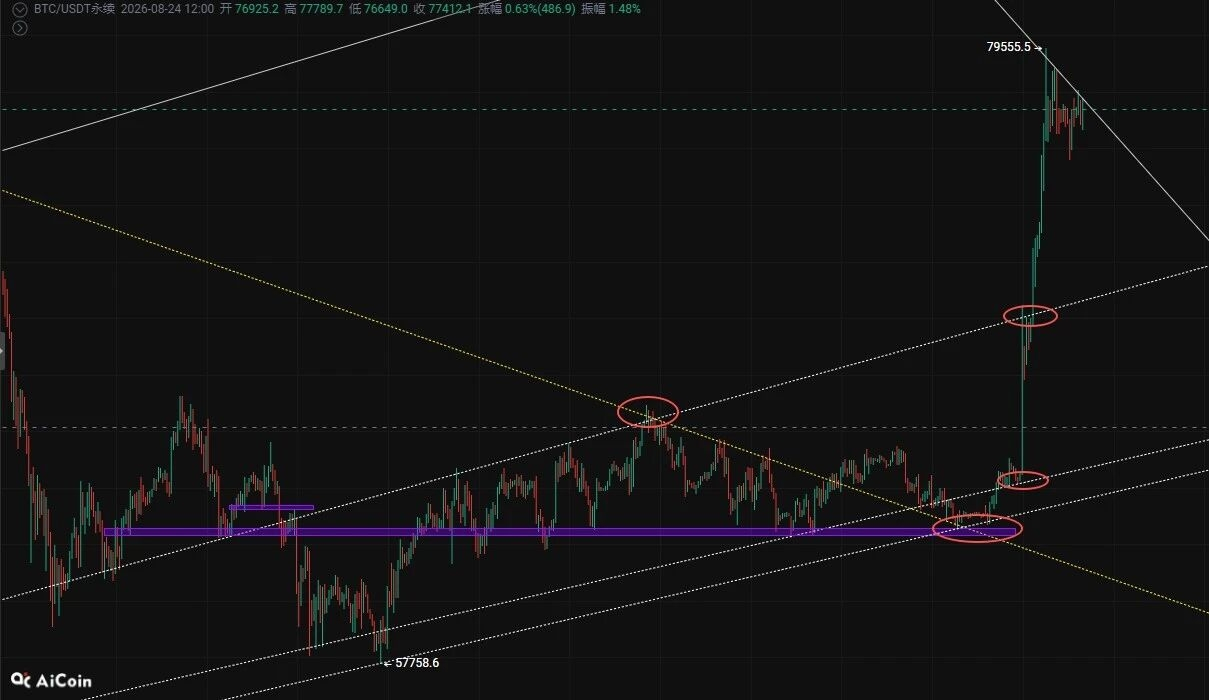
There’s no need to obsess over whether the market start is driven by external calls. News is merely a short-term spark. The key standard for the bigger-picture judgment is the cycle and the market structure itself.
Based on this framework, we can forecast the next outlook. Even though macro-market noise is constant right now, we can establish a core judgment: the chart has already shown signals of a bottoming-up start, but the bottoming has not been finally confirmed yet. Most likely, after a second retest of support, the uptrend will continue.
I understand that most people adhere to the idea of a second bottoming attempt because the root cause lies in macro-level concerns: unresolved geopolitical conflict, the FOMC continuing to release hawkish signals, and significant uncertainty regarding whether relevant legislation will be implemented within the year.
To be frank, I have also been affected by this pessimistic logic for a long time. But we must respect objective chart facts: the price action has already broken through on the upside in the first stage. At this point, we should not cling to old macro expectations; instead, follow the current market structure and update the forecasting approach accordingly.
We bring our focus back to the market changes around the release of July CPI, and then we can clearly see how macro sensitivity changes:
- Before July: whenever there is disturbance in the Strait of Hormuz, the coin price is prone to sharp drops in the short term—even to a phase-level selloff;
- On the eve of July CPI release: the coin price begins to fade the impact from geopolitical conflict and initiates the up move first;
- After the CPI lands: the price spikes into a high-range consolidation, and geographic news-driven disturbances clearly weaken.
As the marginal impact of cross-strait geopolitical shocks fades, inflation data (CPI/PPI, nonfarm payrolls) gradually cools, and policy-side推进 (advancing legislation) expectations heat up—multiple factors resonate together. This leads to a marginal decline in the macro risk premium, providing the environmental foundation for this round of upside, though it does not mean the macro environment has completely flipped from bearish to bullish.
Of course, risks exist objectively: conflicts have not fully been resolved. The financial cycle still exists and may induce severe market volatility. The legislative tailwind remains only at the expectation level. There is always a potential chance that the market will change direction in the near term.
The market always trades expectations. Main capital has already priced and positioned for this expectation in advance.
But it must be understood clearly: there is a risk that expectations could be disproven. If geopolitics, inflation, or policy deteriorate more than expected, the current expectation pricing will quickly become invalid, and the judgment framework needs to be revised. However, getting stuck in old pessimistic logic and consuming ourselves with internal doubts makes it easy to mistime the current market rhythm. So before we overturn our current view, we can use this as a basis to predict outcomes.
Returning to the market’s technical structure:
The current swing high for the big pie has just touched the 3-day VWAP resistance band. Since the pullback began from the big pie at 12.6W, this level has acted as trend suppression three times; the fourth time reaching this zone still needs close attention. In the short term, treat this area as a reference entry zone for shorts: around the prior high of 7.9–7.95W, combined with MA120 line resistance around 8.15–8.2W. However, given the current market environment, we do not expect a deep pullback for now. For the pullback, focus first on a benign retracement; the target is the daily timeframe VWAP support zone at 6.9–7.05W. At that time, observe whether the support proves effective, and then schedule a new round of long entries.
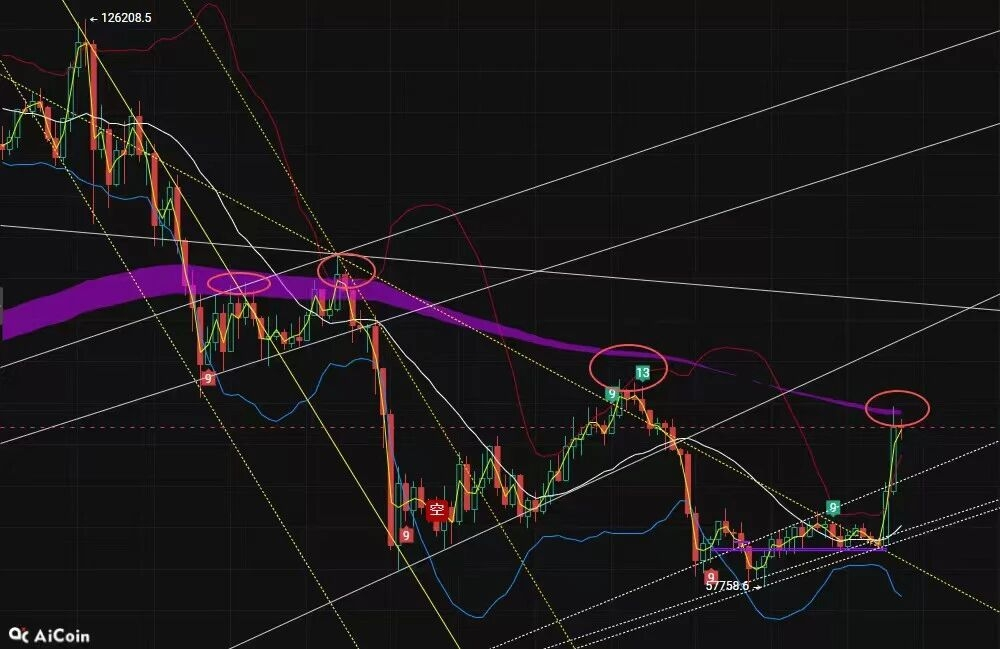
Risk boundary addendum: if the big pie effectively breaks below the 6.9W support, then the entire bullish continuation scenario after a “retracement” would fail, and we would need to reassess the larger structure.
Ethereum logic stays in sync with the big pie as well, and it also meets resistance at the 3-day VWAP level. In the short term, the reference short entry zone is the prior high at 2530–2550; 3-day MA120 resistance is at 2630–2650. The pullback target points to the daily trend support at 2100–2150. Wait for support confirmation, and then lay out a new round of long positions.
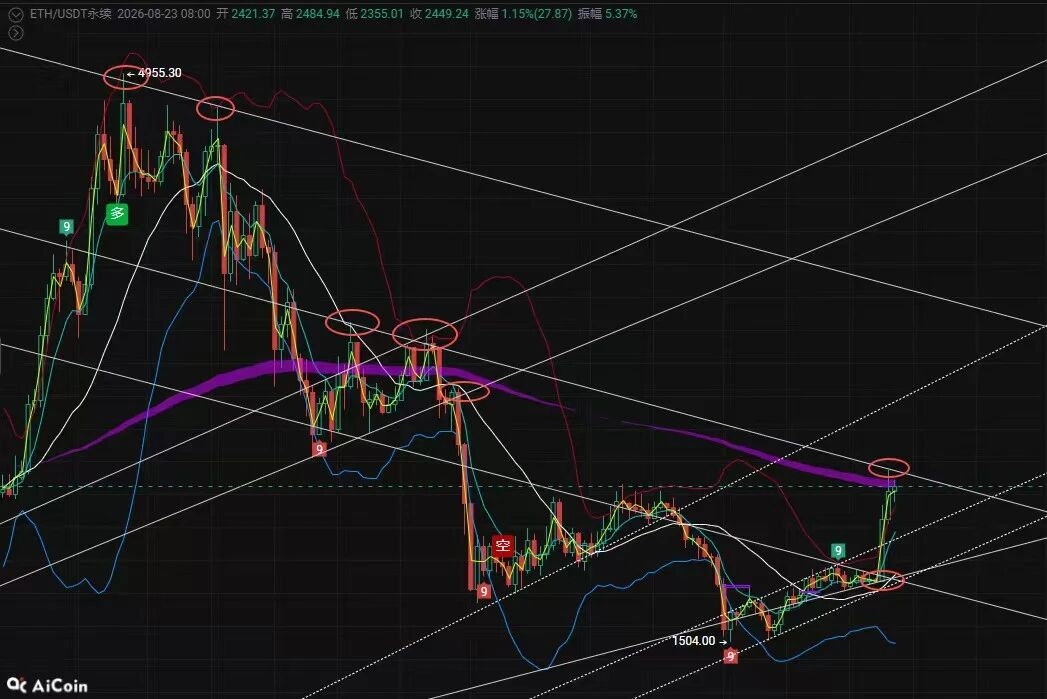
Risk boundary addendum: if Ethereum effectively breaks below the 2100 support, then we also need to reassess.