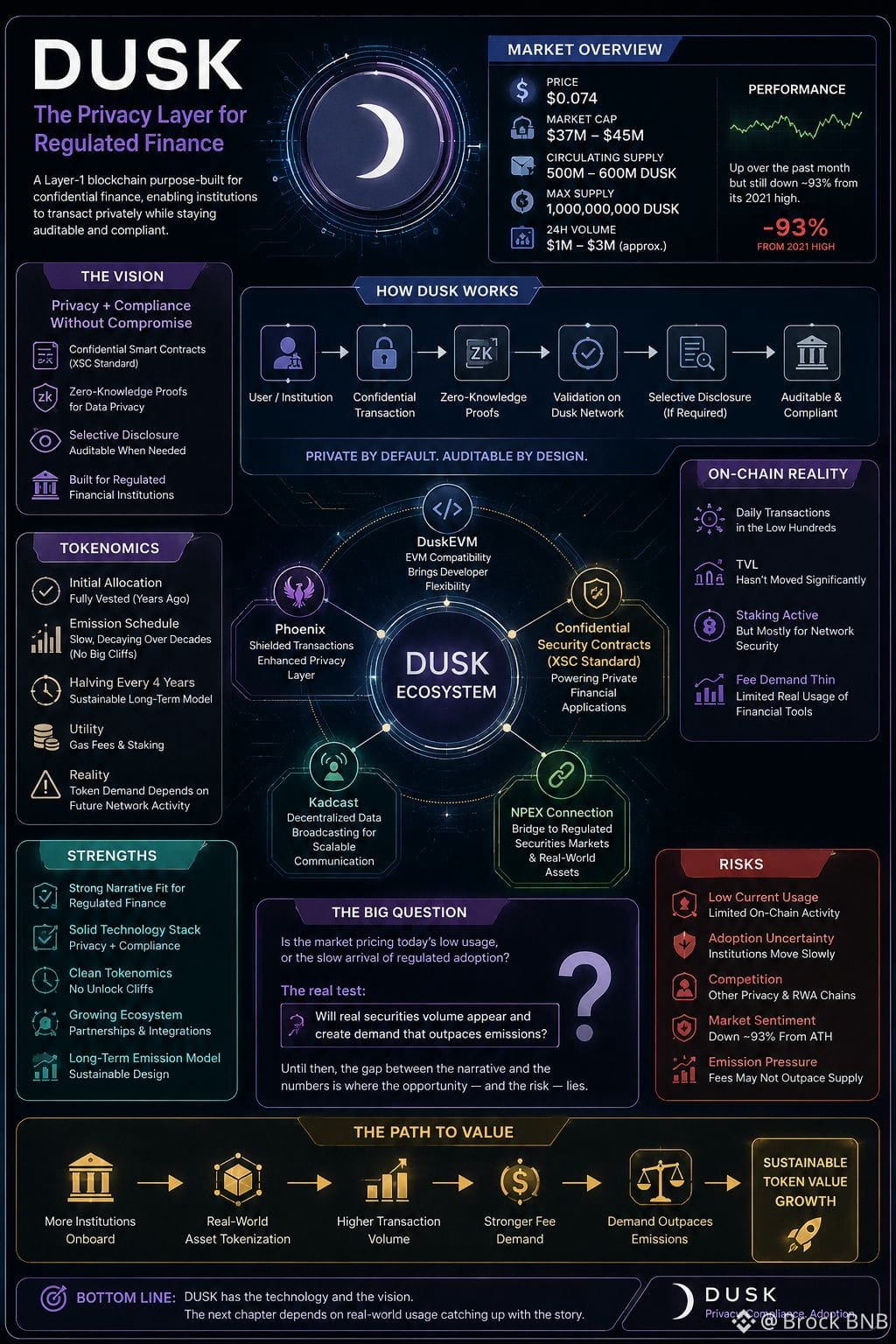

Late last night I was just scrolling through quiet charts and Dusk kept popping up near the bottom. Trading around $0.074, market cap somewhere in the $37–45 million range, circulating supply roughly 500–600 million against a 1 billion max. It’s been up a bit over the past month, but still sits about 93% below its 2021 high. Nothing dramatic.
What stuck with me is the gap between the story and the actual numbers. Dusk sells itself as a Layer-1 built for regulated finance—confidential smart contracts, the XSC standard, zero-knowledge proofs underneath—so institutions can keep sensitive details private while still staying auditable. On paper it makes sense. Privacy and compliance at the same time is exactly what a lot of traditional finance needs.
But the on-chain reality is pretty quiet. Daily transactions often sit in the low hundreds. TVL hasn’t really moved. Staking is more active, though that mostly just reflects people securing the network rather than any real demand for the financial tools the project talks about.
Token side is clean enough. The initial allocation finished vesting years ago. The rest is emitted slowly over decades on a decaying schedule, so no big cliffs coming. Utility is straightforward in theory—gas and staking—but fee demand is still thin, which means the token is mostly just a bet on future activity showing up.
So the question that keeps circling is whether the market is simply pricing today’s low usage, or whether regulated adoption just moves a lot slower than crypto cycles usually allow. The real test will be whether actual securities volume ever shows up and creates enough demand to outrun the emissions. Until then, that gap between the narrative and the numbers is the most interesting part.
#dusk $DUSK @Dusk
What stuck with me is the gap between the story and the actual numbers. Dusk sells itself as a Layer-1 built for regulated finance—confidential smart contracts, the XSC standard, zero-knowledge proofs underneath—so institutions can keep sensitive details private while still staying auditable. On paper it makes sense. Privacy and compliance at the same time is exactly what a lot of traditional finance needs.
But the on-chain reality is pretty quiet. Daily transactions often sit in the low hundreds. TVL hasn’t really moved. Staking is more active, though that mostly just reflects people securing the network rather than any real demand for the financial tools the project talks about.
Token side is clean enough. The initial allocation finished vesting years ago. The rest is emitted slowly over decades on a decaying schedule, so no big cliffs coming. Utility is straightforward in theory—gas and staking—but fee demand is still thin, which means the token is mostly just a bet on future activity showing up.
So the question that keeps circling is whether the market is simply pricing today’s low usage, or whether regulated adoption just moves a lot slower than crypto cycles usually allow. The real test will be whether actual securities volume ever shows up and creates enough demand to outrun the emissions. Until then, that gap between the narrative and the numbers is the most interesting part.
#dusk $DUSK @Dusk