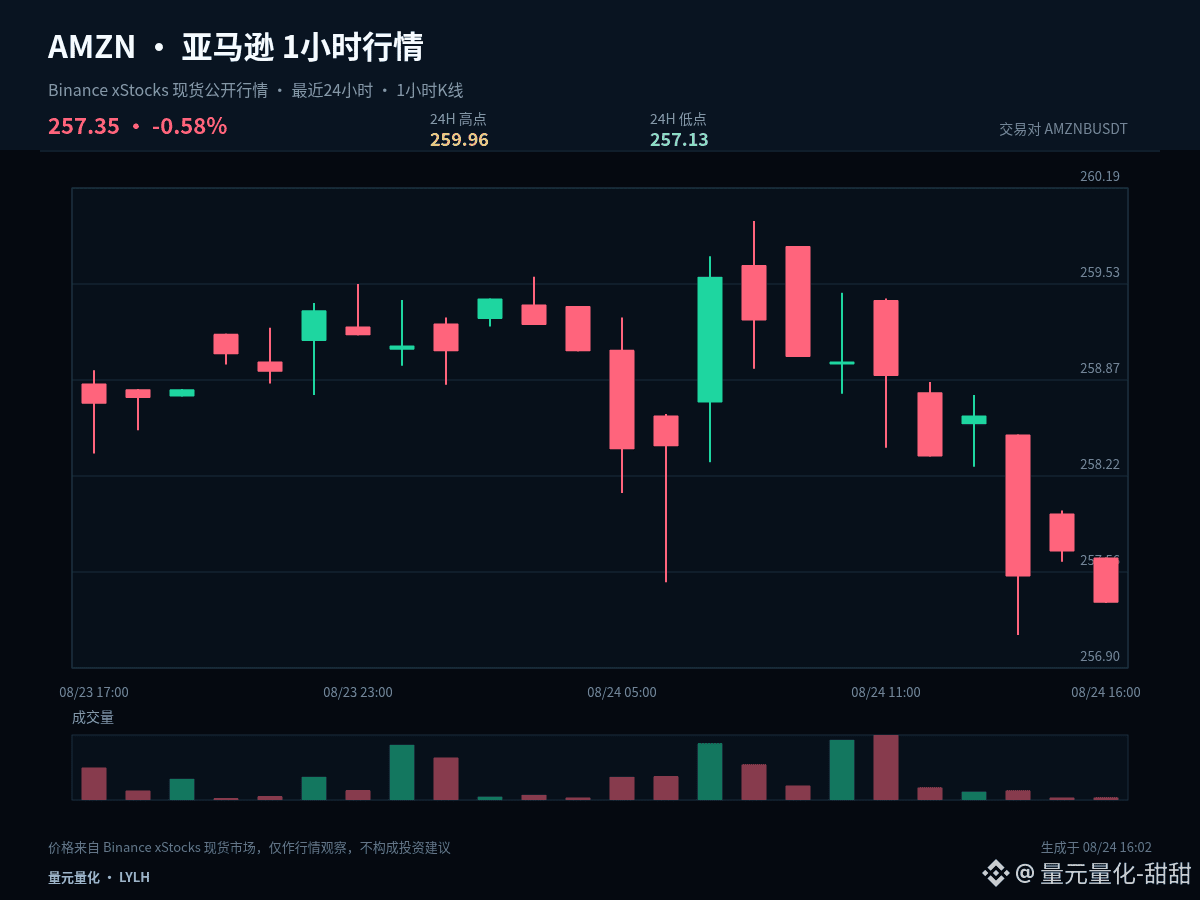
$AMZNB #AMZN This time, we break down the setup from a position perspective. On the same chart, what matters differs for those already in positions versus those with no position. Current price is 257.35, with -0.14% over the past 1 hour and -0.48% over the past 24 hours.
The current price is near the lower bound of the past 24 hours’ fluctuation range: -0.14% in the last hour and -0.48% in the last 24 hours. The core of low-level analysis is not trying to bottom-fish early, but observing whether price can quickly reclaim after it breaks down. Being able to reclaim indicates sell pressure has been absorbed; lingering below the lower bound suggests weakness has not ended.
For those already holding positions, watch whether 257.13 is broken. If it breaks, reduce risk exposure first. For those with no position, wait for the low to stop making lower lows, and confirm that price has reclaimed above 258.545. Don’t catch the drop before the structure stabilizes.
In execution, set clear conditions. After a breakout above 259.96, confirmation is required—don’t chase just because of a brief spike. After probing down to 257.13, you need to see whether price can quickly reclaim—not buy just because you see the dip. If the mid-range doesn’t offer sufficient odds, waiting itself is part of the strategy.
Position management should separate medium-term from short-term. For existing medium-term positions, first assess whether the structure is broken; don’t be repeatedly swayed by individual 1-hour candles. Short-term positions should be executed around support, resistance, and closing confirmations. Those with no position don’t need to chase prices in the middle of the range; waiting for a clearer level usually provides an advantage.
Risk control still comes before conclusions: only act when conditions appear, and if the price action becomes invalid, reassess promptly. The greater the volatility, the more restraint should be exercised with each single position. The above is a scenario analysis based on the current 1-hour and 24-hour data and does not constitute a promise of returns.
#CanadaUSTradeTalksCollapse
The current price is near the lower bound of the past 24 hours’ fluctuation range: -0.14% in the last hour and -0.48% in the last 24 hours. The core of low-level analysis is not trying to bottom-fish early, but observing whether price can quickly reclaim after it breaks down. Being able to reclaim indicates sell pressure has been absorbed; lingering below the lower bound suggests weakness has not ended.
For those already holding positions, watch whether 257.13 is broken. If it breaks, reduce risk exposure first. For those with no position, wait for the low to stop making lower lows, and confirm that price has reclaimed above 258.545. Don’t catch the drop before the structure stabilizes.
In execution, set clear conditions. After a breakout above 259.96, confirmation is required—don’t chase just because of a brief spike. After probing down to 257.13, you need to see whether price can quickly reclaim—not buy just because you see the dip. If the mid-range doesn’t offer sufficient odds, waiting itself is part of the strategy.
Position management should separate medium-term from short-term. For existing medium-term positions, first assess whether the structure is broken; don’t be repeatedly swayed by individual 1-hour candles. Short-term positions should be executed around support, resistance, and closing confirmations. Those with no position don’t need to chase prices in the middle of the range; waiting for a clearer level usually provides an advantage.
Risk control still comes before conclusions: only act when conditions appear, and if the price action becomes invalid, reassess promptly. The greater the volatility, the more restraint should be exercised with each single position. The above is a scenario analysis based on the current 1-hour and 24-hour data and does not constitute a promise of returns.
#CanadaUSTradeTalksCollapse