

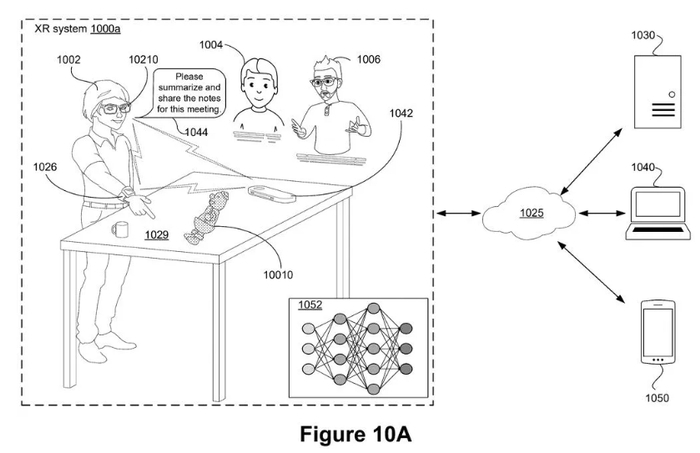
Recently, Meta has submitted a new patent proposing a hardware silent circuit solution, which could help mitigate the long-criticized risks of covert recording and privacy leakage associated with AR smart glasses.
This patent solution is designed specifically for AR devices. Since AR glasses cameras and microphones often need to remain on standby for long periods, there is a risk that permission controls at the software level could be compromised, tampered with, or altered. The core idea of this patent is to hand over sensor on/off control permissions to a pure hardware circuit: turning the camera and microphone on or off can only be achieved by generating physical electrical signals through a physical button and hardware wiring. The operating system and various applications have no authority to interfere with the sensor status.
According to the patent document, all software within the device cannot read the status of the sensor switches nor modify the silent and cut-off commands; the triggering signal only recognizes validated hardware sources, preventing software from forging commands. Turning off the sensors is performed at the atomic level, achieving a one-time, complete cut-off with no intermediate transition states that could be exploited by hackers.
This means that even if the device system is compromised, after all software layers are breached, the camera and microphone still remain in the closed state. It is necessary to wait for the user to manually trigger the hardware switch to re-enable them, thereby establishing a hardware root of trust for the sensors. This is clearly different from the smartphone model that relies on software control for camera recording and audio capture.
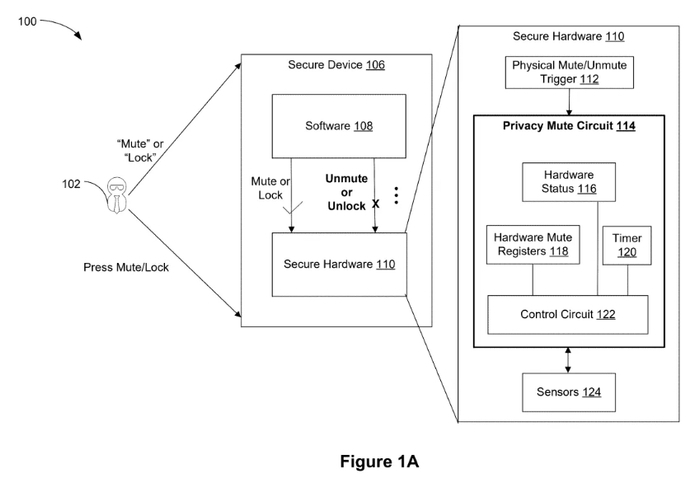
Applied to AR glasses products, this mechanism can be realized through physical buttons or a toggle lock-stop switch. Once switched to the locked position, regardless of the app, system updates, or remote attacks, it is impossible to privately activate the photography and audio capture functions.
However, it should be noted that this file is currently only a publicly available patent and does not necessarily mean it will be directly implemented in mass-produced device models. But it does reflect that the industry is exploring ways to solve privacy and security challenges for wearable devices by moving beyond software permissions and addressing them at the underlying hardware level, providing new technical ideas for using smart glasses in public scenarios.