#BTC ——What's next?
Weekly report: Everything you need to know
TA / LCA / Psychological breakdown:
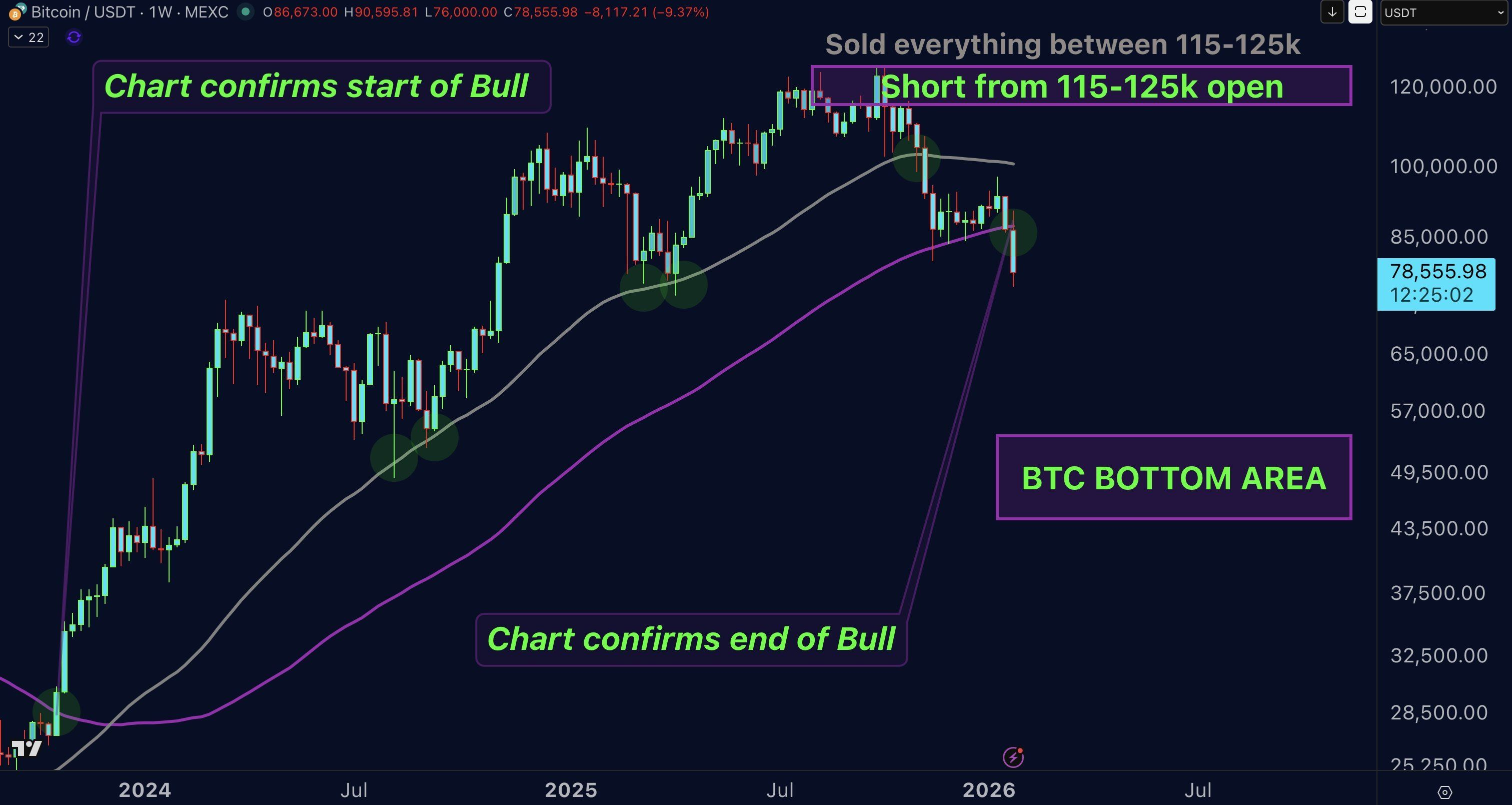
Two weeks ago, I wrote in the weekly report (price at $95,000): “Bitcoin is still in a consolidation phase, which remains bearish, and breaking below $80,000 is just a matter of time. Currently, we are still in the consolidation phase, just as I predicted in November when I mentioned that a consolidation phase was about to begin, but the next round of decline is inevitable.” This statement made two weeks ago at $95,000 now seems completely accurate. As I promised, Bitcoin has now broken below $80,000, and with this trend, it has accomplished something extremely important this week. Of course, most people overlooked this again, but Bitcoin has just broken below the 100-week moving average, which is a key indicator to confirm whether we are in a bull market or a bear market. Bitcoin had previously held above the purple line (the 100-week moving average), but this week it fell below it! As shown in the figure, in October 2023, when Bitcoin broke through the 100-week moving average (purple line), we confirmed the arrival of the bull market for the first time. However, today, two years later, Bitcoin has broken below this extremely important price level, perfectly aligning with the previous bull market cycle and confirming the arrival of the bear market. Another strong evidence is the death cross that is currently unfolding before our eyes. This perfectly matches the peak of the 2021-2022 cycle and its subsequent movements. However, most people are oblivious to this. This is precisely my personal observation and long-term view; several months ago, when Bitcoin's price was at historical highs of $115,000 to $125,000, I repeatedly warned that the bear market had already begun. Now, you should understand what I mean.
Bitcoin has dropped below the current level with such a violent shock—it’s hard to believe. This decline also confirms that the bearish flag pattern I repeatedly mentioned in the past 2–6 weeks has been broken through. I’m very confident that Bitcoin’s closing price next week will fall below the purple line (the weekly 100-day moving average), entering a new consolidation phase, and then continue to drop, with a target of $700,000. $700,000 is not the bottom. As I said a few months ago, my bottom theory is between $500,000 and $600,000; I first proposed it in the $1.15M–$1.25M range. That theory has been proven correct, but now I need to make a critical update to my bottom prediction.
As early as September, when Bitcoin’s price was in the $115,000 to $125,000 range, I predicted that the bottom of this cycle would fall to around $50,000 to $60,000. However, after recalculating and updating my model, I found that the price could go even lower. My new bottom zone aligns with all of the data I currently have and leads to a clear, unambiguous conclusion: the real bottom could be between $44,000 and $54,000. Given current market sentiment and price levels, this forecast is simply unbelievable.
Another key point: Bitcoin’s price has now fallen below MicroStrategy’s average buy price, which is about $76,000. It’s expected that market panic sentiment will intensify over the next few weeks. I publicly warned Michael Saylor to sell his Bitcoin in time and take profits, but he refused and claimed he would never sell Bitcoin. Given that most of MSTR’s Bitcoin was purchased using leverage, while the stocks used as collateral have been steadily losing value, I seriously doubt how he could pull that off in a credit-based financial system. Now that Bitcoin’s price has fallen below the average buy price, it becomes far more difficult to stabilize the stock price. Since MSTR began buying Bitcoin in 2020, the break-even point on its total Bitcoin holdings is roughly +/- 0%. Even the worst-performing ETFs can produce returns, and even just keeping cash in a bank generates interest. MSTR has never taken profits. This means we can’t even claim that their Bitcoin positions are funded by realized Bitcoin gains. This will be a major lesson for Saylor, similar to the one he experienced during the internet bubble, when he suffered one of the largest losses of that era. I warned him many times, but he ignored it. Now, it’s expected that panic and uncertainty sentiment will further intensify.
The release of the Epstein files and rumors connecting Epstein to Bitcoin will undoubtedly trigger even more panic. Personally, even if these claims are true, I doubt they would have a material impact on Bitcoin—yet the public will still blindly follow along, amplifying panic and emotionally driven selling. In short, I remain extremely bearish on Bitcoin. I expect the price to keep falling, which fully confirms the current state of a Bitcoin bear market and validates my earlier view that a “top has been formed” in the $115,000 to $125,000 range. With this additional evidence, there’s no question that Bitcoin is in a bear market, and the existing market outlook remains valid. To understand why Bitcoin is in a bear market, review the October report.
Summary:
- Bitcoin has broken below the weekly 100-day moving average, an extremely critical market indicator, further confirming that a bear market has arrived.
- Lowered expectations for the bottom: I believe the new cycle low is expected in the $54k–$44k area.
- Bitcoin breaking below MSTR’s average entry level of around $76,000 will increase risk, panic sentiment, and ongoing downward pressure.
Overall outlook remains extremely bearish, fully validating the earlier predictions about a cycle top in the $115,000 to $125,000 range and the expectation of continued declines.
- Keep the short positions of 115–125k fully open, with zero consideration for taking profits.