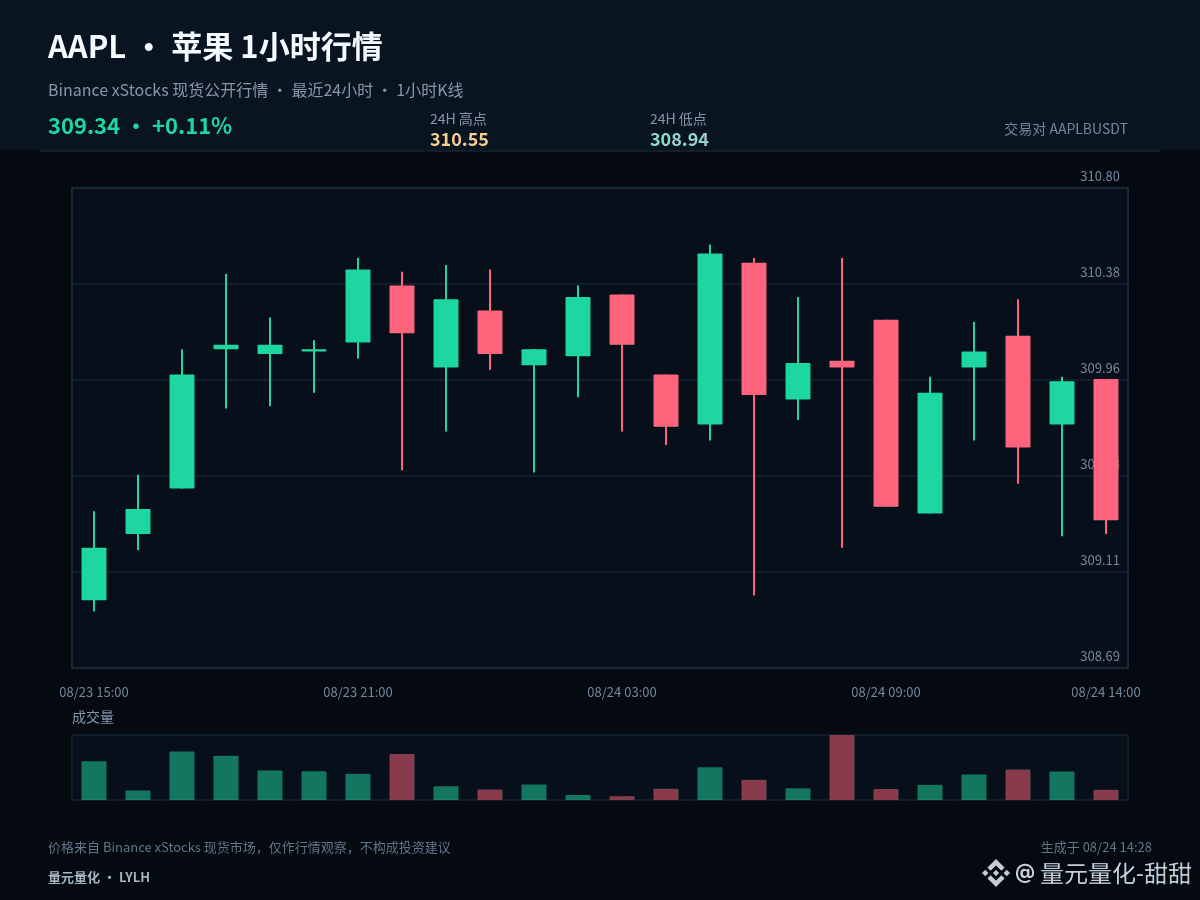
$AAPLB #AAPL From a layout perspective, the key is not to chase fluctuations that have already happened, but to determine in advance the position you are willing to wait for. Current price 309.34, 1 hour -0.20%, 24 hours +0.11%.
With the current 1-hour -0.20% and 24-hour +0.11%, the two periods have not formed sufficiently clear, same-direction alignment. In a range-bound market, the tolerance for chasing and cutting is low. It’s more suitable to use the upper boundary to confirm direction and the lower boundary to confirm follow-through, while the midline only serves as the dividing line between strength and weakness.
The first observation zone is 309.745, used to determine whether a normal pullback has ended. The second observation zone is 308.94, used to judge whether a deeper retracement can form support. On the upside, watch 310.55: after a breakout, you’ll need a pullback confirmation to avoid mistaking a brief pierce for a trend that has already opened.
Existing positions can be managed in segments based on key levels to avoid making all judgments at once. Those who are in cash should wait for breakout confirmation or for the market to stabilize after a pullback. For U.S. stock-related assets, also pay attention to volatility caused by session transitions. Your plan should be based on price conditions—don’t let emotions replace execution.
The purpose of scaling in isn’t to keep lowering your average cost; it’s to control timing while the structure remains valid. Once key support fails, you should stop the original layout plan and wait for a new price range to form.
A trading plan must include invalidation conditions. If your judgment is correct, you can realize profits in stages. If your judgment is wrong, you must also allow yourself to exit. You can’t use adding positions to cover the fact that the original logic has changed. The market will update, and your views should adjust according to price evidence.
#BPIUrgesFinCENExpandStablecoinIDRulesToSecondaryMarkets
With the current 1-hour -0.20% and 24-hour +0.11%, the two periods have not formed sufficiently clear, same-direction alignment. In a range-bound market, the tolerance for chasing and cutting is low. It’s more suitable to use the upper boundary to confirm direction and the lower boundary to confirm follow-through, while the midline only serves as the dividing line between strength and weakness.
The first observation zone is 309.745, used to determine whether a normal pullback has ended. The second observation zone is 308.94, used to judge whether a deeper retracement can form support. On the upside, watch 310.55: after a breakout, you’ll need a pullback confirmation to avoid mistaking a brief pierce for a trend that has already opened.
Existing positions can be managed in segments based on key levels to avoid making all judgments at once. Those who are in cash should wait for breakout confirmation or for the market to stabilize after a pullback. For U.S. stock-related assets, also pay attention to volatility caused by session transitions. Your plan should be based on price conditions—don’t let emotions replace execution.
The purpose of scaling in isn’t to keep lowering your average cost; it’s to control timing while the structure remains valid. Once key support fails, you should stop the original layout plan and wait for a new price range to form.
A trading plan must include invalidation conditions. If your judgment is correct, you can realize profits in stages. If your judgment is wrong, you must also allow yourself to exit. You can’t use adding positions to cover the fact that the original logic has changed. The market will update, and your views should adjust according to price evidence.
#BPIUrgesFinCENExpandStablecoinIDRulesToSecondaryMarkets