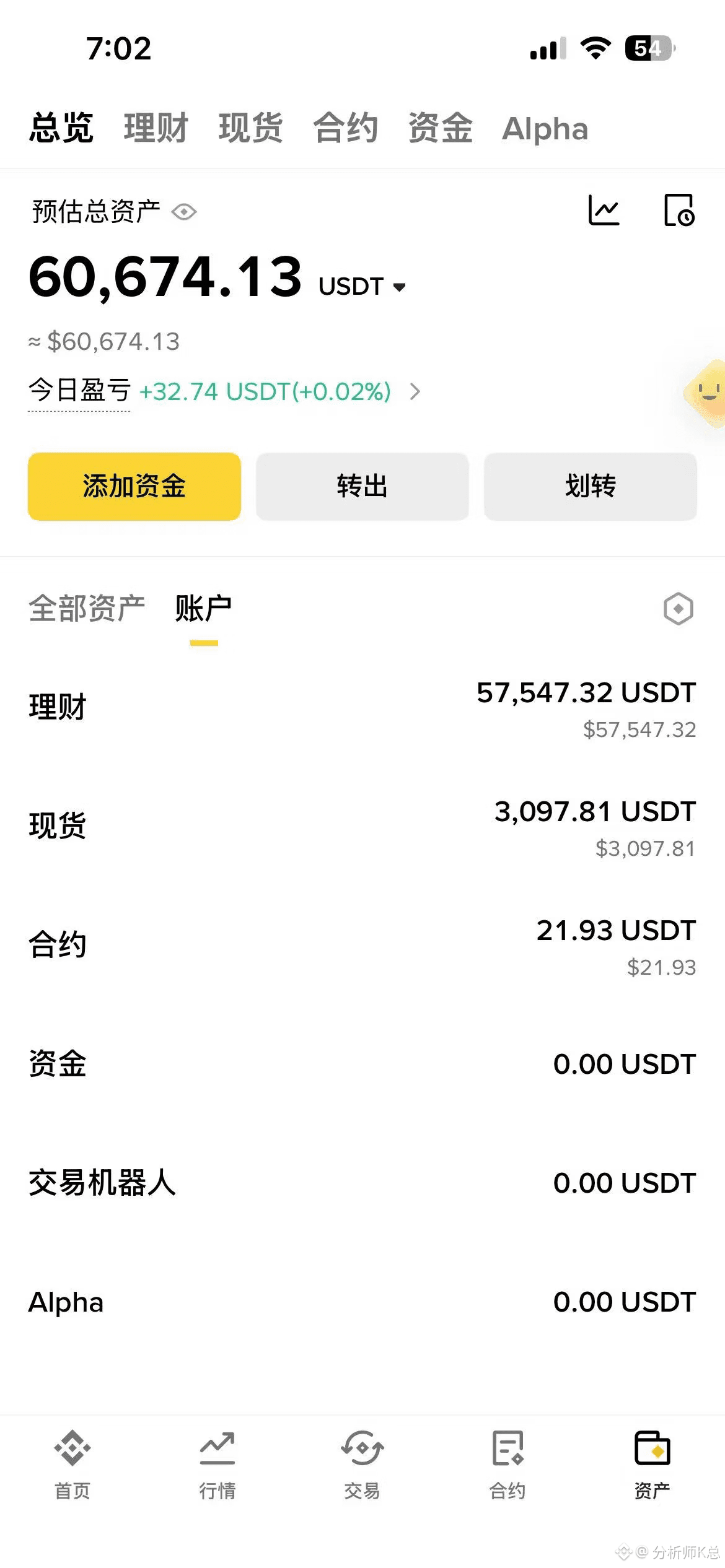
More than 2000 USDT, and in three months she got to almost 60,000. Later, she only told me one sentence: It wasn’t a bad market before—it was that I was too impatient.
When she first came to find me last year, her account only had a bit over 2000 USDT.
She’d actually been right about the market more than a few times, but the money just wouldn’t stay. When it went up a little, she was急着追ing; when it dropped a bit, she couldn’t bear to cut. Sometimes she’d catch a quick profit, but then the next time she’d put on a heavy position and give it all back.
I didn’t teach her any complicated strategies. I only told her to change one thing first: split her positions.
With a little over 2000 USDT, she wouldn’t go all-in in one shot anymore. Each time she’d only use a small portion to test the waters, while keeping the rest of the money. If her direction was wrong, she’d admit it right away and exit. If the market hadn’t played out yet, she’d wait.
At first, she still thought this was too slow.
I told her: With a small account, what you’re really afraid of has never been making profits slowly. It’s making one wrong move that sends you right back to square one.
Later, she gradually got used to it.
Don’t chase coins just because they suddenly pump. Don’t乱开单亂 trade just because the market is moving sideways. After you get profits, take part of them first. If losses reach your level, you leave—never comfort yourself by adding more positions just to “make it back.”
That’s how her account grew, bit by bit.
There wasn’t any single trade that let her instantly turn things around. Instead, it was those small profits—tens of USDT, hundreds of USDT—that slowly built up the results that came later.
After about three months, she sent me the screenshots. Her account was already close to 60,000 USDT.
That’s when I realized her biggest change wasn’t that her technique got better. It was that she finally stopped being impatient.
A lot of people in the crypto world are always waiting for the next bull market, or the next “妖币” to save them.
But the truth is, what most often drags an account down isn’t a lack of opportunities—it’s messy position sizing, rushed emotions, and being unwilling to exit when you should.
A real turnaround isn’t “go all in and do it big.” It’s finally not making things up and doing things recklessly anymore. Brothers who want to eat meat—there’s a spot in the chat.
When she first came to find me last year, her account only had a bit over 2000 USDT.
She’d actually been right about the market more than a few times, but the money just wouldn’t stay. When it went up a little, she was急着追ing; when it dropped a bit, she couldn’t bear to cut. Sometimes she’d catch a quick profit, but then the next time she’d put on a heavy position and give it all back.
I didn’t teach her any complicated strategies. I only told her to change one thing first: split her positions.
With a little over 2000 USDT, she wouldn’t go all-in in one shot anymore. Each time she’d only use a small portion to test the waters, while keeping the rest of the money. If her direction was wrong, she’d admit it right away and exit. If the market hadn’t played out yet, she’d wait.
At first, she still thought this was too slow.
I told her: With a small account, what you’re really afraid of has never been making profits slowly. It’s making one wrong move that sends you right back to square one.
Later, she gradually got used to it.
Don’t chase coins just because they suddenly pump. Don’t乱开单亂 trade just because the market is moving sideways. After you get profits, take part of them first. If losses reach your level, you leave—never comfort yourself by adding more positions just to “make it back.”
That’s how her account grew, bit by bit.
There wasn’t any single trade that let her instantly turn things around. Instead, it was those small profits—tens of USDT, hundreds of USDT—that slowly built up the results that came later.
After about three months, she sent me the screenshots. Her account was already close to 60,000 USDT.
That’s when I realized her biggest change wasn’t that her technique got better. It was that she finally stopped being impatient.
A lot of people in the crypto world are always waiting for the next bull market, or the next “妖币” to save them.
But the truth is, what most often drags an account down isn’t a lack of opportunities—it’s messy position sizing, rushed emotions, and being unwilling to exit when you should.
A real turnaround isn’t “go all in and do it big.” It’s finally not making things up and doing things recklessly anymore. Brothers who want to eat meat—there’s a spot in the chat.