



July 30, Guangzhou International Bio-Island. In the height of summer, the Pearl River glints with scattered golden light. With lush greenery covering the island, the headquarters office location of Wen Yuan Zhi Xing appears quiet and steady. The interview room is bright and spacious, with floor-to-ceiling windows that capture both the island’s greenery and the city skyline.
Just after wrapping up a series of intensive meetings, Han Xu quickly walked into the room. Wearing a neatly pressed gray shirt, his speech was lively and his logic tight, with no unnecessary small talk. The traits of a scholar turned entrepreneur were especially clear in him: cautious and efficient, accustomed to making precise trade-offs between technical ideals and business realities.
In the face of the industry’s prevailing “endgame theory,” Han Xu did not hedge or lay groundwork with polite words. He stated the core judgment directly and with confidence.
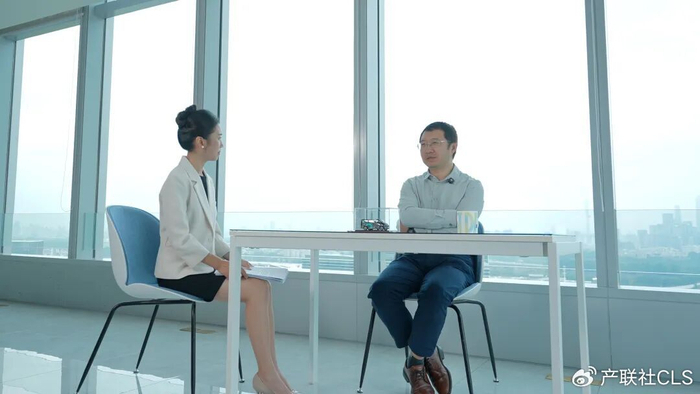
Figure: Han Xu, founder and CEO of WeRide, and a reporter from People’s Industry Union hold a conversation
“It’s not the curtain call yet—it’s just the ‘end of the beginning.’” He said that currently in China, there are still at least seven or eight autonomous-driving solution companies continuously winning OEM-designated projects. New entrants are already very few, but the battle over market share among existing players has just begun—the industry landscape is far from being solidified.
He likened the industry to a marathon spanning the full 42.195 kilometers: so far, autonomous driving has only run the first three or four kilometers—everything is still at the starting line.
In mid-2026, China’s autonomous-driving industry is at a critical paradigm-switching point, where opportunities and controversies coexist.
Driven by iterative upgrades in end-to-end large-model technology, L2 high-level assisted driving is seeing mass penetration. Data shows that in the first half of 2026, the penetration rate of new L2 smart-driving vehicles in China reached 70.5%, and the penetration rate of city NOA exceeded 15%. Previously high-end configurations quickly moved down-market, and smart-driving technology began to cover mass-market models priced around RMB 100,000.
While the industry heats up, the controversy has never stopped. Some are certain that 2026 will be the year the industry’s pattern is fixed, with the top two or three companies monopolizing the market. Others think the mass adoption of L2 will completely squeeze the survival space of L4 driverless. There are also industry voices questioning this: after large models reconstruct the technical system, the hardware reserves and operational barriers accumulated over the past decade by companies will quickly become obsolete. This is not the first time autonomous driving has faced a turning point. More than a decade ago, this technology left the lab and sparked the first wave of tech hype. In 2018, capital flooded in—industry valuation bubbles and technical breakthroughs happened in parallel. From 2021 onward, the capital winter hit; many startups were forced out, and commercialization deployment became the only survival bottom line. From 2025 to 2026, large models empowered the industry and expanded mass-production scale, pulling the sector back to optimism—but entirely new cognitive disagreements also emerged.
WeRide, having worked deeply in the industry for more than nine years, is a core sample for observing this cycle of iteration.
As one of the very few companies globally that runs parallel tracks—both L4 driverless and L2 mass-production assisted driving—WeRide was founded in Silicon Valley in 2017 and ultimately took root in Guangzhou. Over nine years, it has fully gone through three complete cycles: the capital hype, the industry winter, and the recovery of commercialization. Starting from an initial single Robotaxi track, it expanded into multiple scenarios such as driverless microbuses, logistics vehicles, sanitation vehicles, and high-level assisted driving, building a highly generalizable, platformized technical foundation.
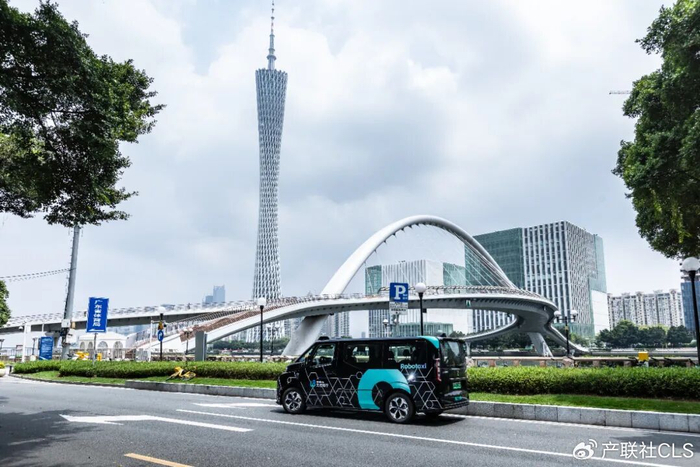
Figure: WeRide’s L4 pure driverless Robotaxi GXR in Guangzhou
In the capital markets, WeRide has carved out a unique path to capitalization. The company listed on Nasdaq and the Hong Kong Stock Exchange in sequence, becoming the “world’s first Robotaxi stock.” It is also the first autonomous-driving company in China to achieve a dual primary listing in both the U.S. stock market and Hong Kong. In June 2026, it was successfully included in the Stock Connect for Hong Kong shares, completing a phased capital-market closed loop.
In 2026, WeRide’s technical and commercialization progress will accelerate across the board. Its R&D WRD 3.0 one-piece end-to-end intelligent driving solution helps mass-production models win an unprecedented seven championships at China’s Smart Driving Competition, securing the company’s position as the first-tier technology leader for full-scenario intelligent driving. Its L2 mass-production business is also especially impressive in growth, making it one of the fastest-growing solution providers in the industry.
Overseas markets have become an important growth engine for the company. WeRide’s strategic partnership with Uber extends from the UAE to Europe. Robotaxi projects in Madrid and Zurich were rolled out one after another. In August 2026, it officially entered Denmark. By then, the business will cover 13 countries and more than 60 cities globally, forming a mature overseas expansion model of “Middle East profitability, European breakthroughs, and global replication.” The company’s UAE overseas project also became the only autonomous-driving project selected as a national-level international cooperation case for the 2026 World Artificial Intelligence Conference.
From a technical perspective, WeRide simultaneously released the WITT physical AI cognition foundation model and innovatively proposed the concept of the “minimal physical fact unit,” providing a fresh underlying way of thinking for iterating world models and end-to-end technologies for autonomous driving.
The founder, Han Xu, is among the first generation of practitioners in China’s autonomous-driving industry, with both academic and industrial experience. Previously, as a lifelong professor at the University of Missouri and Chief Scientist of Baidu’s autonomous-driving business unit, he has witnessed the industry’s full journey—from laboratory concepts to city public roads, and from early experiments in China to global deployments.
He believes in the power of foundational science. The company is named in honor of mathematician Zu Chongzhi; the large-model naming honors philosopher Wittgenstein. At the same time, he understands the logic of survival in industry. During the coldest capital winter, he decisively adjusted strategy, expanded scenarios, and bonded with top global partners. With continuous commercialization and deployment, he helped the company get through the cycle and build strength for development.
In a deep, hour-plus conversation, Han Xu directly addressed every major controversy in the industry: the real development stage of autonomous driving, the truth or illusion of the endgame theory, the cooperation and game between L2 and L4, how large-model-era developments rebuild the barriers, the gap in intelligent driving between China and abroad, the profitability inflection point, and the challenges of globalization—answering them one by one with practical, restrained, and systematic reasoning.
The endgame theory is an illusion—industry is merely “the end of the beginning”
People’s Industry Union: From the deployment of the first WeRide L4 Robotaxi, to becoming the world’s first Robotaxi first publicly traded stock—now you’ve achieved normalized operations in multiple countries. How do you define the company’s current stage and position in the industry?
Han Xu: Looking globally, WeRide is a pioneer and leader in the driverless industry. The company was founded in April 2017 in Silicon Valley. Over the past decade, it has conducted autonomous-driving operations in 13 countries and 60 cities. As of July 30, aside from the China and U.S. markets, for ordinary consumers who want to call a driverless vehicle without a safety operator, they can order via Uber in Abu Dhabi and Dubai. Domestically, we started routine driverless operations in Guangzhou, and the Beijing Yizhuang project has also been deployed.
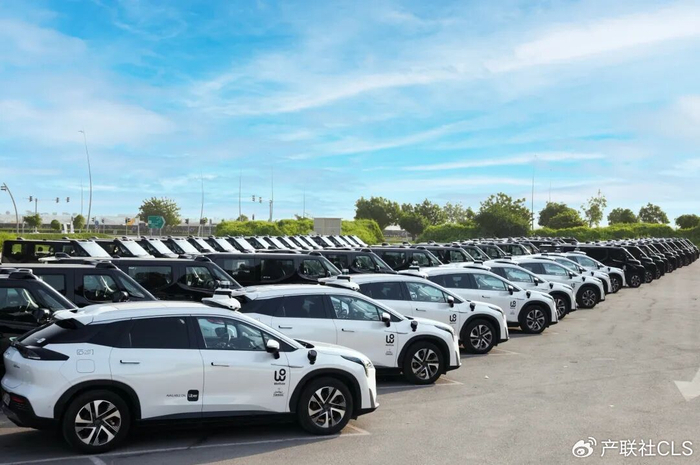
Figure: WeRide’s Robotaxi fleet in Abu Dhabi
In the field of high-level assisted driving, we won seven championships in China’s smart driving competitions—an unprecedented achievement. Before that, the best record was Huawei’s back-to-back double crown, which already proves our leadership advantage in this track. Overall, whether in China or globally, WeRide is in the first tier of the autonomous-driving industry.
People’s Industry Union: You used a marathon to describe industry development. Where is the industry roughly at right now? The market often says the “autonomous driving endgame will arrive in 2026, and in the end only two or three companies will remain.” Why don’t you agree?
Han Xu: I’m clearly opposed to this endgame narrative. Right now, in China alone, at least seven or eight autonomous-driving solution companies continue to secure OEM-designated projects, and the industry is far from being at the end of elimination rounds. A more accurate description today is “the end of the beginning”: the number of new entrants from outside will drop significantly, but competition among existing participants intensifies. Market share will be redistributed, and the final landscape is not yet determined. A 42.195-kilometer marathon—industry has only run the first three or four kilometers. Everything is only just getting started.
People’s Industry Union: The market commonly summarizes autonomous driving as having two routes—China and the U.S. In the U.S., Waymo focuses on Robotaxi and long-term technical refinement; in China, companies tend to deploy across many scenarios and quickly build closed-loop business. Since WeRide has traits of both, how do you view this split?
Han Xu: WeRide indeed advances on two tracks, but you can’t simply label all China-based companies. It’s not the case that every Chinese company only cares about deployment and ignores underlying technical R&D. Individual differences are far greater than country differences. Many domestic peers have long insisted on investing in foundational technology.
People’s Industry Union: What are the respective strengths and weaknesses of the autonomous-driving markets in China and the U.S.?
Han Xu: Commonalities between the two countries’ markets are far greater than differences. There are fewer participants on the U.S. track, and competition in China is more crowded. In terms of internationalization, U.S. companies rely on English advantages, making the barrier to expanding English-speaking markets lower. For Chinese companies to go overseas, they need to recruit a large amount of international talent. WeRide started early. In our Guangzhou headquarters, the proportion of returned overseas employees is 26%, placing us ahead among local companies.
People’s Industry Union: In the next decade, the market will have three types of players—tech giants, full-vehicle OEMs, and autonomous-driving startups. How do you think the long-term landscape will evolve? What is WeRide’s positioning?
Han Xu: The trend is already showing. The frenzy of internet giants moving into autonomous driving has cooled off. Earlier, Baidu, Alibaba, and Tencent all had initiatives, but now only Baidu keeps going deep, and its pace of progress has slowed.
For automakers, I proposed the “qualification theory” for driverless very early: for a company to be considered a professional autonomous-driving company, it needs 100 units of pure driverless vehicles to operate on public roads for the public, covering a complete area, with no major proactive responsibility accidents within six months. Since this standard was proposed, in nearly seven years, no domestic automaker has met it. Only three driverless companies meet the conditions domestically: WeRide, Baidu, and Pony.ai.
In the long run, core innovations in autonomous driving and large-scale operations will concentrate among a small number of professional autonomous-driving companies. WeRide’s goal is to become one of the top players that ultimately remains.
People’s Industry Union: After autonomous driving becomes widely adopted at scale, which industries and city patterns will be impacted first?
Han Xu: Autonomous driving will reconstruct urban transportation, spatial organization, and the human living system. The utilization rate of private cars is currently extremely low, and a large number of vehicles sit idle for long periods, occupying huge amounts of parking space. Autonomous driving fleets can continuously loop, picking up and dropping off requests, greatly reducing the need for parking lots, freeing up public space in cities, and improving the efficiency of road networks—while also reducing carbon emissions from vehicle production.
Bigger changes will likely appear in the real estate sector. Right now, commuting costs are high in major cities and populations are concentrated in the central districts. In the future, during the commute, people will be able to work and relax, and the experience of long-distance commuting will improve dramatically. Population will gradually spread toward the outskirts of cities, reshaping regional housing prices and the land-value landscape.
Surviving the capital winter: three key decisions
People’s Industry Union: Autonomous driving has gone through three cycles—bubble, winter, and recovery—leading many companies to exit. Looking back at the development process, what were the three key decisions that determined life or death for WeRide and allowed it to stay on the table?
Han Xu: The first decision was to establish a platformized strategy at the A-to-B round stage, entering the driverless microbus track. In the early days of the startup, we focused mainly on Robotaxi, but due to policy and technical constraints, it was difficult to deploy at scale. Coupled with the capital winter, the company urgently needed to prove its commercialization capability. We chose to reuse the underlying Robotaxi technology for the microbus scenarios, and reached a deep strategic partnership with Yutong. Even today, there are very few companies in the pure driverless microbus track that can achieve our level of operational scale and technical proficiency. The microbus project not only brought cash flow, but also helped us get through the most difficult funding cycle.
The second decision was to work with Bosch and make a cross-border push into L2++ high-level assisted driving. At that time, we were a pure L4 driverless company, while Bosch is a top-tier global Tier 1 supplier. We believed that the same underlying technology system could support both L4 and L2++. So we投入 significant R&D resources to develop the WRD 3.0 solution in cooperation. During the collaboration, we kept an iteration rhythm four times a year—evolving from high-precision map rule algorithms and light-map approaches to end-to-end models—successfully establishing our footing in the mass-production assisted-driving track.
The third decision was to reach a global strategic partnership with Uber and systematically advance the globalization layout. Uber is the world’s largest mobility platform. The two sides agreed to deploy Robotaxi in 15 cities globally over the next three to five years.
Three major collaborations—respectively with global leading commercial vehicle OEMs, the top automotive supply chain, and global mobility platforms—form key pillars for WeRide’s development.
People’s Industry Union: What period is the toughest for the company? How did you break through at the time?
Han Xu: The hardest time was from June to December 2020. Our Round-A funds were nearly exhausted. The company could only support four to six months of operations. The financing inflow cycle was short, and the pressure lasted for almost a year. Until we finalized cooperation with Yutong and received a $200 million investment, the cash crisis was completely resolved.
During that period, I took on both the CEO and CFO roles. Investor confidence was low, and many questioned whether we could last until going public. I used a “bulldozer strategy,” not letting go of any potential investment opportunities—at my peak, I was in contact with six waves of investors in a single day. We always focused on refining the technology, seriously delivering every technical demonstration, continuously conveying the long-term value of driverless technology. Ultimately, we successfully completed Series B financing. After that, the process of capitalization accelerated: listed on Nasdaq in 2024, listed on the Hong Kong Stock Exchange in 2025, and included in the Stock Connect for Hong Kong shares in 2026.
People’s Industry Union: How did the cooperation with Yutong come about? Were there internal disagreements on the route at the time?
Han Xu: When the Yutong team visited, they brought WeRide the driverless microbus “Xiao Yu 2.0,” but it lacked an autonomous-driving solution that could enable operations on public roads. At the time, I made it clear that WeRide has deployment capability. The two sides first connected in June 2020. We proposed adjusting the vehicle sensor layout and committed to enabling road operations by the end of the year. In the end, we only took six months to complete the retrofit and deployment—without any prior example worldwide. After comparing multiple technology providers, Yutong ultimately chose to deeply bind with WeRide, which has the strongest ability to land technology.
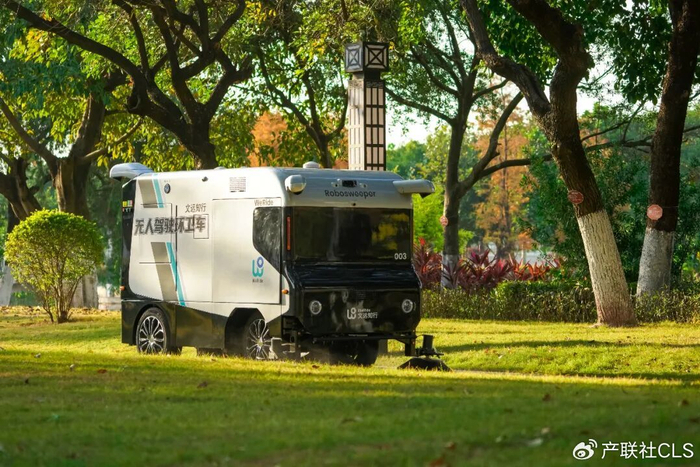
Figure: WeRide’s driverless sanitation vehicle
In internal discussions, some were worried that the microbus resource tilt would slow down Robotaxi R&D. My view was that the two should run in parallel. We wouldn’t give up the Robotaxi long-term goal, but we prioritized tackling the microbus scenario in the short term. The core logic is that platformized technology can be reused bidirectionally: in the microbus scenario, we build algorithm capabilities that can in turn empower Robotaxi. At the same time, the cooperation brings financial support, giving the company a longer development window. After sufficient communication, the team reached consensus.
People’s Industry Union: You simultaneously develop multiple lines—Robotaxi, driverless microbuses, logistics vehicles, sanitation vehicles, and L2++. Some investors question whether such a multi-track layout scatters R&D funds. Do you insist on a diversified scenario-based underlying logic?
Han Xu: The core premise is maximizing technical reuse efficiency. For taxis, buses, logistics vehicles, sanitation vehicles, and mass-production assisted driving, the operating scenarios are mainly on urban roads. They all need to recognize pedestrians, vehicles, and traffic lights, and handle various road obstacles. The underlying algorithm requirements are highly homologous. As long as we build a generalized technical foundation, one set of technology can adapt to multiple vehicle types, and R&D investment can be spread thinner. Of course, generalization is extremely difficult and requires continuous technical accumulation and engineering capabilities.
People’s Industry Union: Among the three main lines—passenger mobility, driverless freight, and L2++ mass-production—where is the growth and profitability potential more prominent?
Han Xu: The final market size and gross margin level will naturally filter the core main track. China has 23 million to 29 million new cars sold each year, so the market space for high-level assisted driving is very broad. Most people do not enjoy full-time driving themselves. If the driving-assist system takes on the majority of driving tasks and the driver only needs to take over a small amount, users’ acceptance will continue to increase.
There is no absolute better or worse across different tracks. Passenger transport and cargo delivery both have unique social value. In terms of deployment pace, I previously judged that the deployment speed of autonomous freight would be faster than Robotaxi—and the current market situation confirms this. In multiple second- and third-tier cities in China, autonomous-driving delivery vehicles have already been operating at scale.
People’s Industry Union: How high is the technology reuse rate between passenger vehicles and freight vehicles? What operational differences exist on the operating level?
Han Xu: The underlying technical reuse rate is very high, and vehicle size is not the core dividing line. Differences are concentrated in three areas. First, the standards for ride comfort differ: in passenger scenarios, smooth acceleration and deceleration are pursued; freight vehicles have no hard requirement for passenger comfort. Second, the path-planning logic differs: taxis prioritize timeliness and route determinism, while freight vehicles can proactively detour around congested road sections. Third, the business model determines technical trade-offs: L2++ assisted driving targets the consumer market, so it needs to balance cost and performance. When the system cannot handle a scenario, it only needs to prompt the driver to take over.
Globalization’s dock/wharf effect and the profitability critical point
People’s Industry Union: What matters most to capital markets: when can L4 autonomous-driving companies achieve sustained positive cash flow?
Han Xu: The window is right in the next two or three years, and the trend is very clear. Through WeRide's regional business in Abu Dhabi and Dubai, it has already achieved positive cash flow locally.
People’s Industry Union: What is the biggest variable in the profitability process?
Han Xu: Profitability is influenced by multiple factors—geopolitical environment, regulatory policies, and macro cycles. Compared with getting stuck on a single variable, the more important test is this: even if the external environment fluctuates, does the company’s business model still have the possibility of turning profitable? The UAE market has already been verified. Even though the local geopolitical environment is complex, we have maintained stable operations and gained regulatory support locally.
People’s Industry Union: Investors keep focusing on the efficiency of capital use. WeRide insists on full-stack self-reliance and multi-point global deployment. Will overseas investment extend the profitability cycle? How do you respond to such concerns?
Han Xu: Overseas investment will raise costs in the short term and delay overall profitability timing, but the long-term upside potential is larger. Dubai and Abu Dhabi have already proven a light-asset operations model. User data accumulated and product experience gained from local operations can feed back into domestic R&D. The operational infrastructure built overseas can also enable Chinese OEM partners to go abroad, providing supporting capabilities for autonomous driving.
Overseas profit mainly comes from collaboration with Uber, including platform ride-hailing revenue and fleet-operation income. This light-asset model isn’t a direct copy-paste. Entering each market requires localized adjustments, but the underlying logic is replicable.
People’s Industry Union: When entering an entirely new overseas market, how long does the full deployment cycle typically take? What is the biggest challenge?
Han Xu: How fast deployment happens mainly depends on the pace of regulatory approvals. Simply completing vehicle deployment and connecting the basic operations can take about two to three months. The biggest difficulty is earning local regulatory trust. As a foreign autonomous-driving company, driverless services on public roads involve public safety, so regulatory reviews should be cautious and thorough by default. We need to rely on continuous records of safe operations and case studies deployed in multiple countries to prove our capabilities.
There is something like a “dock/wharf effect”: once an enterprise has been operating steadily in more than a dozen countries, the difficulty of entering new markets drops significantly. If it only has experience in a single market, expanding to a second market comes with extremely high costs.
People’s Industry Union: How do you view the differences in domestic and international policies and operating costs?
Han Xu: Differences come more from the local level of economic development and consumer spending on mobility. We won’t simply copy one solution. Instead, we provide tailored products based on local regulations and market needs.
Barriers are always dynamic—what is the new winning move?
People’s Industry Union: With WRD 3.0 achieving mass-production deployment, what role does the L2++ mass-production business play in the company’s strategy? What are the plans going forward?
Han Xu: L2++ is a core strategic track. We continue to invest core resources. The current solution has already been deployed on more than 30 models. Even considering the base-number factor, our growth rate is highly competitive within the industry. Next, we will continue to increase R&D and expand OEM designated deployments.
People’s Industry Union: Beyond commercialization, what is the biggest bottleneck to large-scale adoption of L4 autonomous driving?
Han Xu: The core challenge is to establish a scientific and quantifiable regulatory system. Companies shouldn’t just blame slow development on policy constraints; they should proactively cooperate with regulators to build management standards. Autonomous-driving safety can’t rely solely on a company proving itself—regulators need a clear, deployable data-evaluation framework. That requires companies to continuously accumulate operational data.
People’s Industry Union: With end-to-end and large-model approaches reshaping the industry’s technical paradigm, WeRide has introduced the WITT physical AI large model and proposed the “minimal physical fact unit.” In the next three to five years, will the core competitive barriers in autonomous driving be completely rewritten?
Han Xu: Barriers are always dynamic concepts. Many companies plan for world models, but not many truly validate and land the effects. WITT is named after Wittgenstein. Its core idea—“language is the world”—is what we extend: we use language to break down traffic scenarios into the smallest units, building a bridge between the digital world and the physical world. This technology is not limited to autonomous driving; it has potential for general intelligence.
Barriers depend highly on an opponent’s engineering capability. If a competitor only has a two-meter mobile ladder, then an eight-meter wall is an effective barrier. But if the opponent has a thirty-meter mobile ladder, the old barrier no longer has defensive value. There is no permanent moat—you must keep investing to iterate.
People’s Industry Union: Who do you think is WeRide’s most important competitor?
Han Xu: Waymo and Tesla.
People’s Industry Union: How do you view the gap with Tesla?
Han Xu: I’ve used Tesla’s driving assistance system for a long time, accumulating more than 4,000 miles. I have long-term real experience. Earlier, I made an assessment: Tesla’s driving assistance can score 95 points, and WeRide reaches 80. The 15-point gap mainly comes from the sense of peace of mind during long drives and the ability to handle extremely special scenarios.
If Tesla stopped iterating its technology on-site, we could catch up within half a year. But the other side continues to innovate too—catch-up is a long-term dynamic process.
People’s Industry Union: In the past, people valued hardware reserves and fleet-operation scale. With the arrival of the large-model era, will these advantages be diluted?
Han Xu: It will definitely be diluted. The laws of technology development have always been like this: old moats are always pierced by new technologies. Like a medieval castle, once cannons are invented, the defensive value of the old walls drops dramatically. Any advantages that look solid today have limitations that are bound to the era.
People’s Industry Union: What is the deciding factor—the winning hand—in the next round of competition?
Han Xu: Competitive focus will shift toward world models and underlying cognitive intelligence. I’m very optimistic about the WITT physical AI cognition foundation model. In the future, it has a chance to grow into the base layer of the next generation autonomous-driving intelligent ecosystem.
People’s Industry Union: Will there be any adjustments to the sensor hardware roadmap in the future?
Han Xu: There is no forever unchanging “correct answer” for a technology roadmap. WeRide’s sensor solution has iterated from rotating LiDAR to solid-state LiDAR, and it will continue to iterate and optimize in the future, dynamically adjusting based on algorithm performance, cost, and scenario needs.
A long-distance runner, always respectful of technology
People’s Industry Union: As a CEO from a technical background, how do you balance continuous R&D investment with controlling commercialization costs?
Han Xu: This is a daily, ongoing balancing act. Budget allocation isn’t as simple as increasing investment to accelerate development. Under multiple constraints, we have to find the optimal solution: ensure technology iteration, hold the safety baseline, capture market opportunities, and maintain a reasonable gross margin. How to allocate limited resources is one of the most important responsibilities for a CEO.
People’s Industry Union: You were a lifelong professor at the University of Missouri. Why did you choose to leave academia and start a business?
Han Xu: I’ve long studied computer vision. My goal is to have machines understand the real physical world. Autonomous driving is the most valuable deployment scenario for this technology. Personally, I don’t like long-distance driving. While living in the U.S. Midwest, I felt this deeply. Autonomous driving has huge social value.
Also, the funding barriers for autonomous-driving R&D are extremely high, and the academic environment can hardly support large-scale, sustained investment. Entrepreneurship is the opportunity to push the technology into the market, so the public can enjoy the technological dividends.
People’s Industry Union: After nine years of building the industry, moving from a scientist to becoming a company CEO—what irreversible changes have you experienced?
Han Xu: The biggest change might be in mindset—it becomes calmer and more composed.
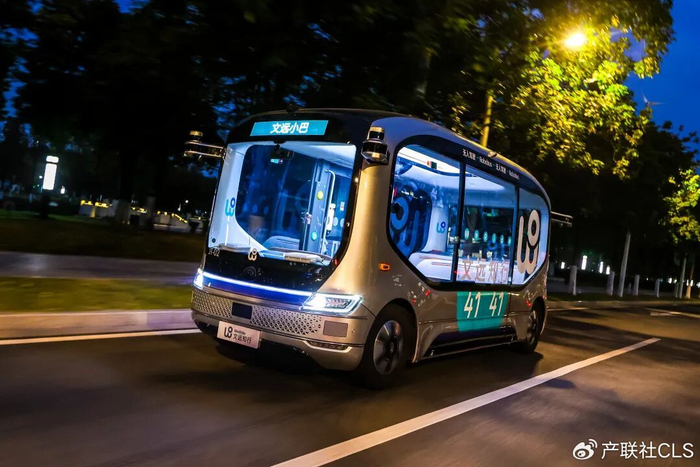
Figure: WeRide’s autonomous-driving microbuses
People’s Industry Union: Why are the mindsets different?
Han Xu: Young people are急 to prove themselves. Even if what they say is correct, they still have to prove it desperately. And for people who have already achieved success and fame, even if they’re saying clichés, everyone thinks they’re wise—because this person has already proven themselves. A diligent young person, even if they say something truly earth-shaking and useful, may not be remembered. But what a traffic celebrity or celebrity expert says will spread by word of mouth. So in this era, young people may be too eager to prove themselves, while successful people may have rigid thinking, believing every sentence they say is gold and jade. That’s not right either.
People’s Industry Union: Standing at the present, what do you think is your most distinctive trait?
Han Xu: First, I’ve always been a technical person. I have respect for technology. Capital can attract talent, but it cannot magically create original technology out of thin air. Second, my experience teaching at a university made me value talent development. The company continues to focus on employees’ growth. When recruiting fresh graduates, we’re not overly constrained by majors, but we care a lot about their learning ability during their undergraduate years.
People’s Industry Union: When it comes to talent recruitment, what do you value most?
Han Xu: What I value most is intrinsic drive—the intense desire to make things happen.
Editor’s note:
Han Xu’s “marathon theory” is essentially a calm correction to the noisy “endgame theory” of the moment. On one side, the rapid scale-up of L2++ brings short-term commercialization opportunities. On the other side, L4 driverless is waiting for the resonance of multiple conditions: regulation, cost, and technology. Running dual tracks in parallel, platformized reuse, and global expansion form WeRide’s core strategy for surviving cycles.
At the same time, industry disagreements also exist objectively: a dual-track layout keeps consuming cash, and the domestic Robotaxi scale-up deployment pace lags behind overseas. Under the wave of large models, the value of advantages built from traditional engineering accumulation weakens, and a new technological contest has just begun. Autonomous driving has nowhere near reached the finish line—every player is still at the starting stage of a long race.
A complete industry data report and market trend analysis—move to the 「People’s Industry Union」 client.