I recently looked into UniHexa. The problem it aims to solve is very straightforward: insufficient liquidity in the Bitcoin ecosystem.
Nowadays even CoinGecko has set up liquidity pools, but many tokens on Bitcoin are still relying on other people to take orders and fill bids. You might see a few million in market cap, yet when you actually want to sell, there aren’t many buy orders. With both buying and selling becoming difficult, retail users naturally aren’t willing to participate.
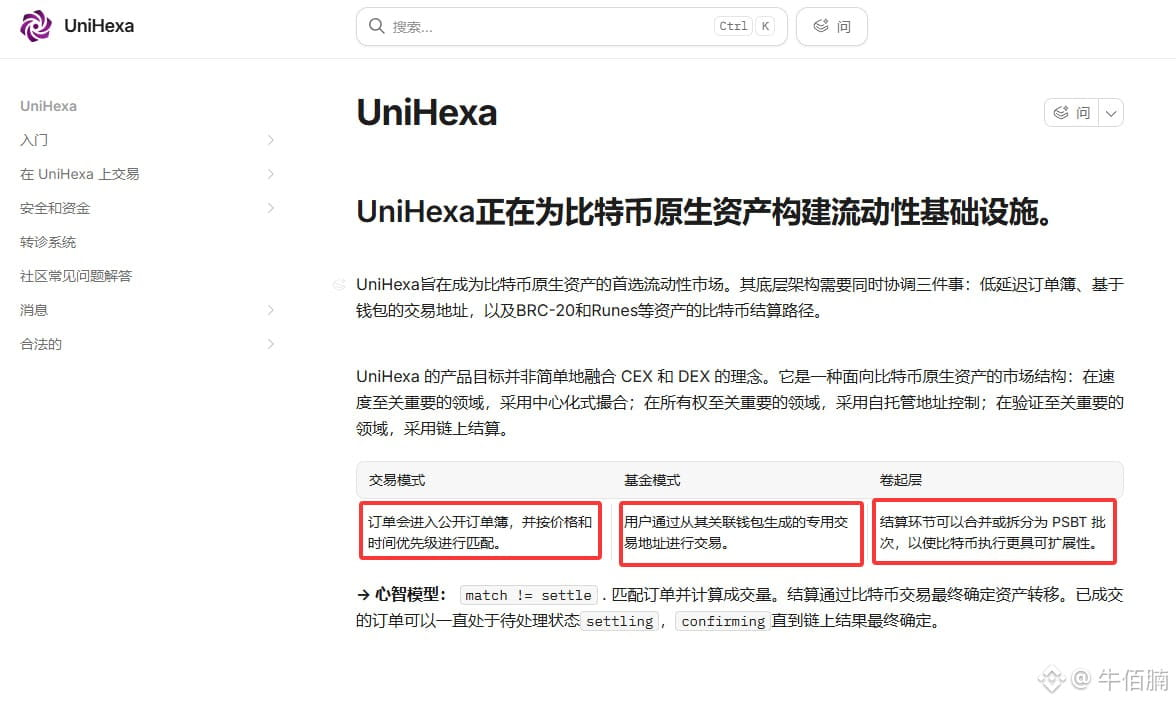
UniHexa uses an order book for trading. Both buyers and sellers post their own orders; the system matches them, then submits the trades to the Bitcoin chain for confirmation.
The experience is close to that of a centralized exchange—assets aren’t stored directly in the platform’s account.
Users receive a dedicated trading address and retain a clear path to transfer the assets directly out. The system handles matching and settlement, and operations require confirmation from 3 of the 5 signatures.
This design balances trading speed and asset control.
However, the fact that users can withdraw their funds doesn’t mean it is fully decentralized. How orders are matched and when settlement happens still depends on UniHexa’s system.
It also needs to distinguish between matching speed and settlement-to-arrival speed.
UniHexa can quickly display order matches, but the assets still need to wait for Bitcoin confirmations. The official claim of “CEX-level speed” mainly refers to the order placement and matching experience, not the speed of on-chain confirmation. #BTC突破7万大关 $BTC
Nowadays even CoinGecko has set up liquidity pools, but many tokens on Bitcoin are still relying on other people to take orders and fill bids. You might see a few million in market cap, yet when you actually want to sell, there aren’t many buy orders. With both buying and selling becoming difficult, retail users naturally aren’t willing to participate.
UniHexa uses an order book for trading. Both buyers and sellers post their own orders; the system matches them, then submits the trades to the Bitcoin chain for confirmation.
The experience is close to that of a centralized exchange—assets aren’t stored directly in the platform’s account.
Users receive a dedicated trading address and retain a clear path to transfer the assets directly out. The system handles matching and settlement, and operations require confirmation from 3 of the 5 signatures.
This design balances trading speed and asset control.
However, the fact that users can withdraw their funds doesn’t mean it is fully decentralized. How orders are matched and when settlement happens still depends on UniHexa’s system.
It also needs to distinguish between matching speed and settlement-to-arrival speed.
UniHexa can quickly display order matches, but the assets still need to wait for Bitcoin confirmations. The official claim of “CEX-level speed” mainly refers to the order placement and matching experience, not the speed of on-chain confirmation. #BTC突破7万大关 $BTC