


By | Silicon Valley 101
$1.65 trillion—if you stack $100 bills end to end, you can circle the Earth’s equator about 64 times. This number is the total bond issuance of the United States’ five largest data center operators today. And now, these liabilities seem to have mysteriously “disappeared.”
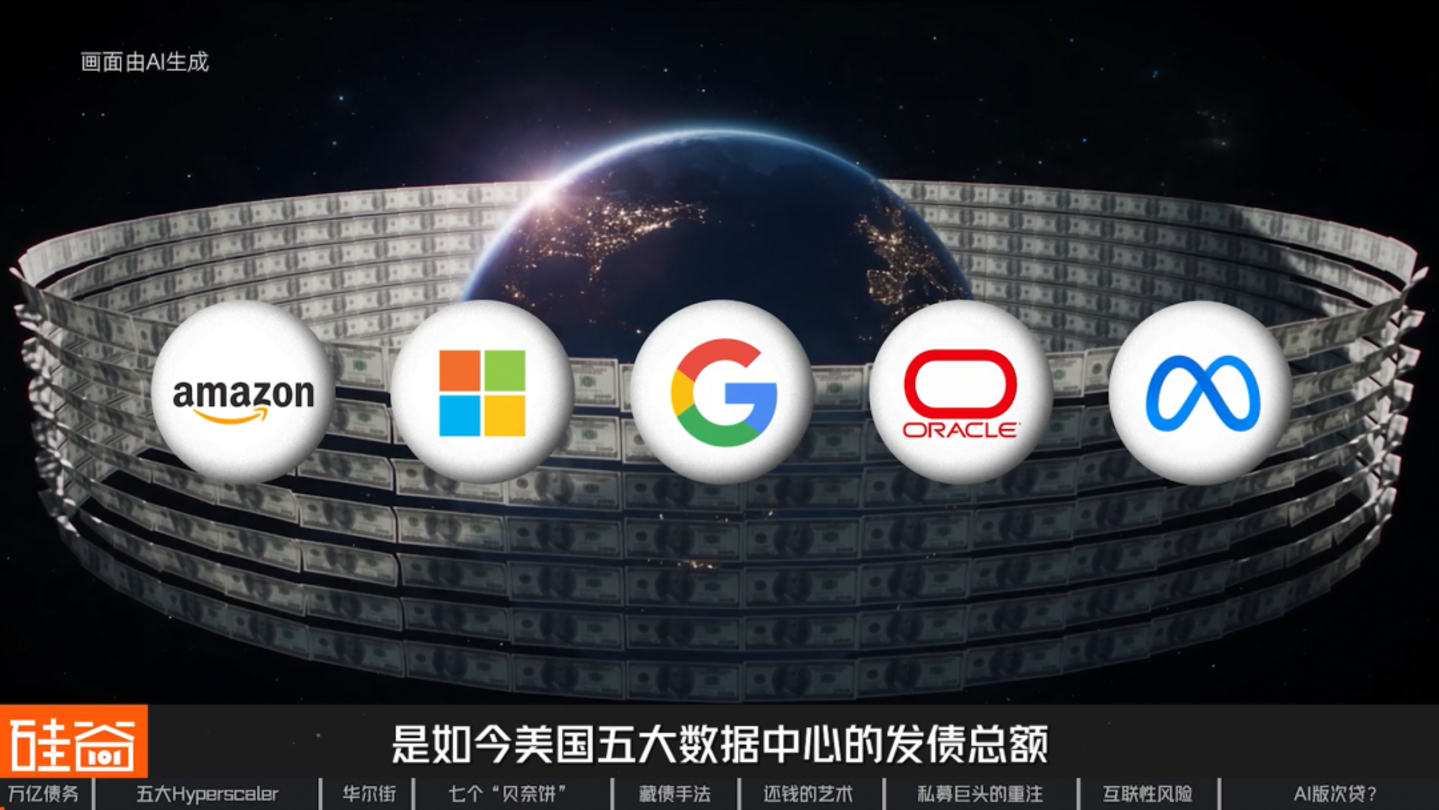
Where did they hide them? The Bank for International Settlements has given this practice a name: Shadow Borrowing. Today, the large cloud giants known as hyperscalers are using such methods to conceal their eye-watering debt figures, with the goal of presenting cleaner balance sheets.
This article is about the debt behind AI data centers.
We carefully reviewed all kinds of filings for large data centers and identified at least five different ways of hiding debt. How exactly are the giants making these liabilities “disappear”? Who are the backstage operators and real decision-makers in this financial game? And is there a subprime crisis emerging in the AI era?
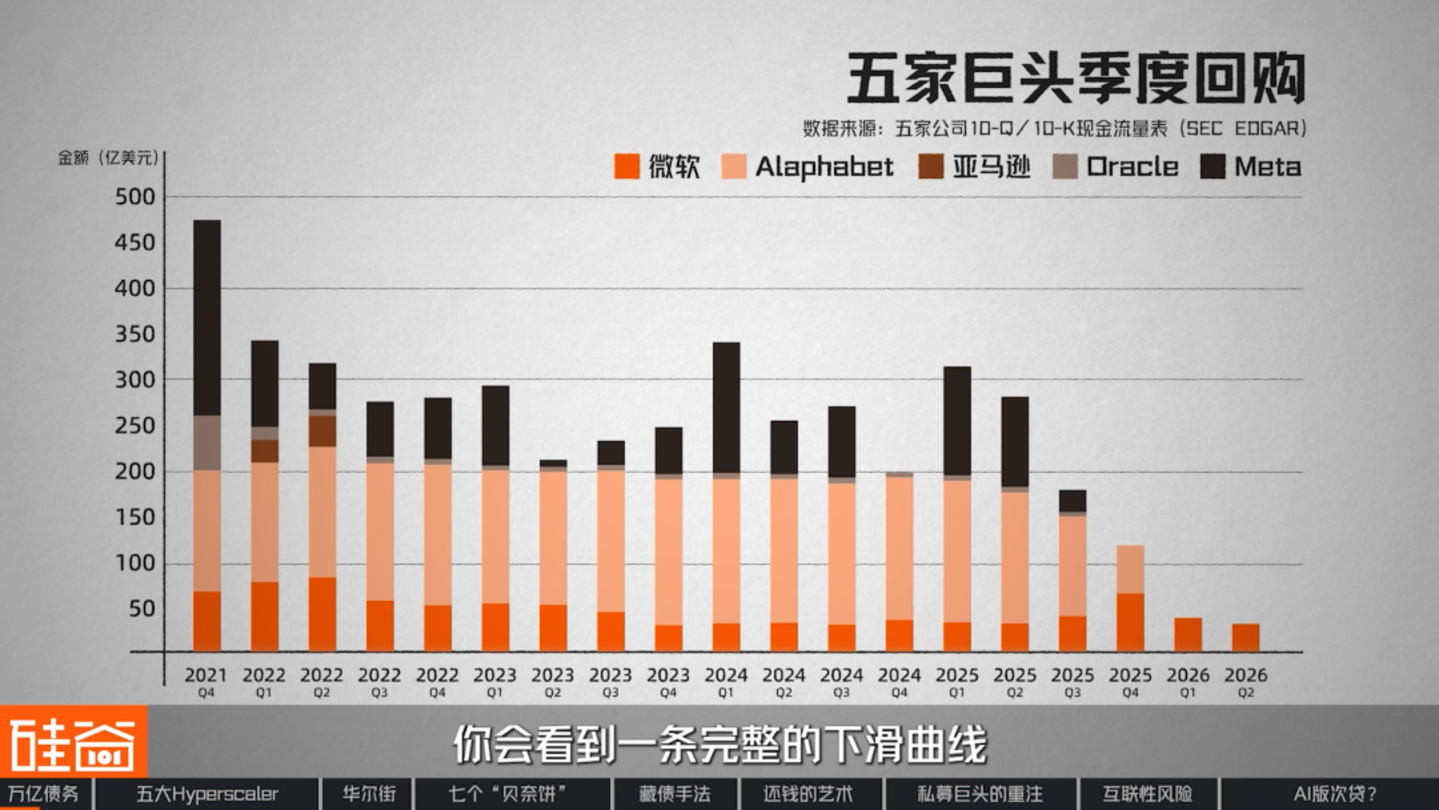
Today, the data centers of the five major hyperscalers—Amazon, Microsoft, Google, Meta, and Oracle—can be said to be the world’s most powerful money-printing machines. The tech giants have so much cash that they don’t know where to put it, so they do one thing over and over: buy back their own stock.
But now, something strange has appeared.
If we lay out the quarterly buybacks of the five giants since 2021, we can see a complete downward curve: in Q4 2021, four years ago, the five giants collectively bought back $48 billion in a single quarter, a historic peak; by the last quarter of last year, that was down to $12.9 billion; and in this year’s first quarter it was cut by nearly two-thirds again, to just $4.6 billion. In a little over four years, it has fallen by 90%.
Now the only one still buying back shares is Microsoft. Google stopped buybacks completely starting this year’s first quarter, Meta has had zero buybacks for three consecutive quarters, Oracle bought back less than $100 million in the entire last fiscal year, and Amazon hasn’t bought any since mid-2022.
You might think buybacks are something companies can do more or less of. But for these firms, it’s actually a signal: in the past they returned earnings to shareholders; now that money has to stay to build buildings.
So the question becomes: how can these five companies, sitting on hundreds of billions in cash, suddenly be short on money and need to tap shareholders’ funds? Let’s look at two lines first.

The blue line in the chart is the operating cash flow reported by these five hyperscalers—the money they “earned.” The orange line,
It is their annual capital expenditures, and a large part of the growth in spending is the money spent building data centers.
In a report published this June, the AI research institute Epoch AI ran a projection, extending the five companies’ operating cash flows and capital expenditures based on their trends since 2023: if operating cash flow grows about 23% annually while capex grows about 70% annually, the two lines would cross in the third quarter of this year.
In other words, before 2027, if the tech giants keep spending at the current pace, they will collectively “fall back into poverty” next year and return to the loss-making era. So the problem these companies face is that money is not coming in fast enough.
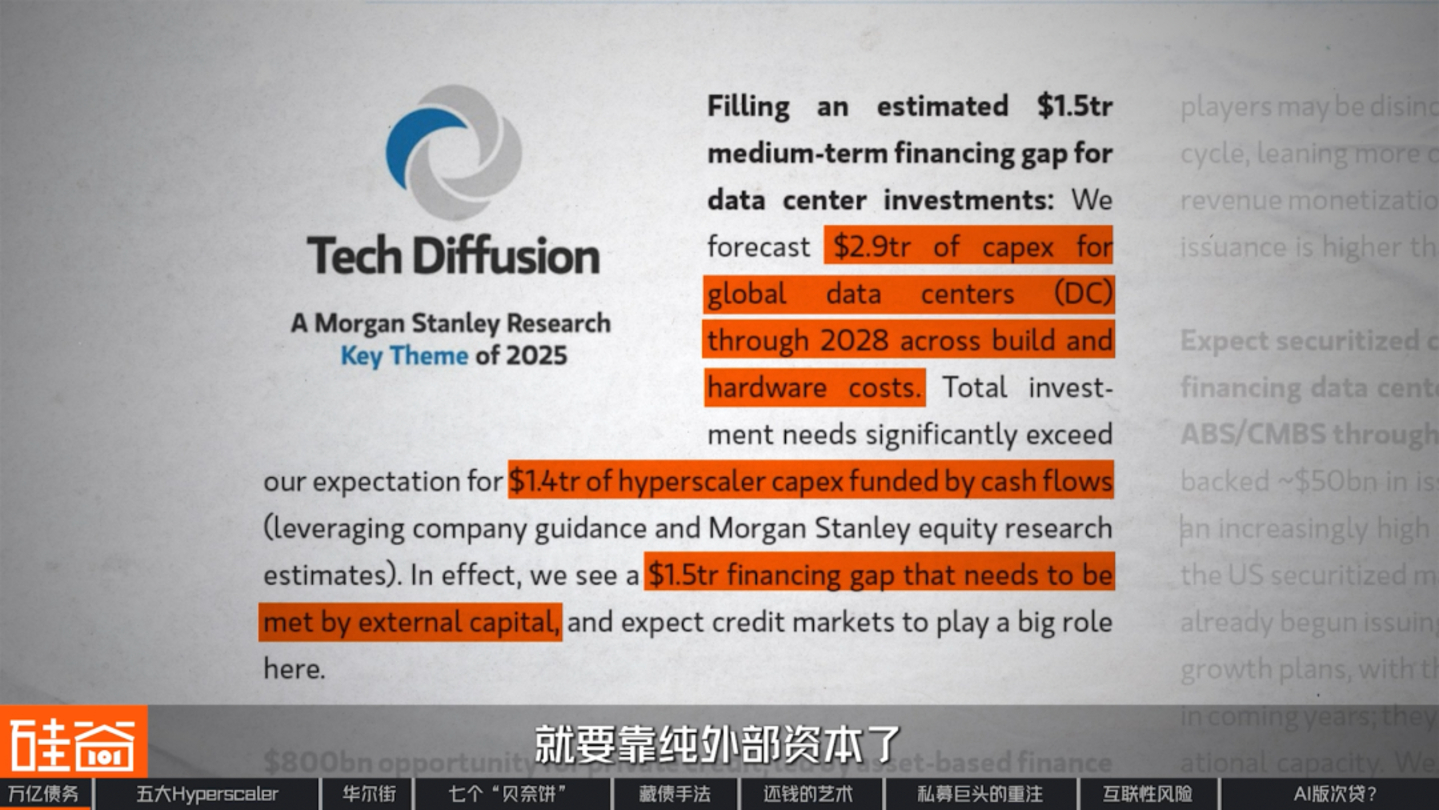
According to Morgan Stanley estimates, global data center capital expenditures before 2028 will be about $2.9 trillion, of which about $1.4 trillion can be covered by the cash flows of hyperscalers, while the remaining roughly $1.5 trillion will have to come from pure external capital.
So the five hyperscalers started issuing debt at a frantic pace. From 2020 to 2024, these five companies issued an average of about $28 billion of debt per year. But in 2025, that figure jumped to $108.3 billion. As of early August this year, the giants had already issued more than $200 billion, six times the prior annual average.
Still, there is one exception among the five, and that is Microsoft. From 2024 to now, it hasn’t issued a single public bond, and its total debt has actually gone down. That’s unusual, and we’ll explain the twist later in the article.
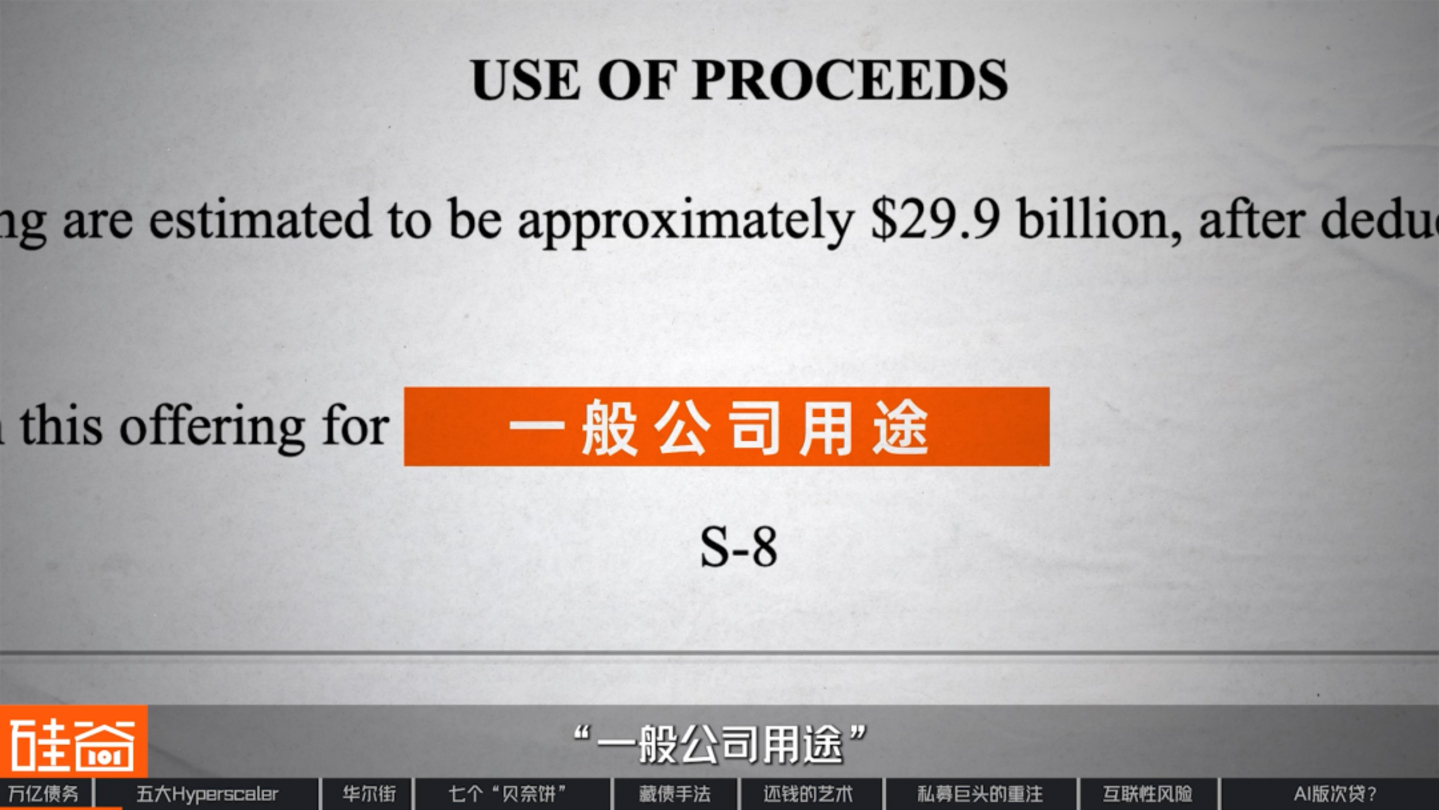
So the question is: what exactly was all that borrowed money used for? You might think, of course it went to buy GPUs and build data halls. But we read through all the prospectuses issued by these five companies over the past two and a half years, and in the “use of proceeds” section, looking for the words “data center” and “artificial intelligence,” the result was: they never appeared once.
Take the $30 billion bond Meta issued earlier: Meta itself said the money was to provide long-term financing for AI and data centers. But in the prospectus filed with the SEC, the entire “use of proceeds” chapter was basically just six words: “general corporate purposes.”
Oracle was the same way. When it issued debt in February 2026, it said the money was for expanding cloud customers, but the prospectus it submitted the next day instead wrote: “dividends and stock buybacks.”
So there is a very interesting mismatch here: the same money is “all in on AI” on earnings calls, but in the prospectus it becomes only six words: “general corporate purposes.”
The reason they are so evasive is simple: the former is a story told to shareholders, while the latter is a concrete statement that carries legal responsibility. The giants make their language in legal documents so vague precisely because they don’t want to publicly announce to the market that they are taking on massive amounts of debt.
But if the market is willing to buy it, and public debt is cheap, standardized, and large in capacity, why not just admit it openly? There are mainly three reasons:
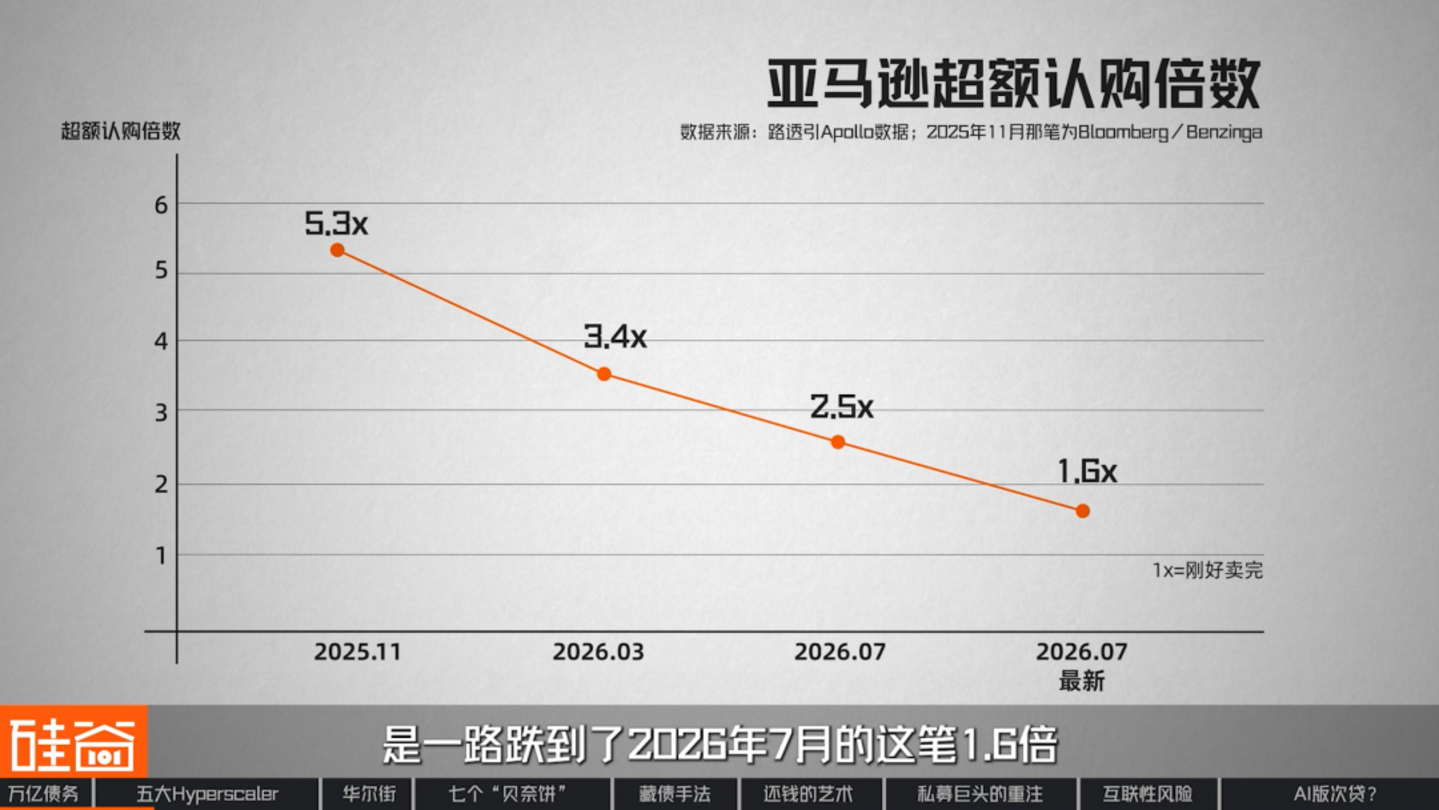
First, market appetite has limits. There is an industry metric for how easy a bond is to sell, called the oversubscription multiple—that is, how many times the market’s orders exceed the amount issued. The higher the multiple, the hotter the demand. For example, this metric for Amazon has been declining over the past nine months, falling from 5.3x in November 2025 to 1.6x for this issuance in July 2026.
There are concerns in the market that if the multiples are dropping this fast, the market is starting to get scared. But in our Silicon Valley 101 interviews, two Wall Street investors offered a different perspective.
Christina Xu
Silicon Valley AI Infra investor, head of “Silicon Valley Non-Consensus”
My understanding is that the issue of subscription multiples is because this market is still too new. It has more to do with issuers not yet learning how to line up than with market worries.
What’s called “new” here means this market only started last October. For example, when Meta’s second SPV bond of more than $12 billion came to market this year, several hundred billion dollars’ worth of other projects were also on the roadshow in the same window, all piled together. Add in the sentiment triggered by Google’s recent negative cash flow, and the result was a natural dilution of the subscription multiple.
Rob Li
Managing Partner, Amont Partners, New York
This has nothing to do with whether your pockets are full or not. It mostly reflects people’s willingness, much like an IPO. For example, when the bond is very tight, I may only need to buy 100 shares, but because I know there will be a lot of competition, I’ll apply for 200 shares.
So the multiples dropped not because the market ran out of money, but because everyone became more selective. In the same time window, several hundred billion dollars of public debt were all on the roadshow together, but the institutions willing to buy these assets were still basically the same group. And the amount of similar debt they can absorb over a period of time has a ceiling.
Once the pace of issuance exceeds this cap, the issuer is left with only two paths: either raise the interest rate to attract the money that was previously sitting on the sidelines and thought it was too expensive; or simply bypass this market and look for a whole new set of buyers.
Now, both of these things have already happened. Let’s first look at the price side.
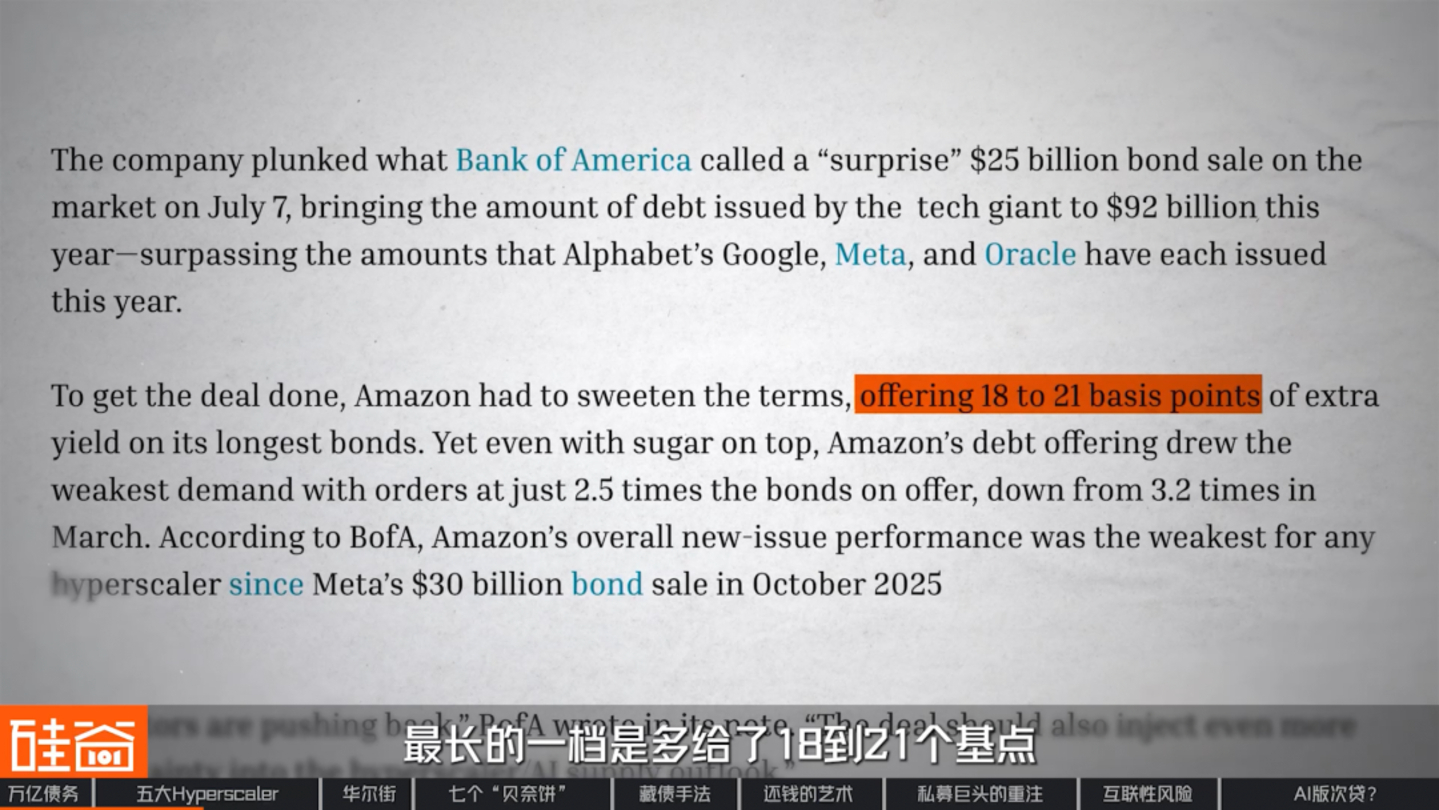
The cost of borrowing is changing too. In 2025, in the entire investment-grade bond market, issuers only needed to pay 2.25 basis points above secondary-market levels to sell. But by 2026, that rose to 12 basis points. Take Amazon’s deal this July as an example: the longest tranche required an extra 18 to 21 basis points, nearly five times the cost.

Those extra dozen basis points may sound small, but spread across hundreds of billions in issuance and terms of 20 or 30 years, they mean several billions of dollars more in cash out every year. Even worse, the cost of borrowing only keeps climbing like a staircase: the pricing of the current debt sets the floor for the next issue, and it also drags down the price of the company’s existing bonds in the secondary market.
In other words, the public bond route is not impossible for these five companies; it’s just that every step gets more expensive. And the speed at which it gets more expensive is even faster than the speed at which they build.
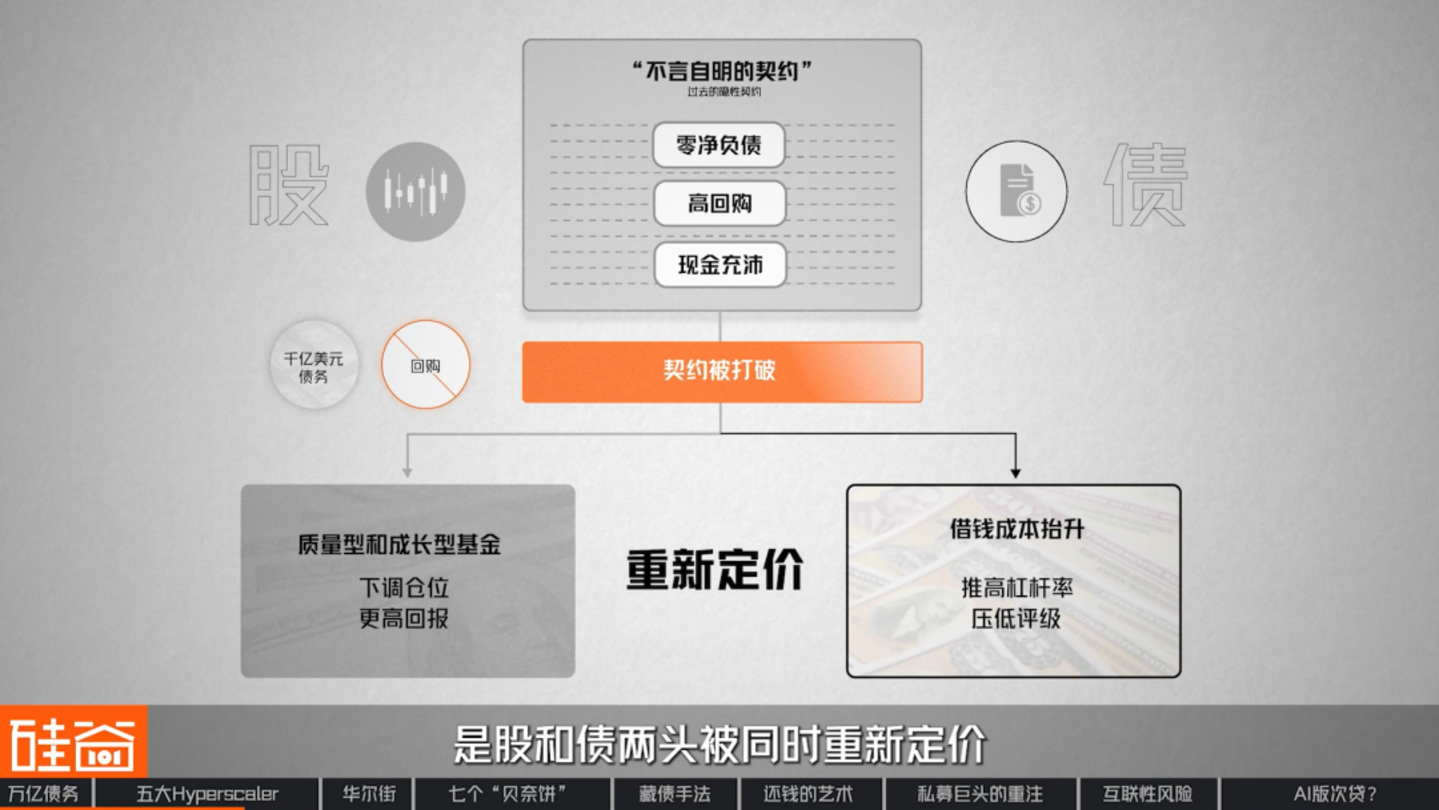
Second, too much public debt has broken the tacit understanding with shareholders. These companies used to be seen as having net cash on hand, barely any debt, and when they made money they returned it to you. Now they are taking on massive debt and cutting buybacks. CNBC commented that this breaks the “self-evident contract” between them and investors.
The reason this covenant matters is that it determines who today will end up holding these companies’ stocks. In the past, a large share of their buyers were quality and growth funds attracted by the profile of “zero net debt, high buybacks, ample cash.” Once hundreds of billions of dollars of debt start piling up on the giants’ balance sheets and buybacks are cut, the holding logic for those shareholders no longer holds.
They either reduce their positions or demand higher returns as compensation. On the bond side, new debt pushes up leverage and drags down ratings, making the next bond more expensive. So the cost of breaking the covenant is that both stocks and bonds are repriced at the same time.
The third reason may be the most fundamental one: money borrowed through public bonds is recorded one-for-one on the borrower’s balance sheet. This directly determines what rating agencies assign, and the rating in turn determines who is allowed to buy the bond.
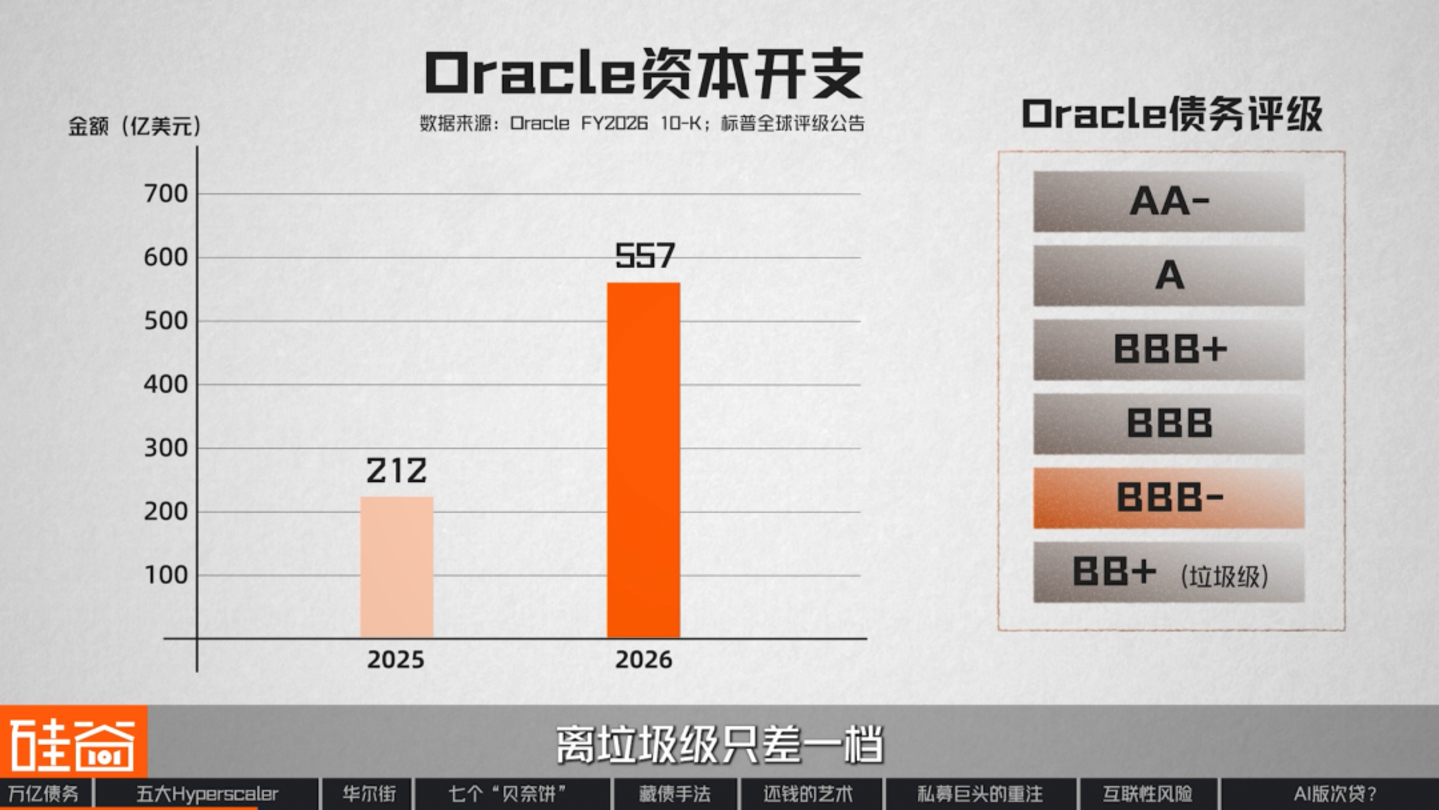
The most heavily pledged and most indebted of the five is Oracle, whose capital expenditures jumped from $21.2 billion to $55.7 billion in just one year. And this July, S&P downgraded Oracle’s debt rating from BBB to BBB-, just one notch above junk.
But if the rating only drops one notch, why are the consequences so severe? The issue is that falling out of investment grade is not just a matter of face—it’s also a matter of the buyer list.
Normally, institutions such as insurance companies and pensions—those with the deepest pockets but an extreme aversion to risk—have strict internal rating requirements. Once a rating is downgraded, it directly affects their judgment of the investment, and they happen to be the biggest buyers of these companies.
Christina Xu
Silicon Valley AI Infra investor, head of “Silicon Valley Non-Consensus”
Insurance funds also have investments in Oracle, though at the time they were relatively small because of this risk. If Oracle were to fall out of investment grade in the future, what they would care more about is whether Oracle would default. Because once it gets to default, equity holders will certainly take the first losses, and then creditors begin to bear losses. So they are not that worried about rating changes; they care more about the underlying credit, meaning the actual ability to repay.
Because this is private debt, once everyone wants to exit, it probably won’t be that easy to sell.
The real problem is not just “they have to sell,” but whether there will still be a buyer when they want to sell. So for these companies, the debt on the books cannot rise without limit. Once it reaches a certain point, the buyers themselves disappear. And Oracle may already be the one that has reached that point.
So to summarize, what these five companies really want is three things.
First, more money. Because the old buyers in the public market are already clearly unable to keep up.
Second, money with a longer duration. Building a data center takes ten or twenty years from breaking ground to recovering costs, and public debt can’t provide terms that are this long and this customized.
Third, and the hardest one: ideally, they want this money not to be so visibly recorded on their own balance sheets.
And the public bond market doesn’t provide all three. So who can meet all these requirements at once? Conveniently, around the same time, Wall Street also had a group of people in trouble. The best way to solve their problem was precisely to hand over all three things at once, and the match clicked instantly. Among the people on Wall Street, there is an institution called Blue Owl.

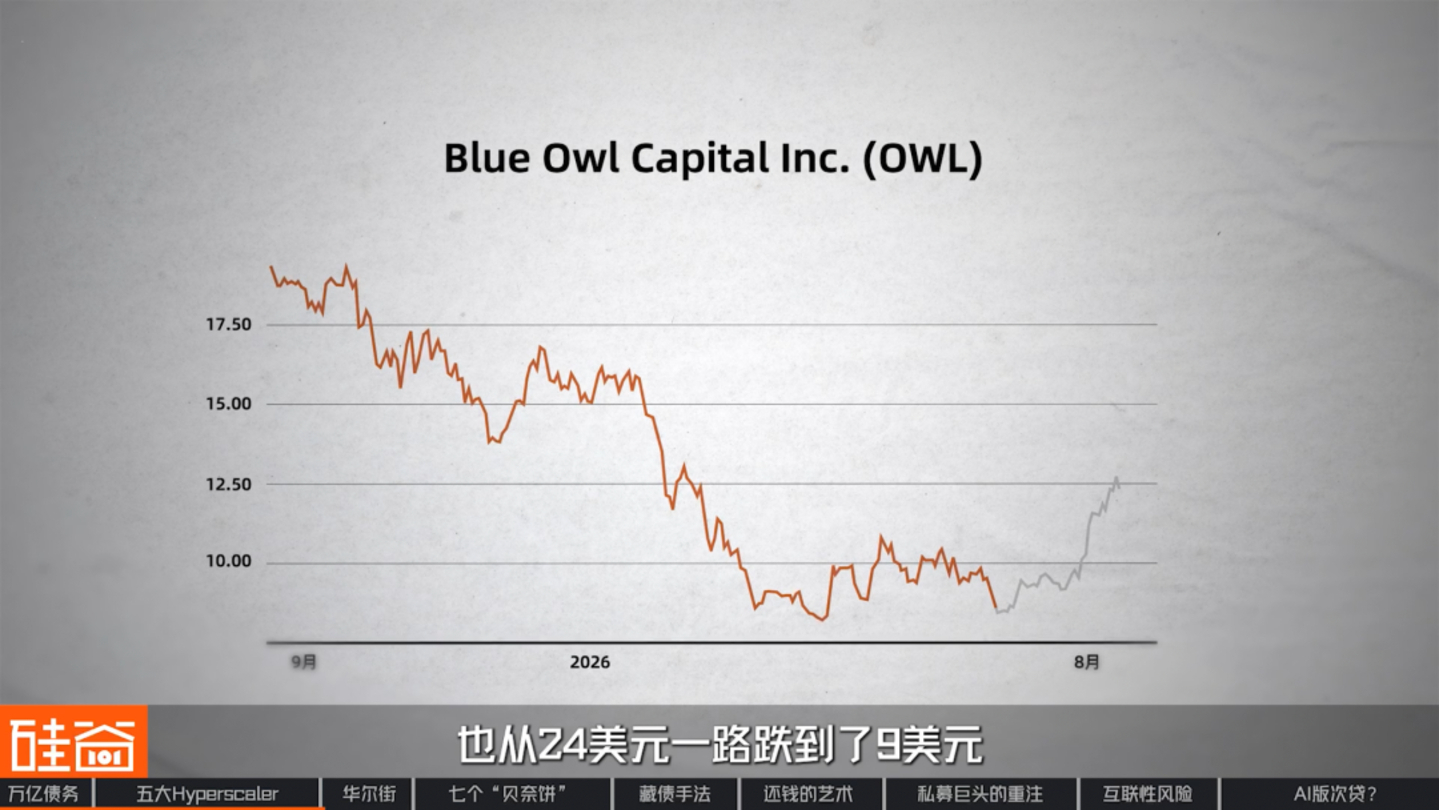
In the first half of 2026, Blue Owl, one of the world’s largest private credit institutions, saw one of its funds experience a 40% redemption run for two consecutive quarters. But in the end, it only paid out less than 15%, and the company’s stock price fell from $24 all the way to $9.
In other words, for every three people who wanted to take their money out, only one could actually get it. Why did this happen? Because the fund that was being run on by investors mainly invested in SaaS software, and software-company loans accounted for more than 60%—exactly the kind of asset Wall Street least wants to hold this year.
There are two keywords here: one is “loan rate,” and the other is “AI.” Put together, the two factors have caused the SaaS sector to crash several times in U.S. stocks this year. Since the peak in September 2025, software stocks have fallen by nearly 40%. In the past, investors were willing to give software companies very high valuations because of certainty: customers would renew every year, and revenue would keep rising. But now that certainty has been called into question, because the market believes AI will kill software.
The logic is simple: if a company can already build a good-enough tool using AI itself, why would it still pay subscription fees every year?
But interestingly, if you look at the fundamentals, things are not that bad. Microsoft’s M365 subscription business saw revenue growth rise from 15% to 19% over the same period. ServiceNow, Salesforce, and Snowflake also saw revenue stabilize or even accelerate in the latest quarter.
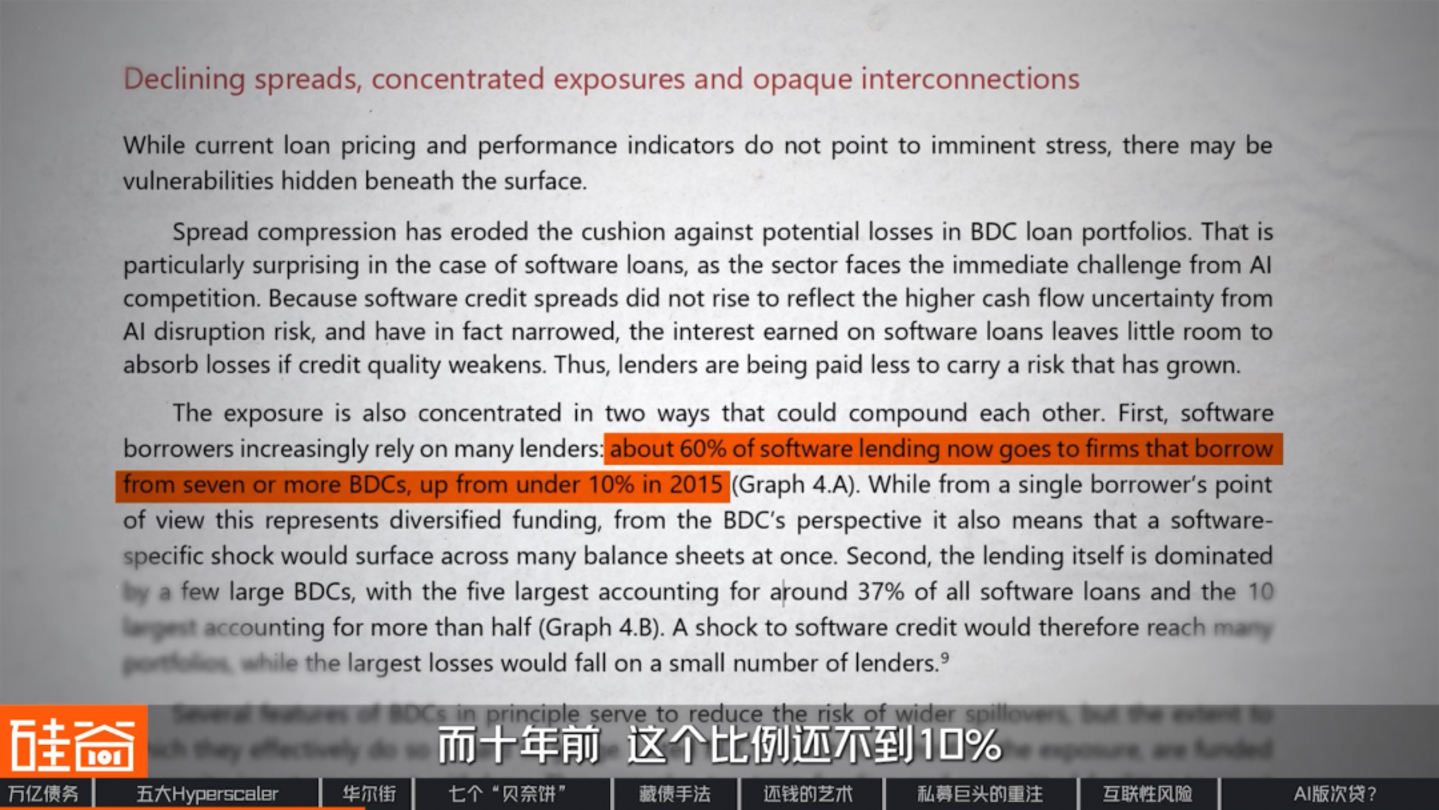
If the fundamentals are fine, then why did it crash so badly? That brings us to software loan rates. A report by the Bank for International Settlements this July showed that of all the loans private credit institutions have extended to SaaS companies, 60% went to businesses borrowing from seven or more institutions at the same time. Ten years ago, that figure was less than 10%.
So even if the SaaS business has not been hit by AI for now, once market sentiment turns, the credit logic of the entire SaaS industry may also start to loosen, and Blue Owl has acknowledged that.
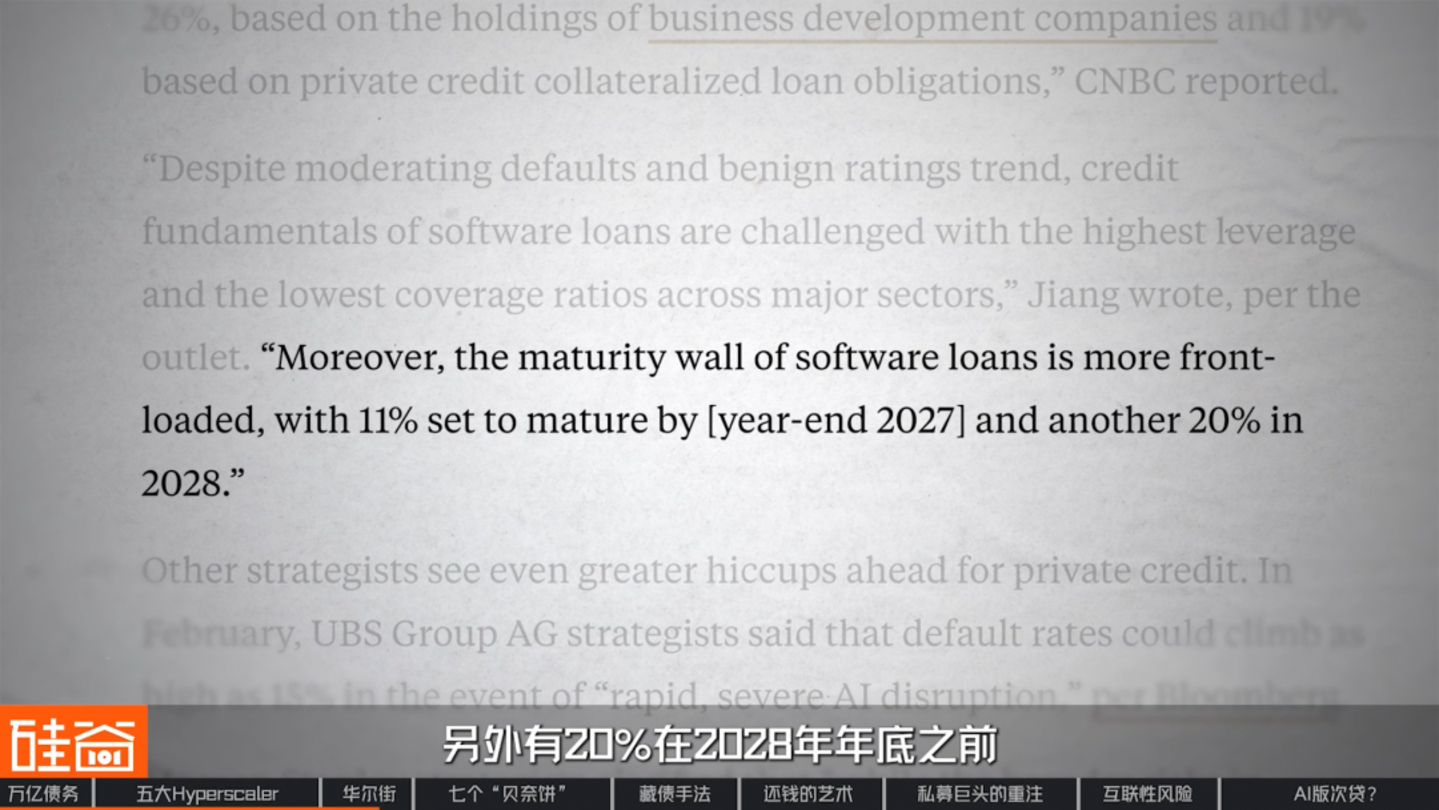
More importantly, the real test has not even arrived yet. According to Morgan Stanley’s calculations, about 11% of software loans will mature by the end of 2027, and another 20% by the end of 2028. That means asset-management giants must find a story that can get the market to buy in again before SaaS “fails.” And that story is AI data centers.
Christina Xu
Silicon Valley AI Infra investor, head of “Silicon Valley Non-Consensus”
In the past, the biggest asset class for private credit was actually software companies. But now that the software story is losing momentum, these investors are shifting that capacity over to data center debt.
For example, in December 2025, Blue Owl rejected Oracle’s data center project in Michigan on the grounds that it didn’t meet underwriting standards. But soon after, the deal was snatched up by another private asset-management giant, PIMCO, at a higher price.
In 2026, “抢单” battles around AI data centers have been happening almost every month on Wall Street. When the same data center project needs financing, several institutions can submit bids at the same time. Whoever offers the lower rate and looser terms wins the deal.
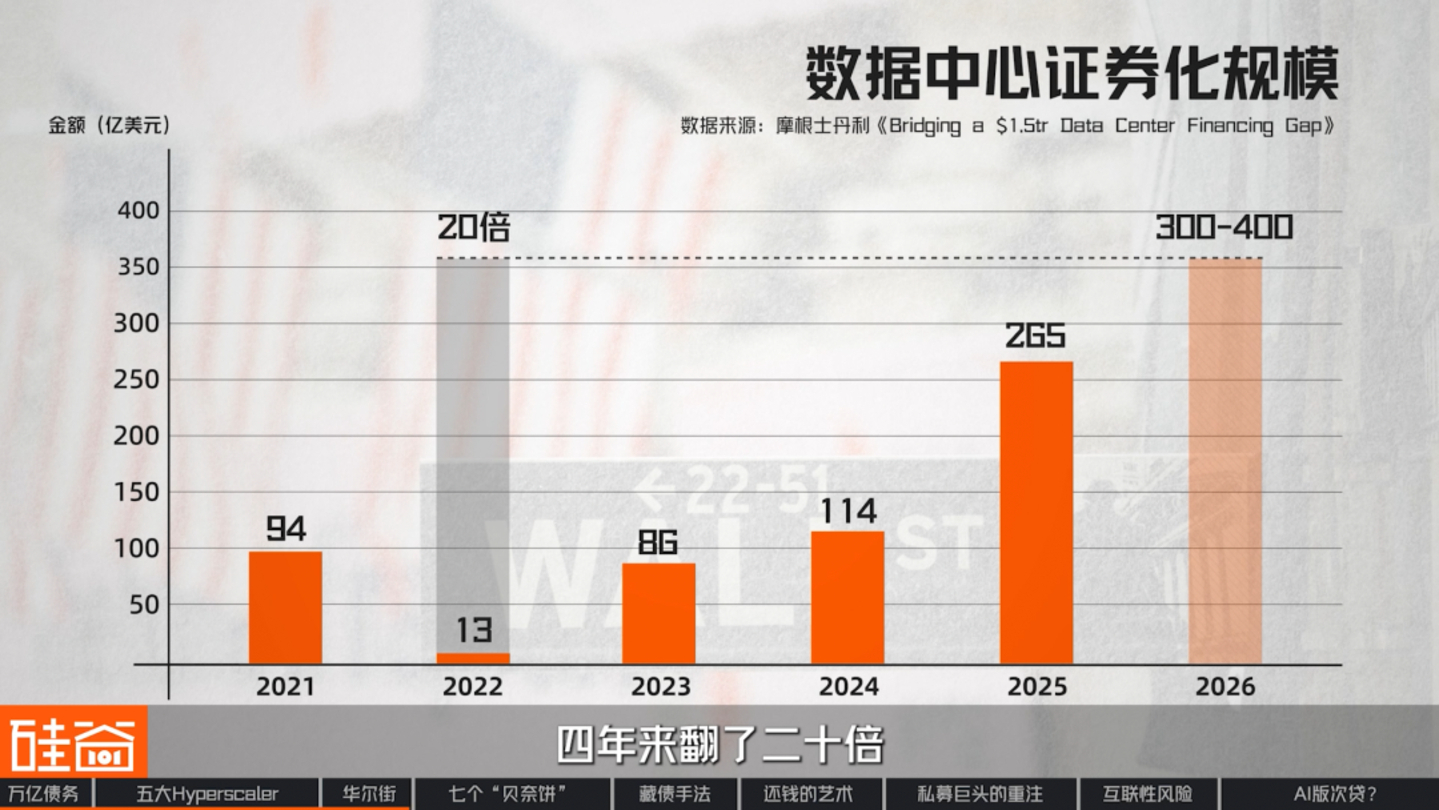
The scale of packaging data centers into securities and selling them to investors has risen from $1.3 billion in 2022 to $30 billion to $40 billion now—up twentyfold in four years.

And among all these transactions, the most symbolic one is Meta’s latest hyperscaler: Hyperion. Next, we’ll use it as a case study to break down the “debt-hiding” playbook step by step.

The Hyperion project borrowed a total of $27.3 billion. And on Meta’s own balance sheet, the only record related to this project is a $2.37 billion investment. Where did the remaining more than $20 billion go? Let’s break down their “debt-hiding tools” layer by layer.
▍Seven “Beignet”s
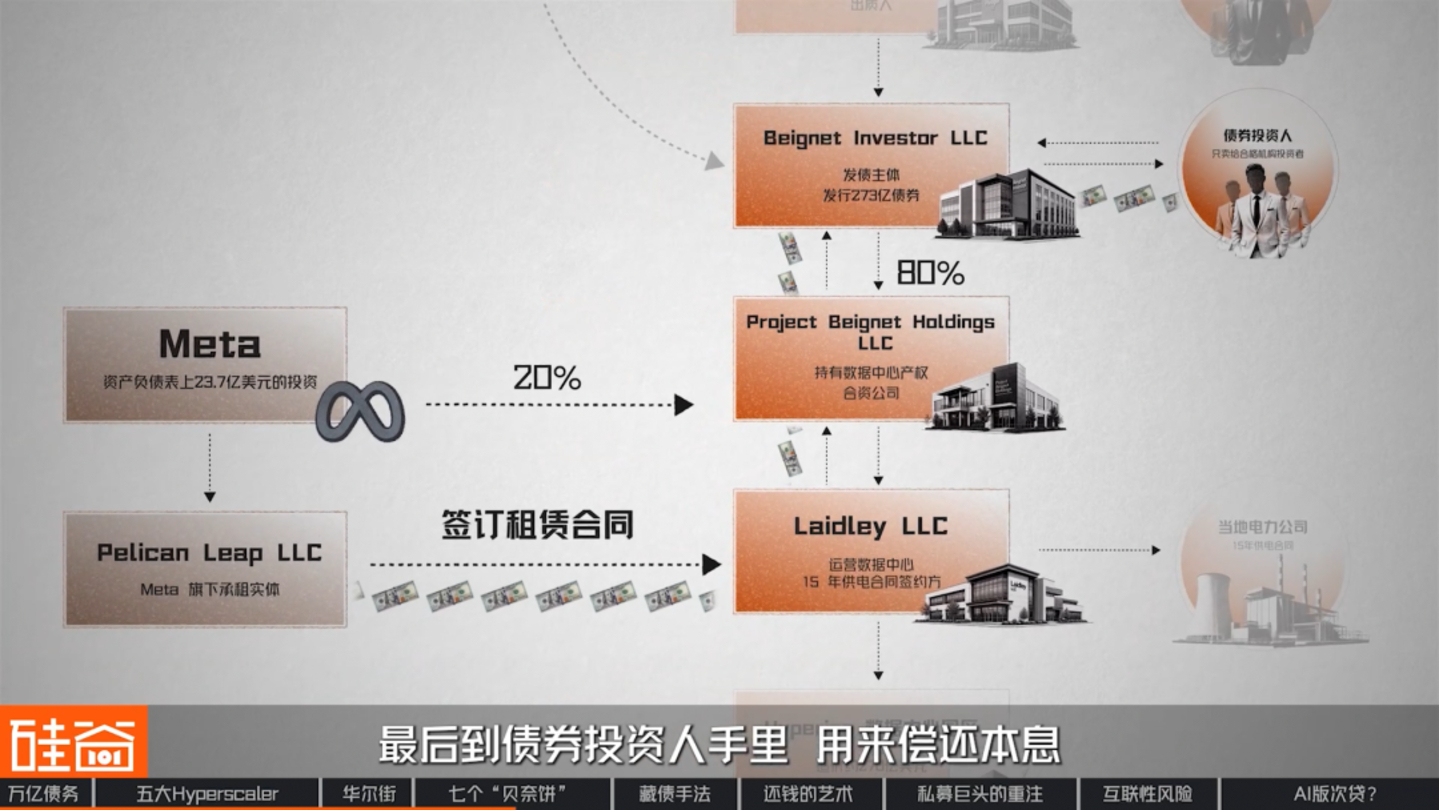
This data center is in Louisiana, registered under a company called Laidley LLC, which operates the campus and has also signed a 15-year power supply contract with the local utility company.
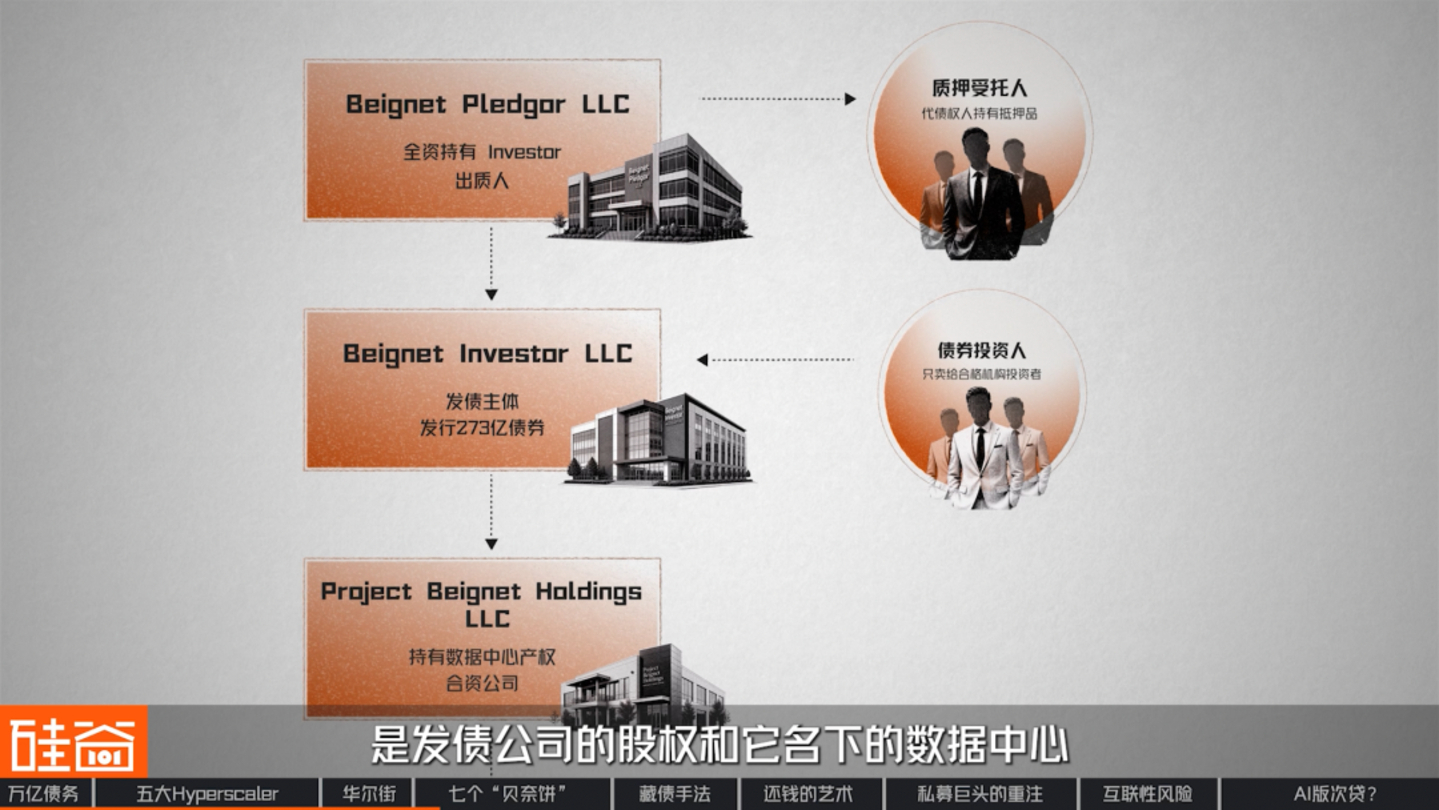
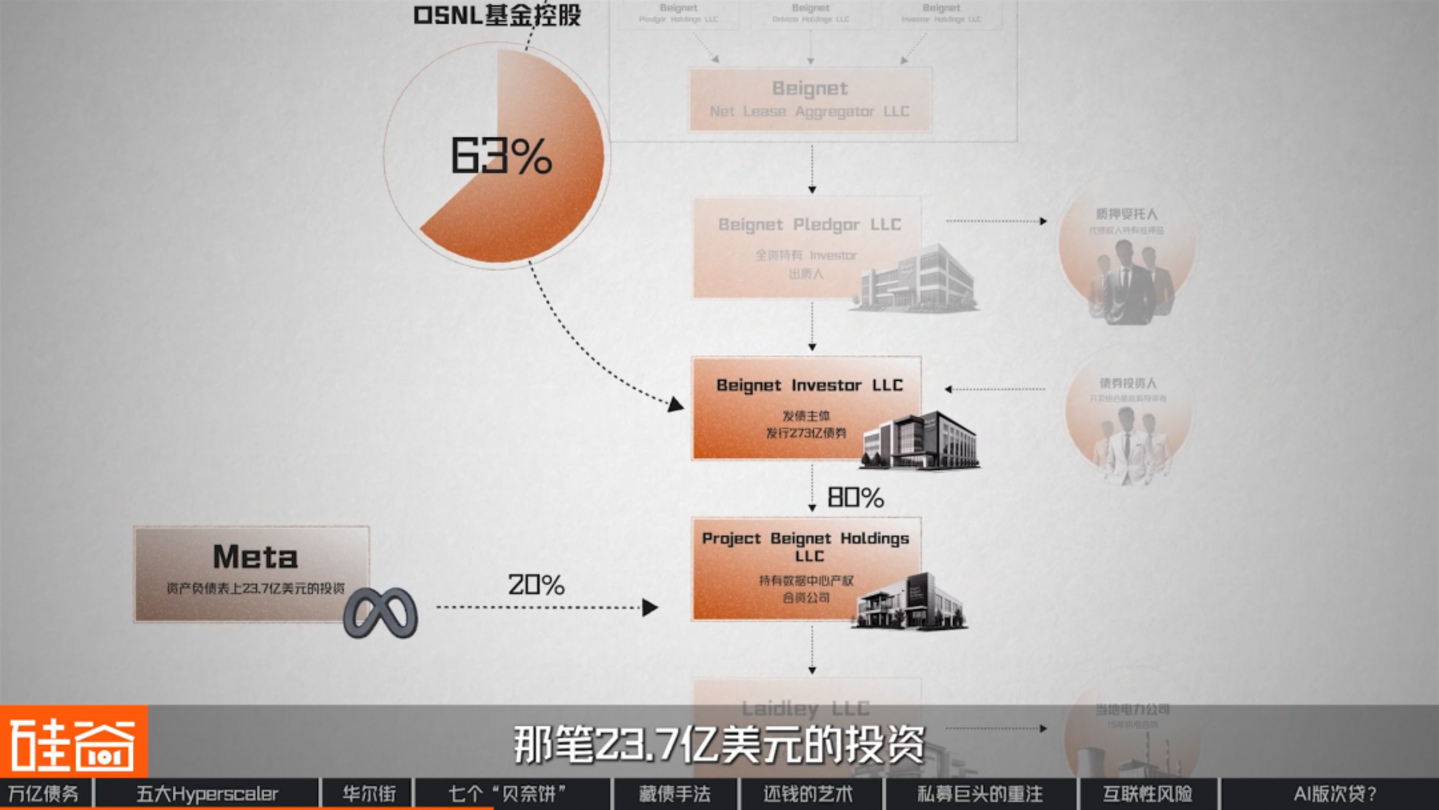
Above Laidley is Project Beignet Holdings, which holds the title to the data center. Above that is Beignet Investor, the issuer of the $27.3 billion bond. Higher up is a company called Beignet Pledgor, which wholly owns Beignet Investor. At the same time, it pledged those equity stakes to the trustee, so when creditors lend out the $27.3 billion, the collateral they get back is the issuer’s equity and the data center under its ownership.
Above Pledgor there are still four holding companies, one of which is called Beignet Net Lease Aggregator. It first pools all the investors into a shell, and then that shell company holds the equity. At the very top sits a fund called OSNL under Blue Owl, which specializes in net lease real estate. In addition, there is a group of co-investors contributing capital alongside Blue Owl. At this point, the Hyperion data center asset and its related debt have already been legally isolated.
Also, you’ll notice that all these companies have “Beignet” in their names. That’s a kind of fried pastry from the streets of New Orleans, and this “food-based naming method” follows the same logic as the naming of Meta’s large models.
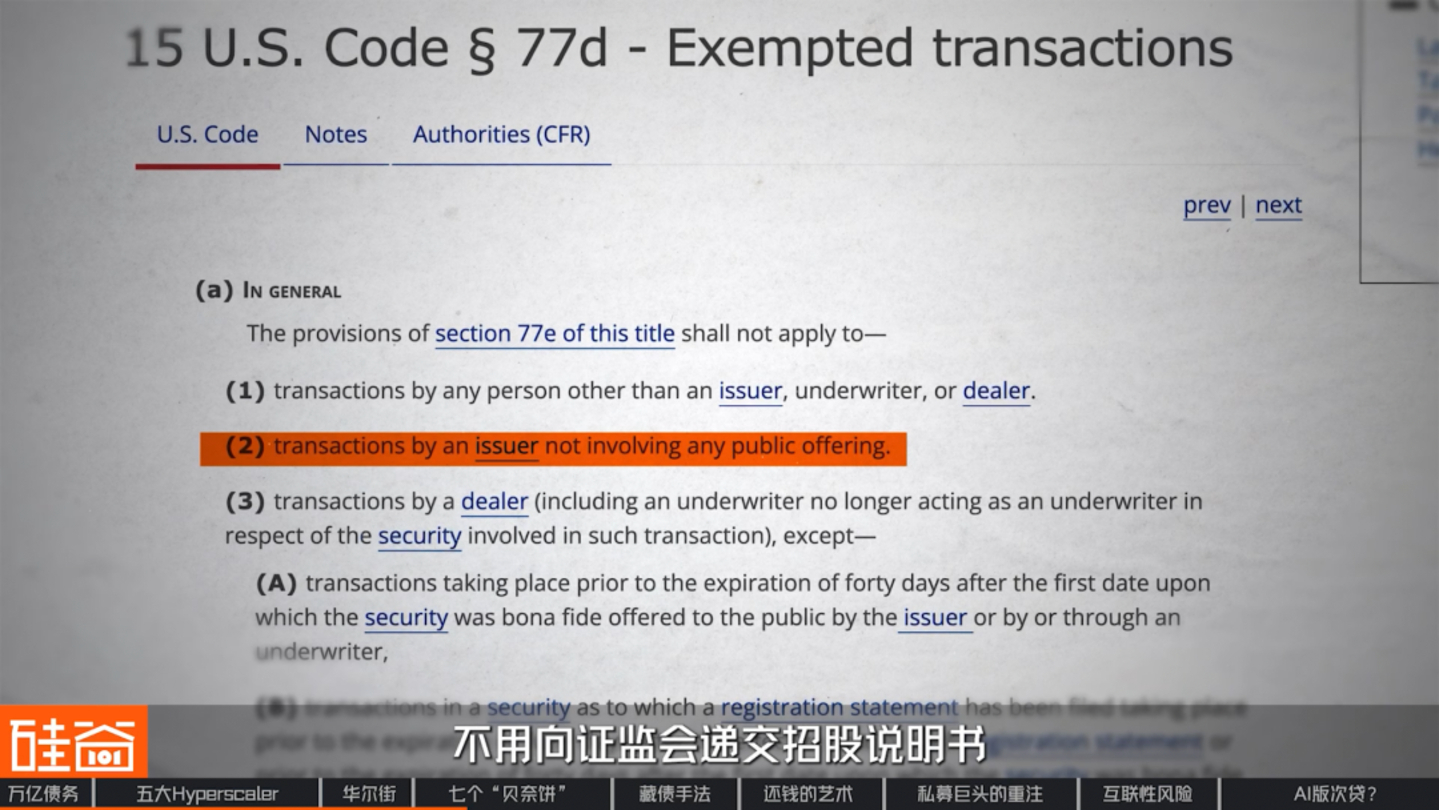
We checked the registration records of the seven companies with Beignet in their names. They were all registered in Delaware, within less than six weeks of one another. In Delaware, an LLC does not need to disclose its members or ownership stakes, and this $27.3 billion bond also does not need to file a prospectus with the SEC. In other words, it will never become a publicly registered bond.
▍Why isn’t the $27.3 billion on Meta’s books?
But legal isolation cannot really make debt disappear. This kind of shell-company structure is actually nothing new. In finance, it has a proper name: SPV (Special-purpose entity, a legal entity set up by a parent company for a specific project, where liabilities and risks are kept inside and do not enter the parent company’s balance sheet). Because it is so common, accounting standards have long been prepared for it.
There is a specific rule in U.S. accounting standards for this. The principle is: whether a debt should go onto your balance sheet mainly depends on two things.
First, do you have controlling power over the key decisions of the project?
Second, are you the primary beneficiary of the project?
And Meta’s answer is written in the equity structure. Blue Owl indirectly controls 63% of Beignet Investor, and then Beignet Investor holds 80% of Project Beignet Holdings—the company that actually owns the data center. The remaining 20% belongs to Meta, which is the $2.37 billion investment on Meta’s balance sheet.
Meta wrote it this way in its own financial statements: because it does not have controlling power over the most important operating activities of this joint venture, Meta is not the primary beneficiary, so it does not need to consolidate it. If the joint venture is not consolidated into Meta’s statements, then the $27.3 billion debt tied to it naturally disappears from Meta’s balance sheet.
But that raises the next question: if this debt isn’t on Meta’s books, does that mean Meta doesn’t have to pay it back? The answer is: of course it still has to be repaid, just by going around a circuitous route.
▍Where does the money for repayment come from?
Meta has a lessee entity called Pelican Leap, which signed a lease with the Hyperion operating entity Laidley LLC. Starting in 2029, Pelican Leap will pay rent to Laidley every month. The money first goes to Laidley’s books, then moves up through the chain of Beignet shell companies, and finally reaches the bond investors to repay principal and interest. So after all this roundabout routing, the money for repayment is still coming out of Meta’s own pocket.

Let’s look at the debt itself: the total amount is $27.29 billion, the coupon is 6.581%, it matures in May 2049, and it is fully amortizing. So this is basically a 24-year mortgage loan. But there’s another detail worth noting: the initial lease term is four years, starting in 2029, and Meta is given renewal options, with the maximum extension reaching 20 years.
But the problem is, this debt has to be repaid over 24 years, while Meta only leases for four. In other words, by 2033, Meta can choose to walk away. Then who repays the remaining more than $20 billion of debt? The answer is still in this lease.
▍The real collateral is Meta itself
Let’s look closely at this lease. In addition to the monthly rent, Meta also attached a residual value guarantee with an upper limit of about $28 billion. Meta wrote very clearly in its financial statements: if it decides not to renew the lease, or exits the campus, then the difference between the campus’s market value and $28 billion will be fully covered by Meta.
So the real collateral for this $27.3 billion loan is actually Meta itself. That conclusion can also be seen from the bond’s credit rating. S&P rated the bond A+, while Meta itself is rated AA-, which is essentially taking Meta’s own credit and stepping it down one notch.
Bruce Liu
CEO & CIO of Esoterica Capital (Jirong Investment), U.S.
Just because I give you a guarantee doesn’t mean you automatically get to enjoy my credit rating—that’s impossible. The market is not that naive. Its credit rating is lower than Meta’s, and the market will take Meta as a backstop, but it will not give you 100% credit recognition; there has to be a haircut.
Christina Xu
Silicon Valley AI Infra investor, head of “Silicon Valley Non-Consensus”
As an investor evaluating Meta, I’m not that concerned with which line it sits on—on-balance-sheet or off-balance-sheet—but rather with the fact that it is indeed a real obligation of Meta. The lease plus the residual value guarantee is essentially Meta’s long-term, fixed spending commitment, so I would include it in my model.
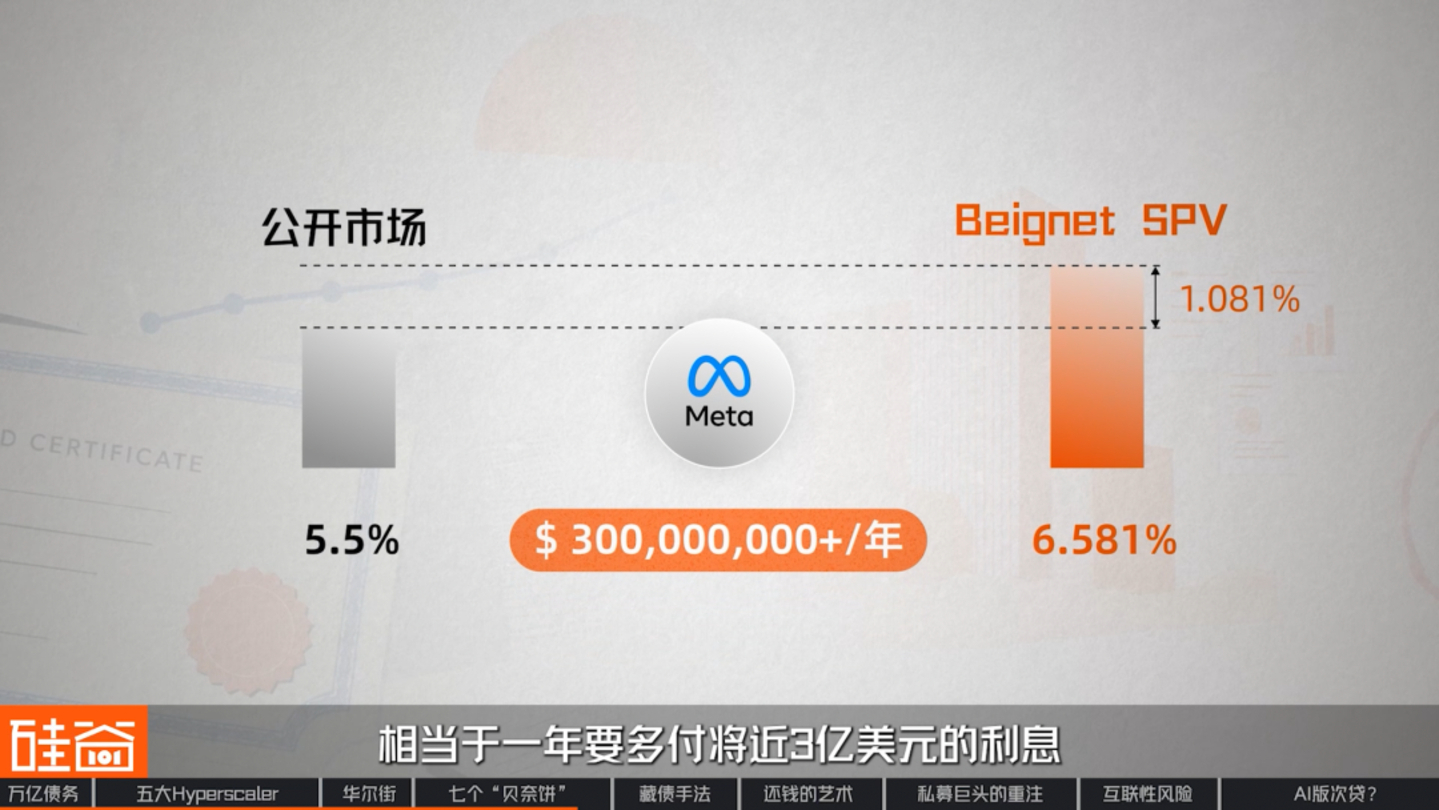
Of course, for Meta to get this clean balance sheet, it has to pay an extra price. If Meta were to issue a bond of the same term directly in the public market, the cost would be about 5.5%. But through the Beignet SPV structure, the borrowing cost is 6.581%, meaning it has to pay nearly $300 million more in interest every year.
Meta and Wall Street clearly didn’t plan to use such an expensive instrument just once. Then in July this year, the second deal arrived, called Sopaipilla, another Meta project in El Paso, Texas. It priced on July 27, ultimately issuing $12.5 billion at a 7.534% coupon, maturing in 2048, also fully amortizing, and with the same 80/20 equity structure. The only difference was that this time the party holding the 80% stake changed from Blue Owl to BlackRock.
In less than a year, Meta issued two data center bonds totaling nearly $40 billion. And the buyers of those two bonds were basically the same group of institutions. It can be said that Meta’s bond issuance structure has become very mature. But the current market still maintains fairly strict control over exposure to the risk of a single company issuing debt repeatedly and rapidly.
Christina Xu
Silicon Valley AI Infra investor, head of “Silicon Valley Non-Consensus”
I noticed that many large institutional investors who actually participated in these two Meta financings are much less involved this year compared with last year in the $12.5 billion project.
There are several reasons. First, they felt these two issuances came too fast and suddenly created a large number of investable assets. Second, as they invested more and more in data centers, the share of data centers in the portfolio had already become quite high. At that point, they needed to balance their credit allocation, so they would invest a bit less this year, but that itself has nothing to do with Meta.
We also went through the financial statements of the other four giants and found that when it comes to “issuing debt,” everyone really has their own tricks.
▍Microsoft: finance lease liabilities
As we said at the beginning, Microsoft is pretty unusual: no SPV shell, and no bond issuance. Over the past nearly two years, Microsoft’s total debt on the balance sheet has not increased but instead fallen, from $44.9 billion down to $40.3 billion, but that is actually a smokescreen.
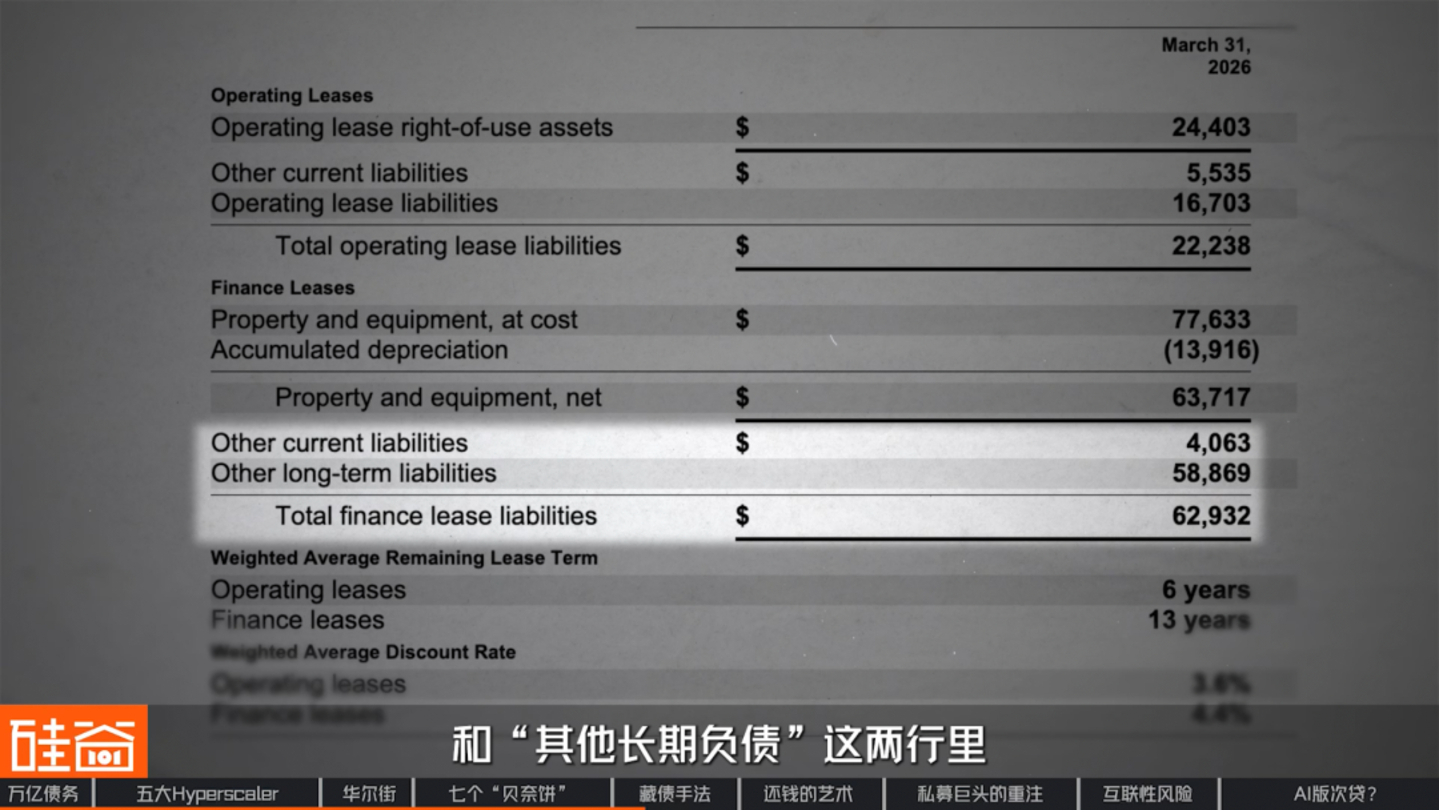
During that same period, Microsoft’s finance lease liabilities rose from $27.1 billion to $62.9 billion, more than doubling and even exceeding its total debt by more than $20 billion.
A finance lease is, in name, a lease but in substance an installment purchase, with the lease term covering almost the entire useful life of the building. Accounting treats it as if you had already bought it, just paying in installments, so the full amount has to be recorded as a liability. But on the balance sheet, it does not need to be written on the “debt” line, meaning you can’t see it on the face of the balance sheet. The $62.9 billion is indeed recorded on Microsoft’s balance sheet, but it is not called “debt”; instead, it is split into the lines for “other current liabilities” and “other long-term liabilities.”
▍Google: credit derivatives
Look at Google too—it has gone one step further than Microsoft. It doesn’t even set up a shell or hold equity; it only does one thing: it provides payment guarantees for data centers built by others, so they can borrow money. Google wrote one sentence in its financial statements: “If the other party defaults, we retain the right to take over the underlying lease.”
These guarantees were recorded in accounting as “credit derivatives,” and the book value surged from $16.9 billion to $43.8 billion within six months. But of that $43.8 billion, only a small portion made it onto Google’s balance sheet—namely, how much that guarantee is worth today. That portion totaled $815 million, less than 2% of the total amount.
▍“The honest one” Amazon
Amazon is the most straightforward of the five—it just borrows money and builds with it.
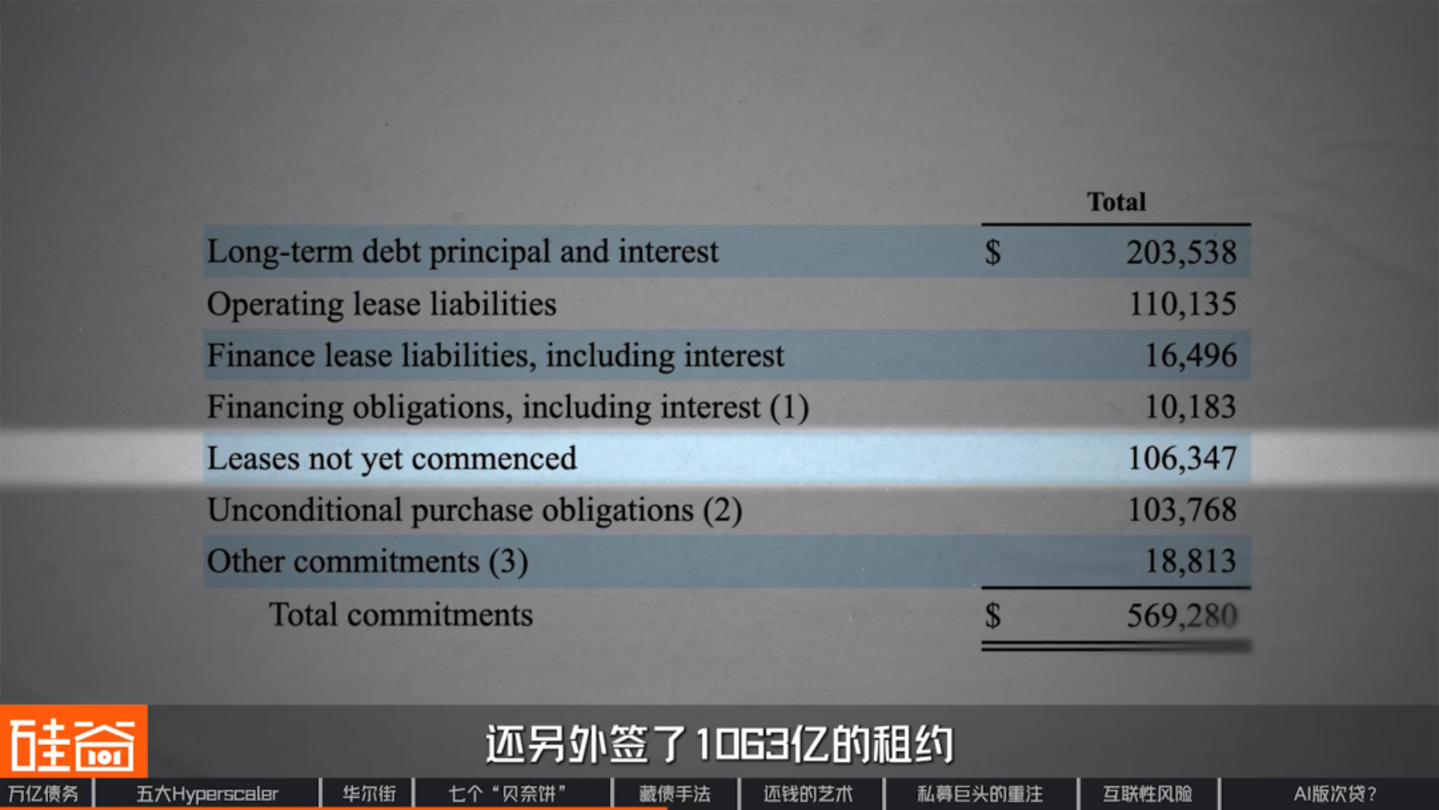
This March, Amazon issued more than $50 billion of debt in one go. But it also had another $106.3 billion in leases signed, which, like Oracle’s later on, did not make it onto Amazon’s balance sheet.
▍Oracle: the lease giant
Finally, Oracle does neither a shell structure nor guarantees; it just signs contracts.
Oracle’s signed leases total $260 billion, almost all related to data centers, with lease terms of 15 to 19 years. And these leases won’t even start until next year. That means that as of today, not a single cent of these lease liabilities appears on its balance sheet.
Overall, Meta uses an SPV shell, Microsoft uses finance leases, Google sells credit protection, and Amazon and Oracle rely entirely on leases. Their approaches are basically all different. But if you stack these five pictures together, you’ll find they are actually doing the same thing: what we call “the art of paying back debt.”
▍The art of paying back debt
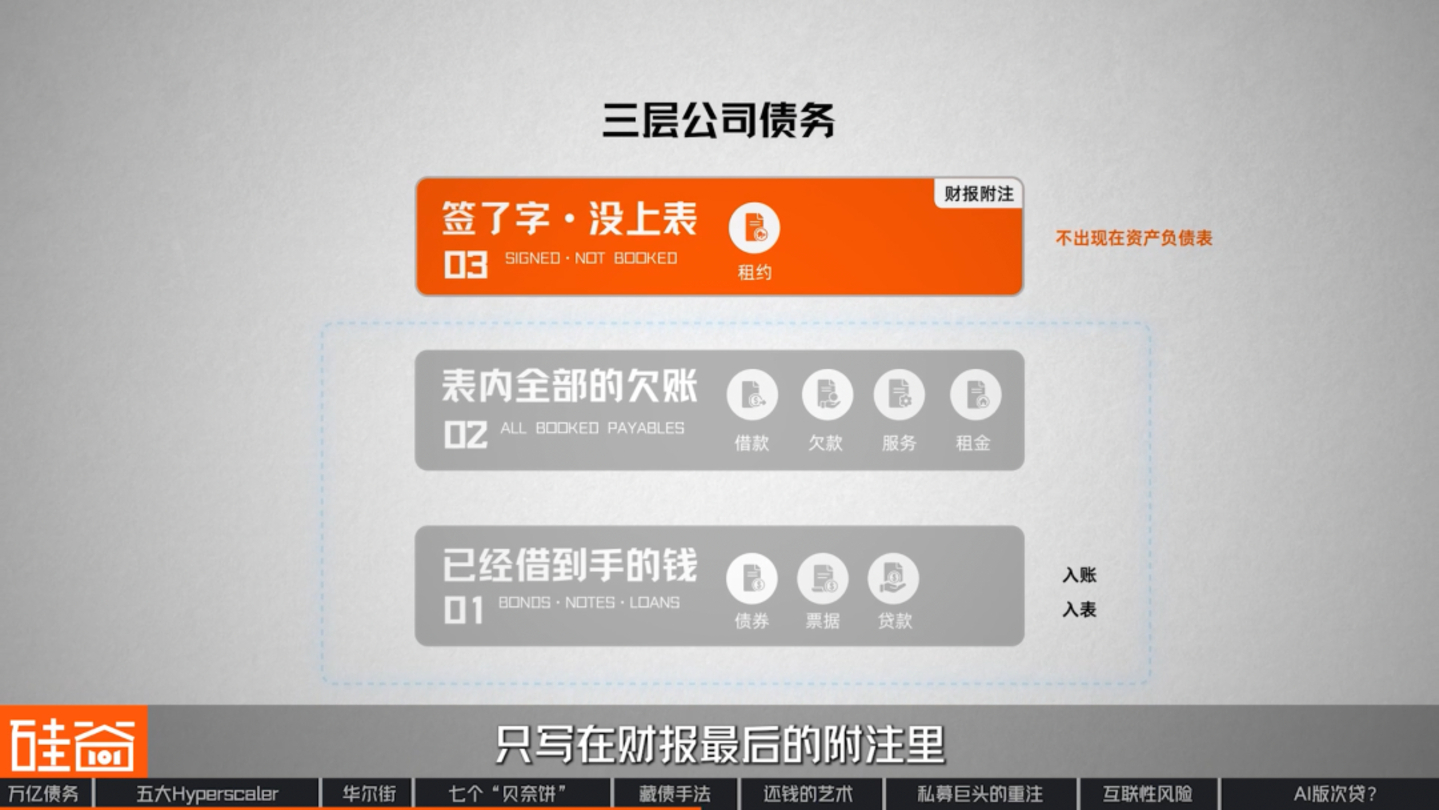
Let’s first establish a standard and divide a company’s debt into three layers.
The first layer is the money already borrowed. For example, bonds, notes, and loans—this is real money that has already entered the books and is truly recorded on the balance sheet.
The second layer is all the debts on the balance sheet. Besides borrowings, this includes things like money owed to suppliers, services owed to customers, and leases that have already started to be paid.
The third layer is what has been signed but hasn’t yet hit the balance sheet, such as “leases.” This layer does not appear on the balance sheet; it only shows up in the footnotes at the end of the financial statements.
So the question is: when does a payment that must be made in the future count as debt?
According to accounting standards, once you’ve received money, goods, or a building that is already usable, you have to record it. If you haven’t received anything yet, you don’t have to record it. This is the core method the giants use to hide debt: turn “building the building yourself” into “renting the building from someone else.” There are mainly three forms of renting:
The first kind is finance leases. They are on the balance sheet, but split into “other liabilities,” so they are invisible at first glance. Microsoft’s $62.9 billion debt belongs to this category.
The second type is operating leases. They are also on the balance sheet, but only for the small portion representing the present value of rent. For example, Meta’s lease only records four years of debt.
The third kind hasn’t even started leasing yet, so not a single cent appears on the balance sheet. Oracle’s $260 billion and Amazon’s $106.3 billion are both in this layer.
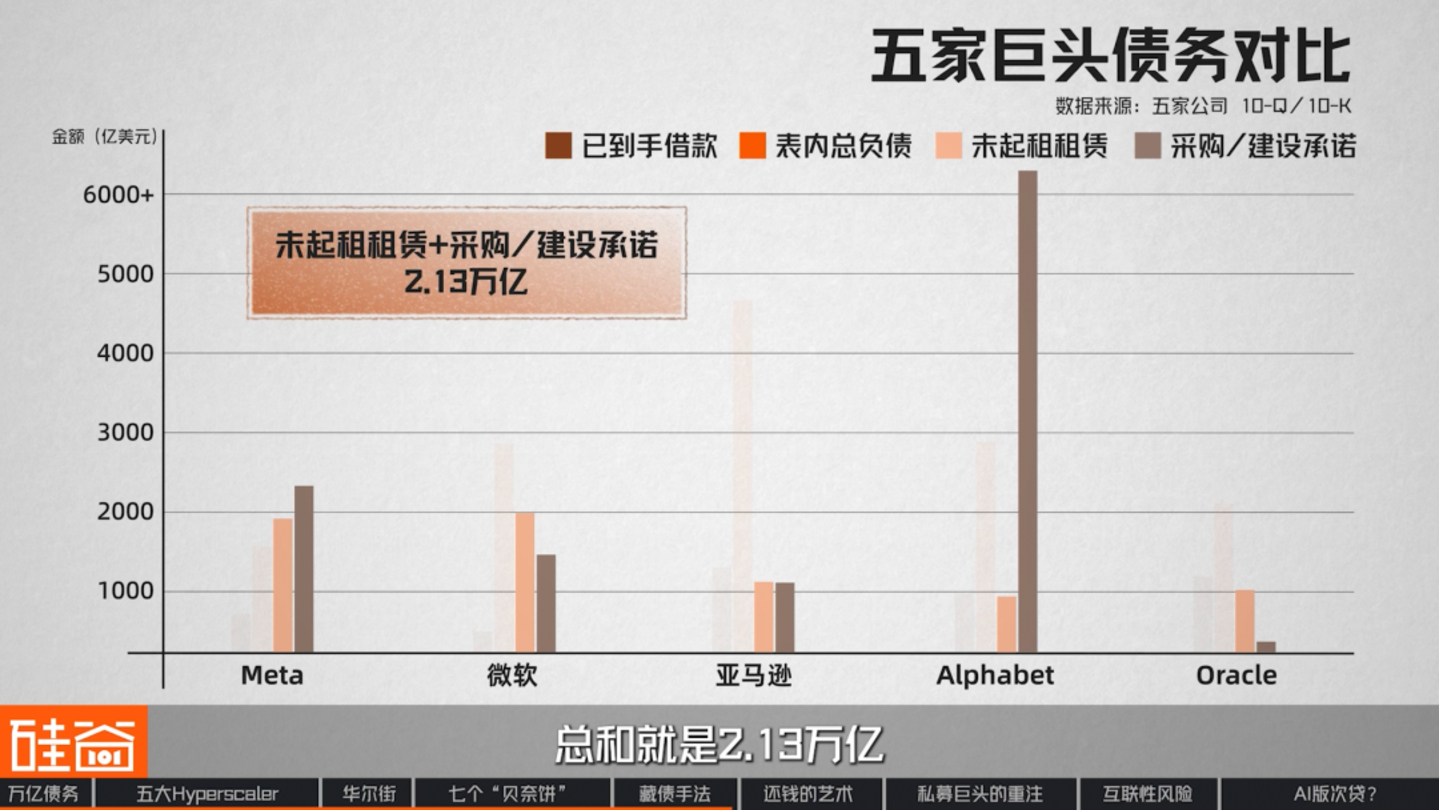
Let’s put the numbers for these five companies together: the money already borrowed totals $445.8 billion. And the leases signed but not yet on the balance sheet amount to $831 billion—almost double. If you include procurement and construction commitments, the total comes to $2.13 trillion.

This is the money that ultimately has to be paid out behind AI data centers. When Silicon Valley and Wall Street come together like this, is there any risk in the game?
▍Wall Street’s “financial knife work”
By here, we’ve already gone through the different approaches of the five giants. If you line them up, you’ll find it’s a financial product chain extending downward step by step. The farther down you go, the more expensive the price and the higher the risk.
Bruce Liu
CEO & CIO of Esoterica Capital (Jirong Investment), U.S.
At the beginning, these companies were historically very cash-rich, and they could rely on burning their own cash flow to do it, but that is definitely not possible now.
Further down are company bonds issued by Meta, Microsoft, Amazon, and others. Then lower still are project-based financing or joint ventures. After that, they help companies like CoreWeave and Nebius issue debt.
Then moving further down are some recent loans backed by GPUs, which didn’t exist before. So from a risk perspective, it’s a gradual move from the top downward.
Of course, in this AI arms race, it’s not only the giants who need to borrow. Wall Street has also prepared a full range of financial products for everyone. Among the most noteworthy are loans secured by graphics cards as collateral.
Christina Xu
Silicon Valley AI Infra investor, head of “Silicon Valley Non-Consensus”
For example, this large insurance company had already invested in debt similar to Meta’s, but had not previously done GPU-related debt. Now, they are also starting to try shorter-duration credit tied to GPUs.
They were discussing that this is a relatively new attempt. In their portfolio, GPUs and data centers are both AI assets, but they belong to different allocations.
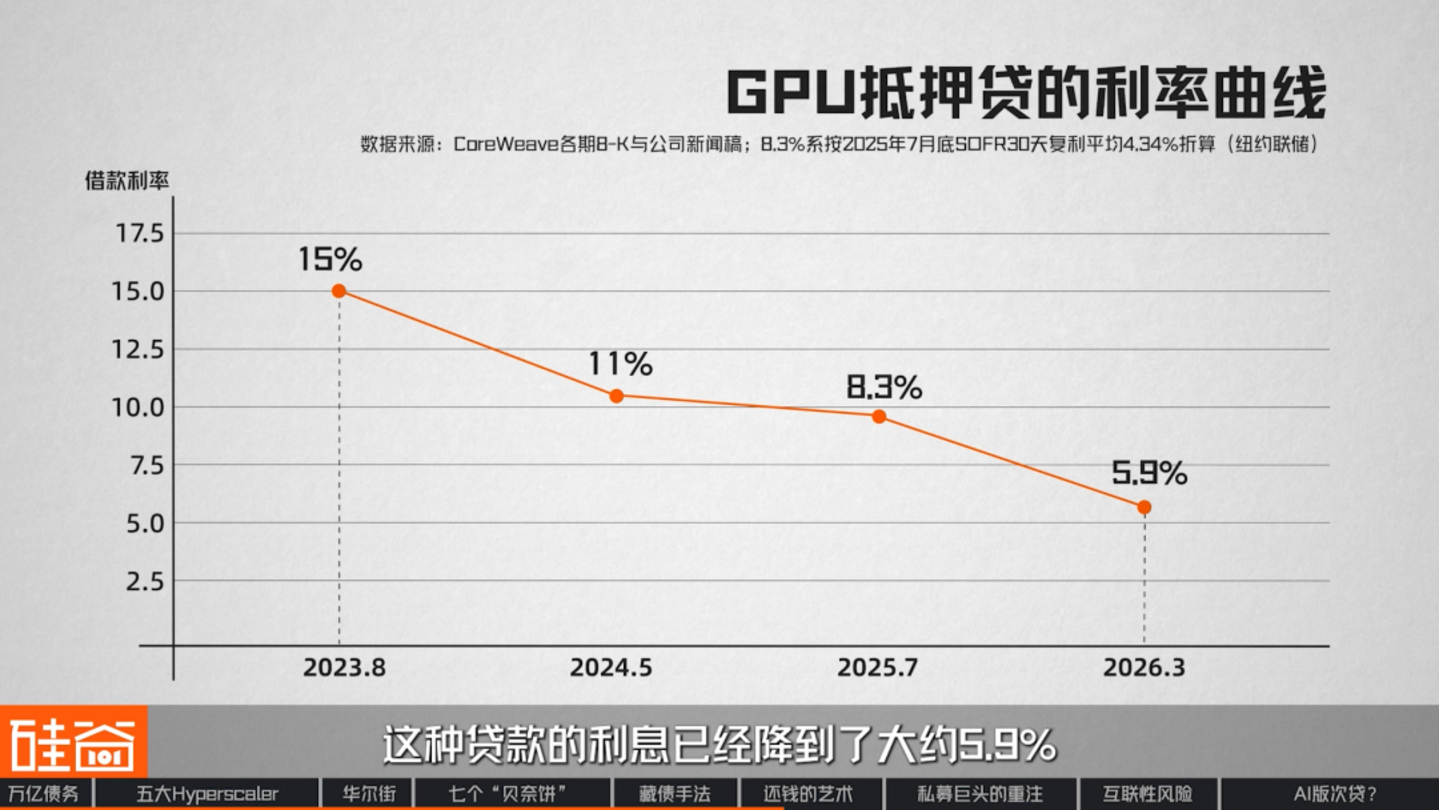
In 2023, AI cloud provider CoreWeave would have had to pay about 15% interest to borrow this kind of money. By March this year, the interest rate on such loans had fallen to about 5.9%, and they could even get investment-grade ratings. In other words, in less than three years, Wall Street has already come to treat graphics cards as a new hard asset, and the boundary of that asset class is still expanding.
In July this year, General Compute, a reasoning-cloud company founded only in 2026, borrowed $400 million using a batch of inference-specific chips as collateral. This was also the first time inference chips became the main collateral for a large AI loan. And not long before that, the conversion of graphics cards into assets was pushed to a new level.
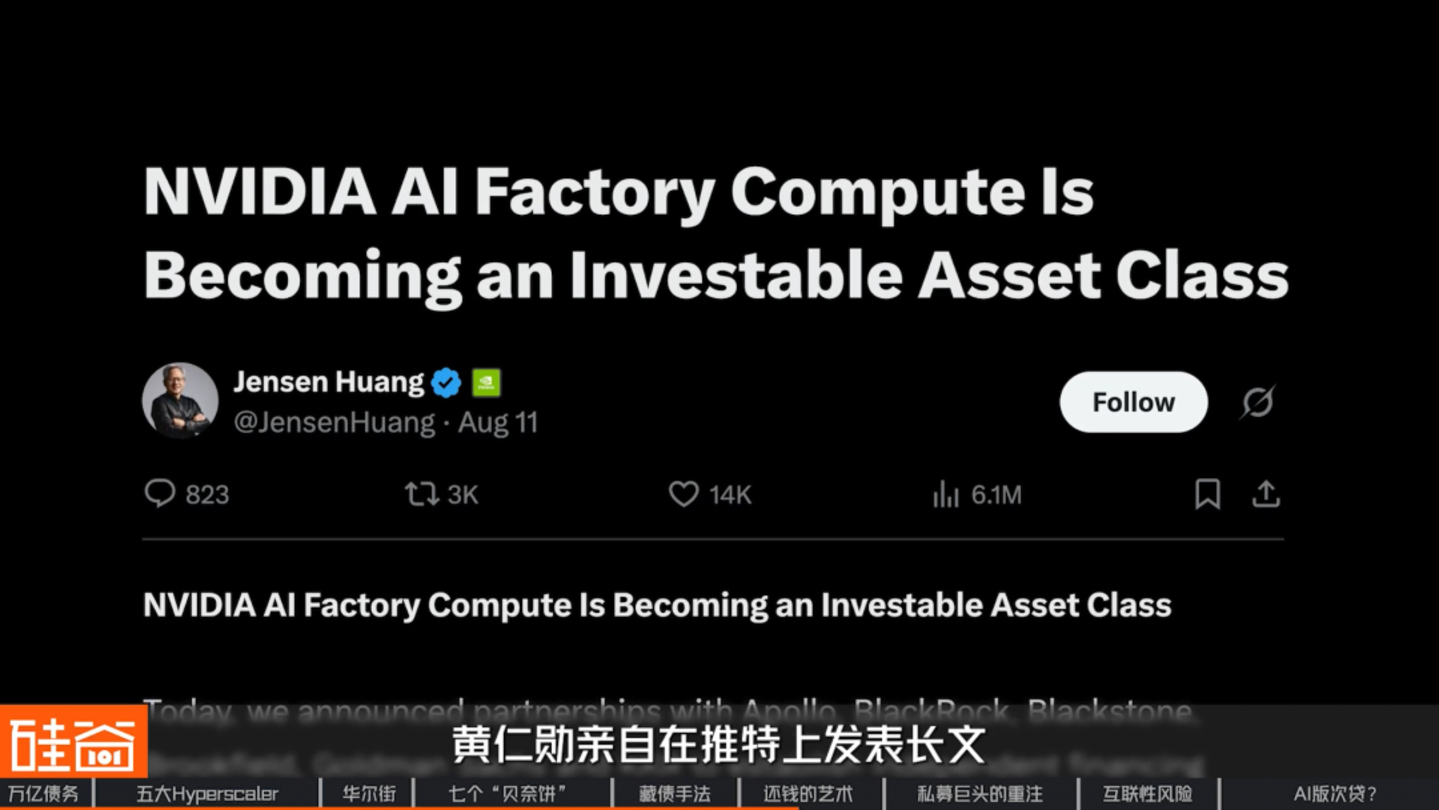
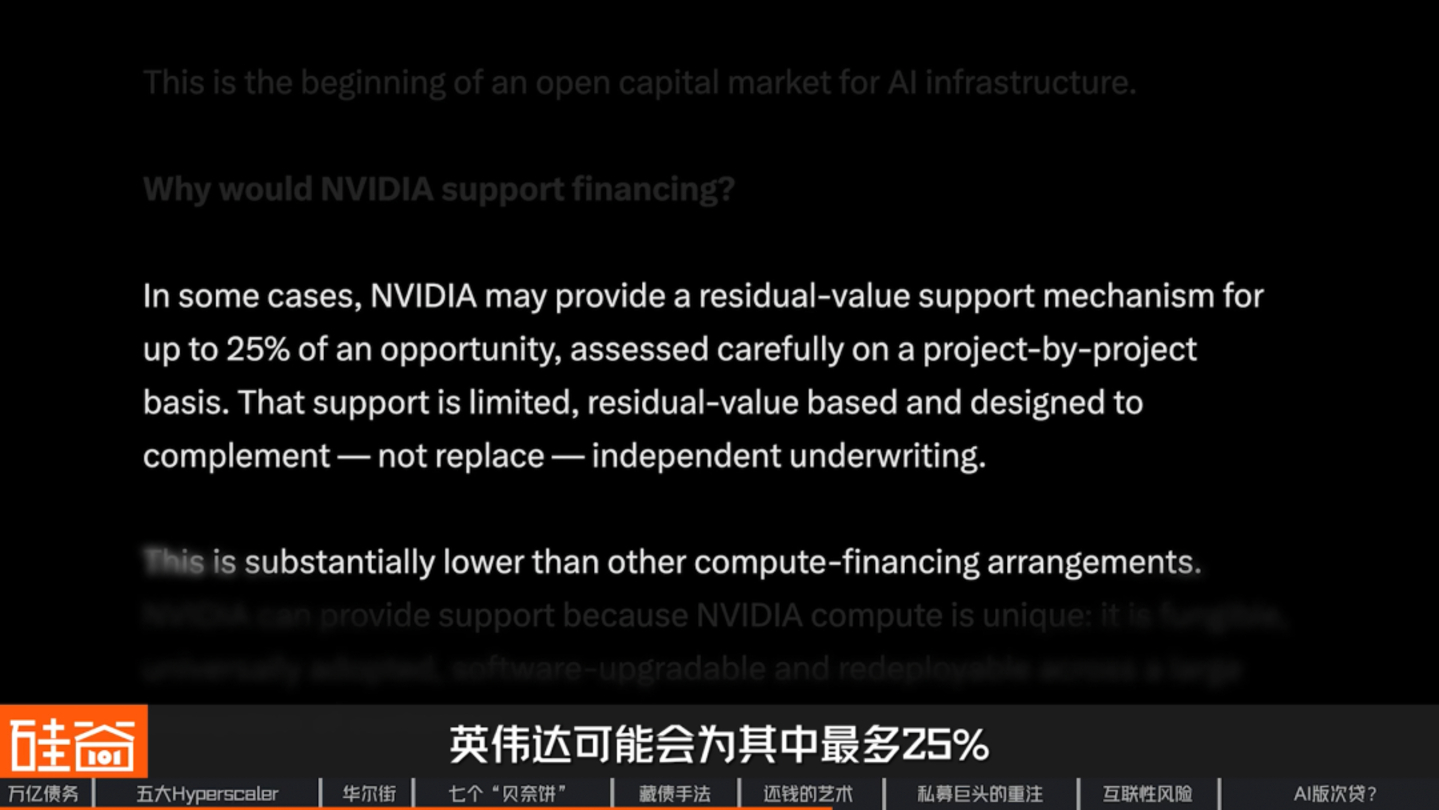
On August 10, Jensen Huang personally posted a long essay on X, titled “NVIDIA’s AI computing power is becoming an investable asset class.” In it, he announced a dedicated AI compute financing platform formed with Apollo, BlackRock, Blackstone, Brookfield, Goldman Sachs, and KKR, with the goal of mobilizing more than $500 billion in third-party capital. And we’ve already seen almost all six of those names before.
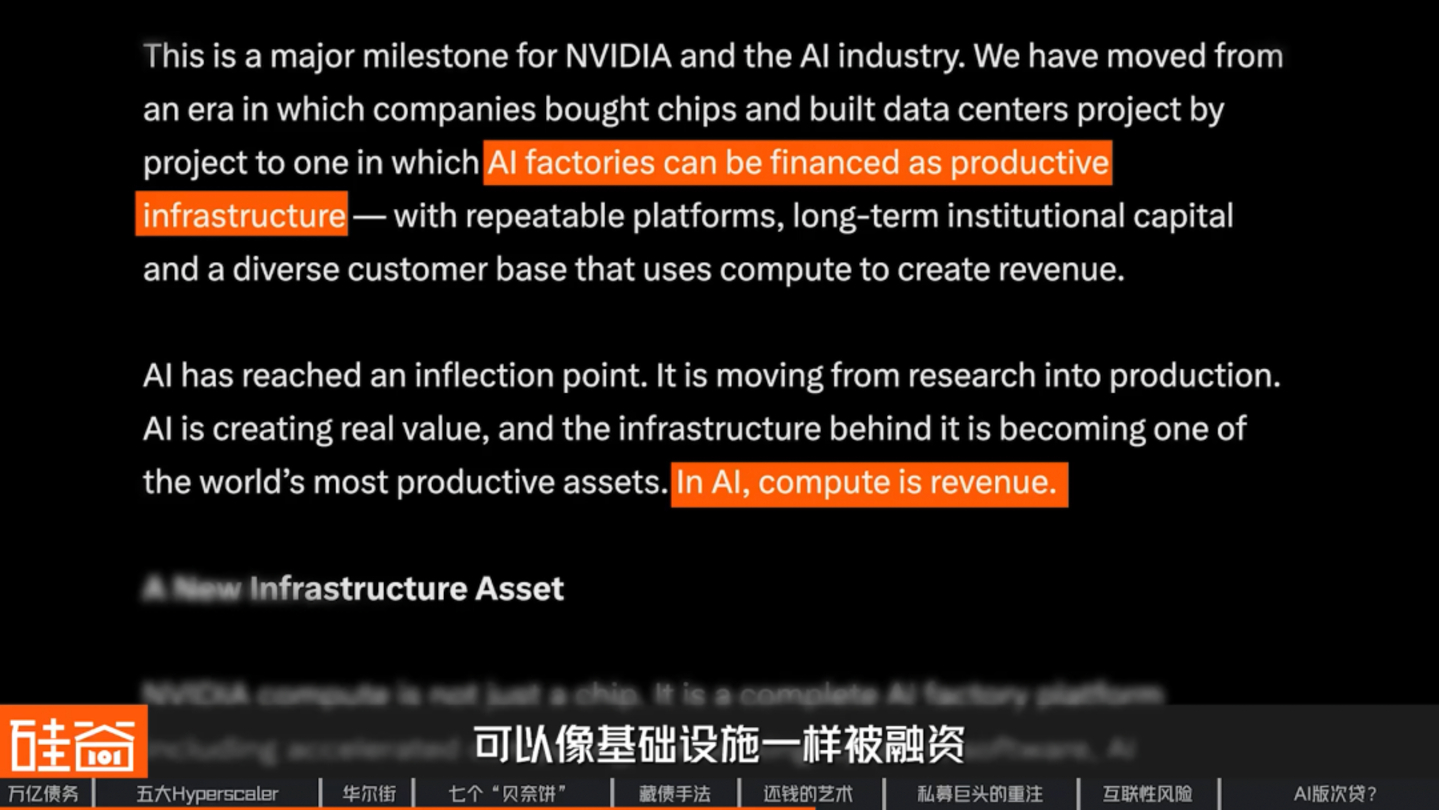
Nvidia specifically said that the $500 billion is not its own revenue, nor a commitment from any one fund or to any one customer, but the total amount of social capital these platforms will mobilize in the future. In the article, he wrote, “In the AI era, compute is revenue,” and argued that AI factories can be financed like infrastructure.
But for something to be used as collateral, it’s not enough that it can generate revenue; you also have to answer another question: how much will it still be worth a few years later? Jensen Huang’s answer has two layers:
The first layer is speaking through market price. He said that the A100 launched in 2020 is still commercially used six years later, and its economic life is approaching ten years. Meanwhile, the one-year lease price for the H100 rose from about $1.70 per card-hour in October 2025 to about $3.35 this March, showing that the chip’s earning power has gone up too.
The second layer is Nvidia stepping in to backstop it themselves. In the tweet, he said that for some projects Nvidia may provide up to 25% “residual value support,” and emphasized that this proportion is much lower than other compute-financing arrangements in the market.
We mentioned those two words, “residual value support,” when talking about Hyperion’s $27.3 billion debt. In that loan, Meta provided a residual value guarantee for the data center. Now, the one stepping in to backstop things is no longer just the renter; the chip seller has come too.
Bruce Liu
CEO & CIO of Esoterica Capital (Jirong Investment), U.S.
I think everything has a price; as long as the price is right, that’s fine. Even if the cabbage is rotten, if the price is low enough, you might still be able to make a good dish out of it.
Its useful life isn’t like a data center, which can have a duration of 10 or 20 years; a GPU may only last within five years. In that case, what is your risk? You still have to come back to whether the price actually makes sense. The people borrowing money this way may be the ones at the highest risk along the whole risk chain.
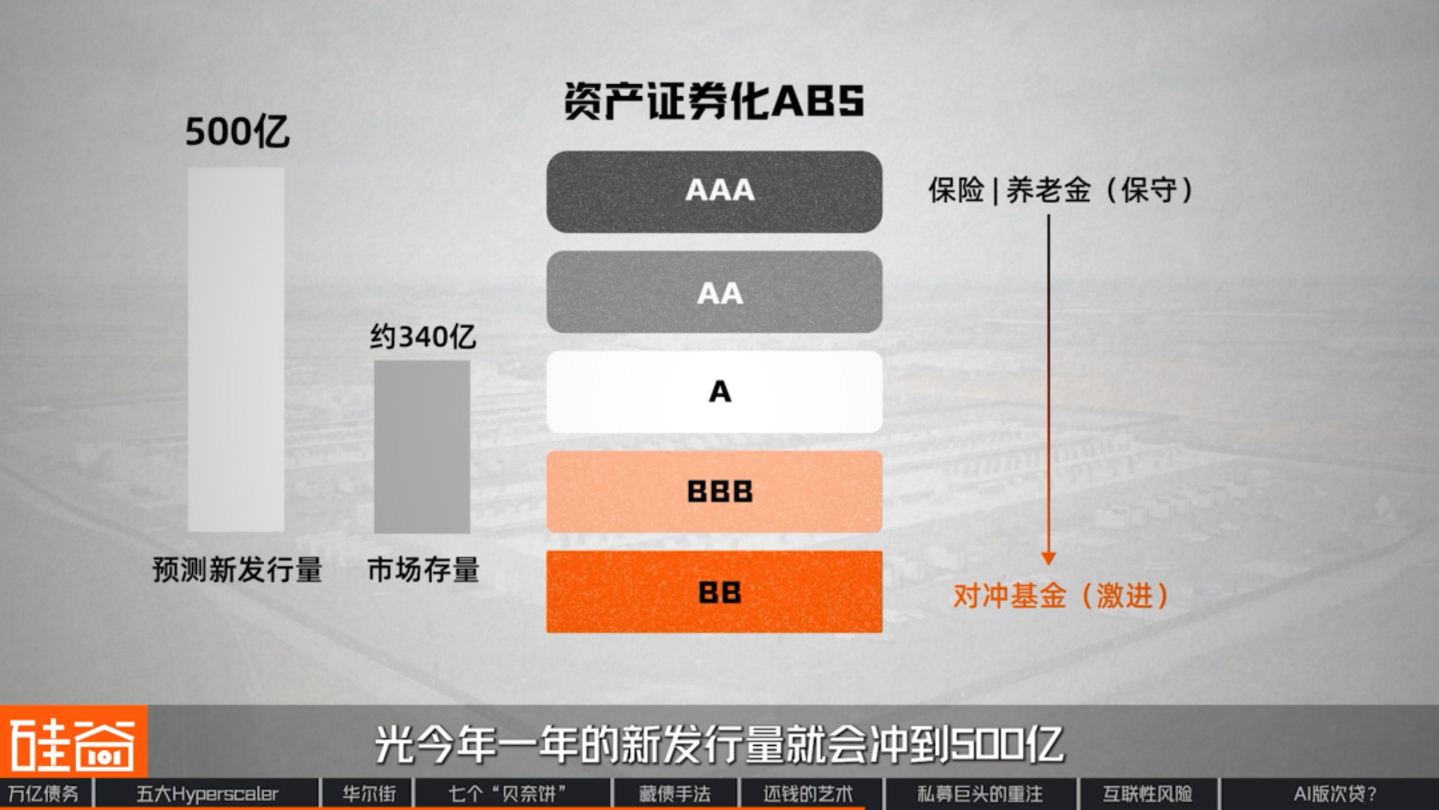
The second mainstream loan type is ABS (Asset-Backed Securities). It packages the future rental income from data center leases into securities, sliced into tranches from AAA to BB and sold to investors with different risk appetites. The current market size of these securities is about $34 billion, and institutions predict new issuance alone this year could reach $50 billion.

The third category is a bit more complex, called SRT (Significant Risk Transfer). The way it works is: a bank keeps the loan on its books, but buys “first-loss insurance” from a private fund, transferring the risk of losses while the loan still remains under its name. That frees up more capital to make new loans. SRT is already a trillion-dollar market, and more and more SRT is being used for AI-related loans.
By now, we’ve understood how these bonds are hidden, and we’ve also talked about how Wall Street turns capital into a game on top of that. But there is still one question: who actually owns these newly built data centers?

▍Clues laid five years ago
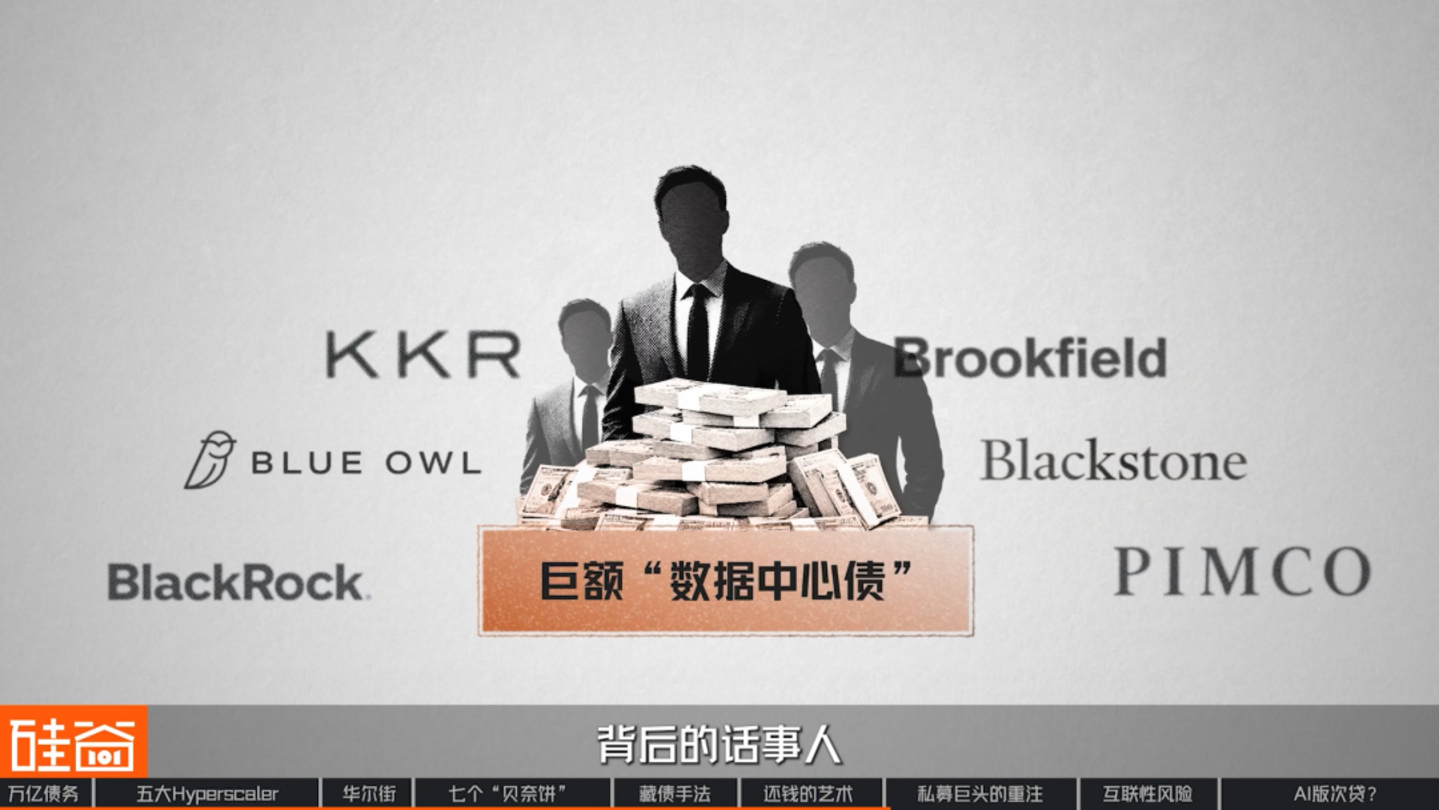
If we carefully sort through the names behind the loan deals we just discussed, we find the same few names coming up again and again: Blue Owl, Brookfield, PIMCO, Blackstone, KKR, and BlackRock. Yes—they are the decision-makers behind these huge “data center bonds.” What’s even more surprising is that they had already been planning this business long before the AI wave arrived.
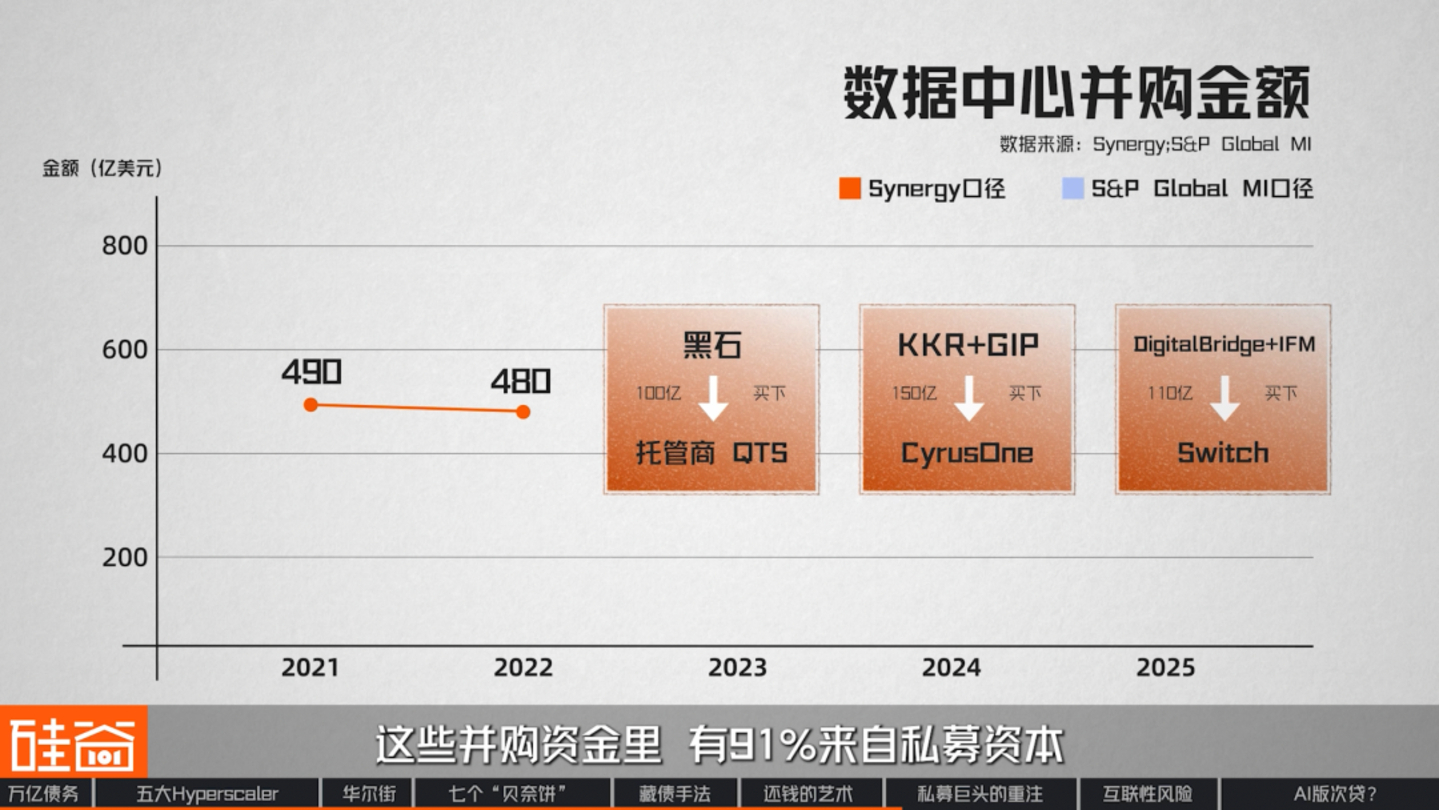
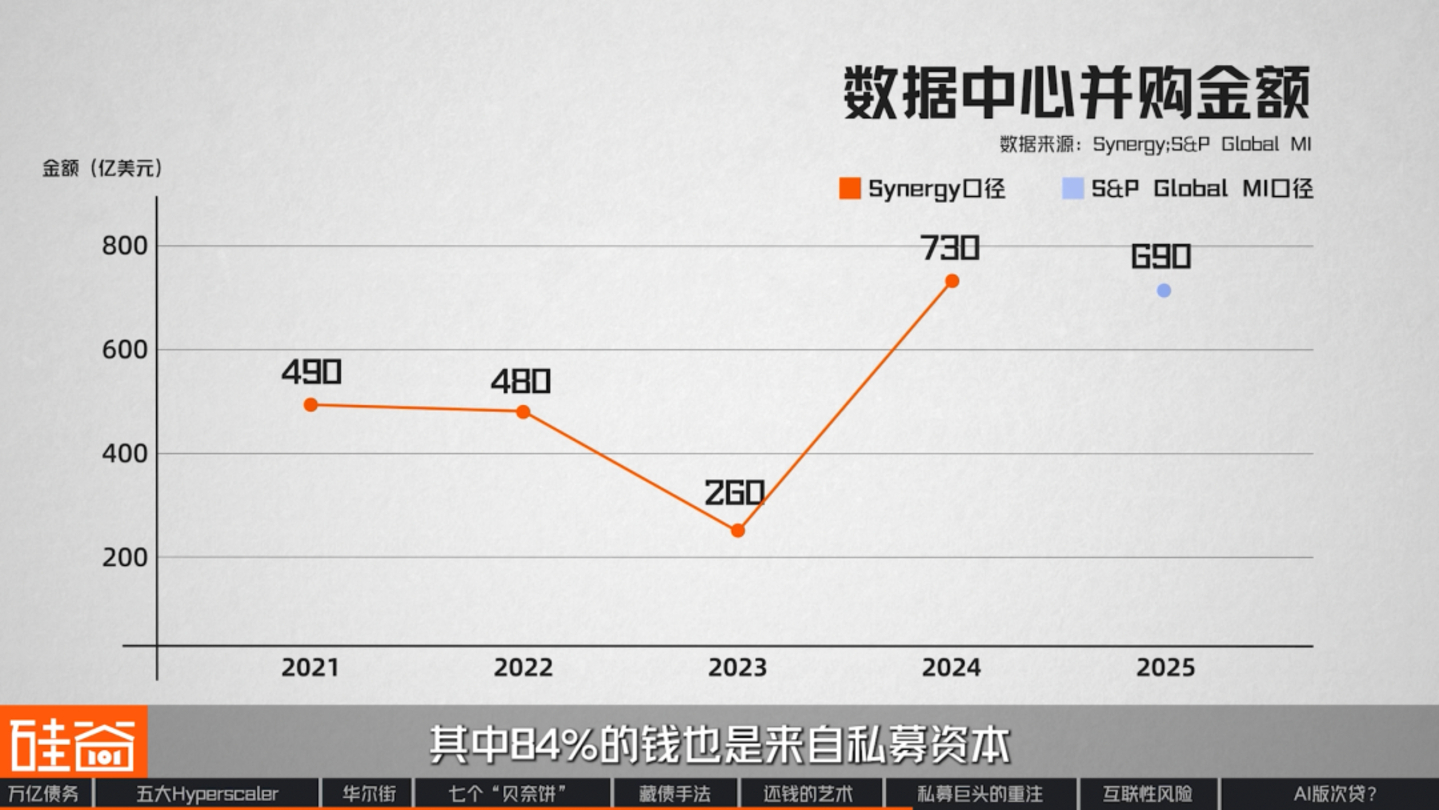
Let’s roll the clock back to 2021. That year, global data center M&A totaled $49 billion, setting a record at the time. In 2022, the amount stayed at $48 billion, across 187 deals. Of that M&A money, 91% came from private capital.
And the average size of each transaction rose from $80 million in 2018 to $235 million in 2022—almost tripling in four years. You might think they were buying servers? But actually, they were buying the data center buildings, the land, and the power grid already connected to them.
Later, in 2023, M&A volume briefly fell because of interest-rate hikes. But starting in 2024, it hit record highs year after year, and 84% of that money also came from private capital.

Why did these asset-management giants get interested in these plots of land so early? The answer is actually simple: because the tenants of data centers are some of the most creditworthy companies in the world.
Since the COVID pandemic, the rise of remote work has started to bring cloud computing into Wall Street’s field of vision. But data centers are extremely capital-intensive. Hosting providers can’t build them on their own and must look for partners. The tenants involved are investment-grade cloud giants, signing long-term contracts for ten-plus years at a time. So in Wall Street’s eyes, data centers are no longer a tech business, but a stable, infrastructure-like income stream.
In that era of near-zero interest rates, pension funds and sovereign wealth funds sitting on piles of cash were looking for exactly these kinds of assets. So long before AI, Wall Street had already turned hosted data centers into a rent-collection business. Let’s look at two typical cases:
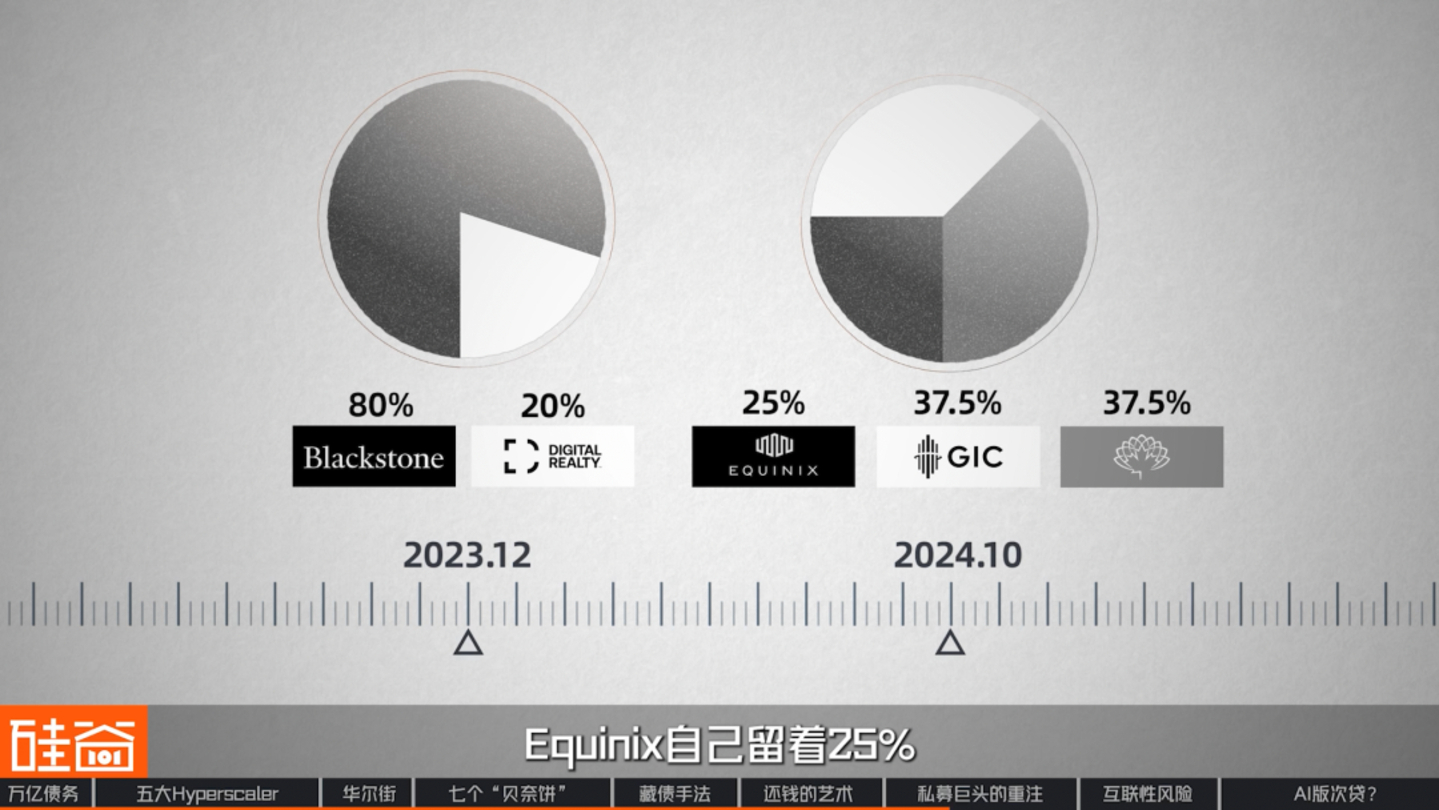
In December 2023, Blackstone and data center real estate firm Digital Realty set up a $7 billion development joint venture. The equity split is: Blackstone 80%, Digital Realty 20%.
In October 2024, Equinix, the world’s largest data center colocation provider, teamed up with Singapore’s sovereign wealth fund and a Canadian pension fund to set up a joint venture worth more than $15 billion. This time, the two capital providers each held 37.5%, and Equinix itself kept only 25%.
So looking back, Meta’s “80/20” equity structure had actually already been in place, with exactly the same ratio. In other words, by 2023 the things needed for the AI data center business were already in place: the structure was ready, the tenant was ready, and even the proportions were ready.
But there’s still one question left unexplained: why is such a huge amount of money coming entirely from private capital? That brings us to the retreat of traditional banks.
▍The retreat of traditional banks
Logically, this should have been work for the banks. But it just so happened that at this moment, the very people who should have been doing this work stepped aside first.
Rob Li
Managing Partner, Amont Partners, New York
Why, before the financial crisis, was there no private credit industry, only a few small companies doing usury? Why has a gigantic private credit industry formed over the past 20 years? A big reason is that the state doesn’t allow banks to participate in high-risk activities. Banks don’t participate, but demand remains, so who does the job? Private credit emerged. It is essentially a complement to banks. Many high-risk loans can’t be done by banks because of regulation and leverage constraints, so private credit does them instead. That’s why this industry appeared.
In other words, this industry was originally in the business of doing for banks what banks can’t do. In 2023, that boundary was pushed outward again.
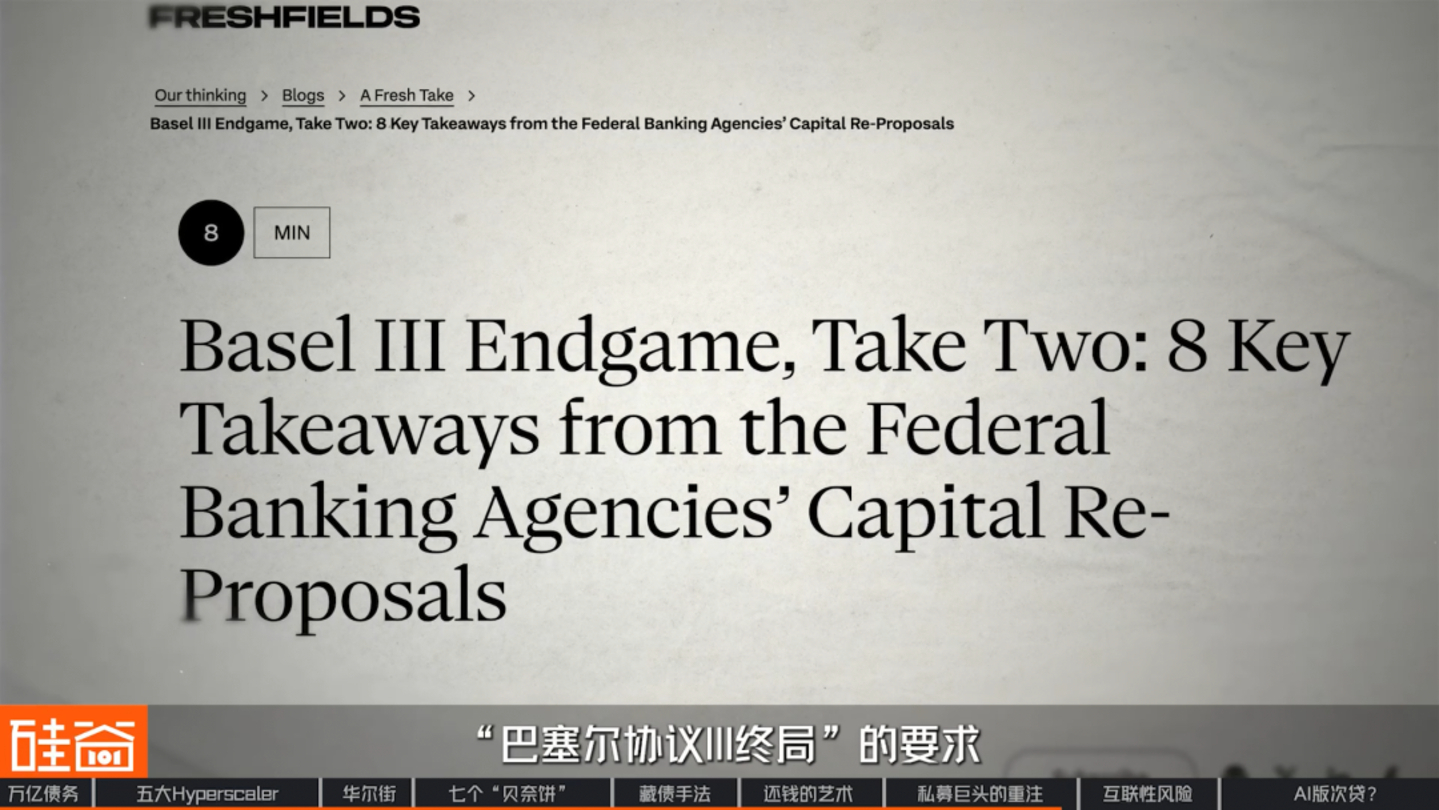
In March 2023, Silicon Valley Bank collapsed, triggering a chain of banking crises. In July of the same year, U.S. regulators proposed a draft capital rule called the “Basel III Endgame.” Under this draft, every additional ultra-long-term, large, customized loan kept on a bank’s books would require significantly more of its own capital.
What’s called own capital refers to the money the bank’s shareholders themselves have invested. Regulators require banks to put up a portion of this capital behind every loan they make. If the loan can’t be repaid, shareholders take the first hit, not depositors. The more own capital a loan consumes, the fewer loans the bank can make.
As a result, the entire banking industry began shrinking balance sheets and became especially cautious about long-term, large, and non-standard assets. And data centers happen to be exactly the kind of asset banks least want to keep on their books: they often have maturities of more than a decade, the ticket size is huge, and they are highly non-standardized.
But private capital is the opposite: behind it are insurance annuities and pensions, truly patient capital, which fits the appetite perfectly. So AI infrastructure is gradually becoming the main battleground for private credit, while the role of traditional banks is increasingly shifting toward that of an “intermediary.”
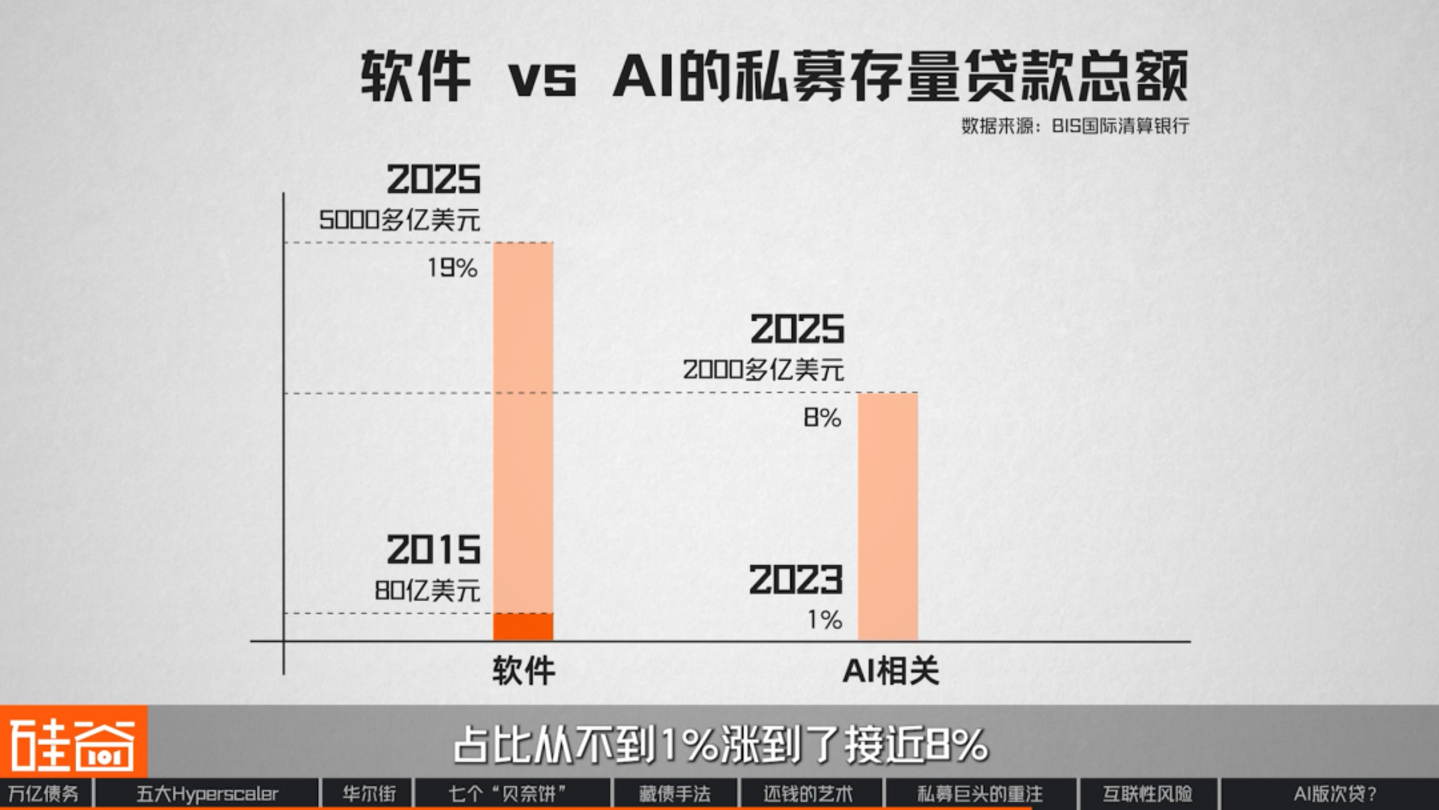
As mentioned earlier, over the past decade the biggest business in private credit has actually been SaaS software. The outstanding loan balance that private funds have lent to software companies but not yet been repaid has grown from less than $8 billion in 2015 to more than $500 billion by the end of 2025, accounting for 19% of direct private-credit lending. In other words, one-fifth of the money private funds have lent out of their own pockets went to SaaS companies.
AI-related loans have grown from zero to more than $200 billion in the past three years, and their share has risen from under 1% to nearly 8%. Now, among private credit funds investing in AI-related areas, the proportion has risen from 5% ten years ago to 20%. By number of deals, AI-related transactions already account for 34%.
The market side is also changing. Private placement bonds like Hyperion, mentioned earlier, were almost a blank slate in the data center sector by the end of last year. But statistics show that this market has now expanded by more than $40 billion. And in the next three years, AI infrastructure is expected to obtain another $800 billion from the private credit market—more than the cumulative amount software built up over ten years. So can we say that the real decision-makers behind AI data centers have already shifted from banks to these asset-management giants?
Bruce Liu
CEO & CIO of Esoterica Capital (Jirong Investment), U.S.
Don’t deify them. They’re just a channel for providing capital. Companies can still issue bonds in the investment-grade market, and they can also issue in the high-yield bond market. Going further down, if they can’t borrow money anymore, then you can think of it as usury—in other words, the part that traditional institutions can’t participate in and that they step in to provide. I think everyone is doing what they should be doing and earning the money they should earn.
On the other hand, in this wave of AI infrastructure, the position of asset-management giants may not be as secure as they think.
This March, the requirements under the Basel III Endgame were significantly relaxed, and the risk weight for corporate loans was lowered. Before that, for ordinary corporate lending, banks had to back each loan with four times the loan amount in their own capital, effectively killing the business outright. Now that requirement has been withdrawn, and the capital consumed when banks make ordinary corporate loans has returned from the draft’s 4:1 level to the original 1:1.
According to regulators’ own estimates, this would free up more than a trillion dollars of new lending capacity for banks. For example, according to reports, JPMorgan has already set aside $50 billion in direct lending capacity.
So traditional banks are re-entering the fight for control over AI infrastructure. A dramatic tug-of-war may just be beginning. But the question is: is this huge AI debt, and all these capital maneuvers, giving rise to a new AI-era subprime crisis?
In April 2026, not long after a Blue Owl fund suffered a severe redemption run, it issued a new $400 million bond, and the market immediately bought it all up. There was only one buyer for this bond: PIMCO, Pacific Investment Management Company, one of the world’s largest bond investment firms, managing more than $2 trillion in assets globally. In other words, a bond issued by one private-equity firm was entirely absorbed by another private-equity firm’s fund.
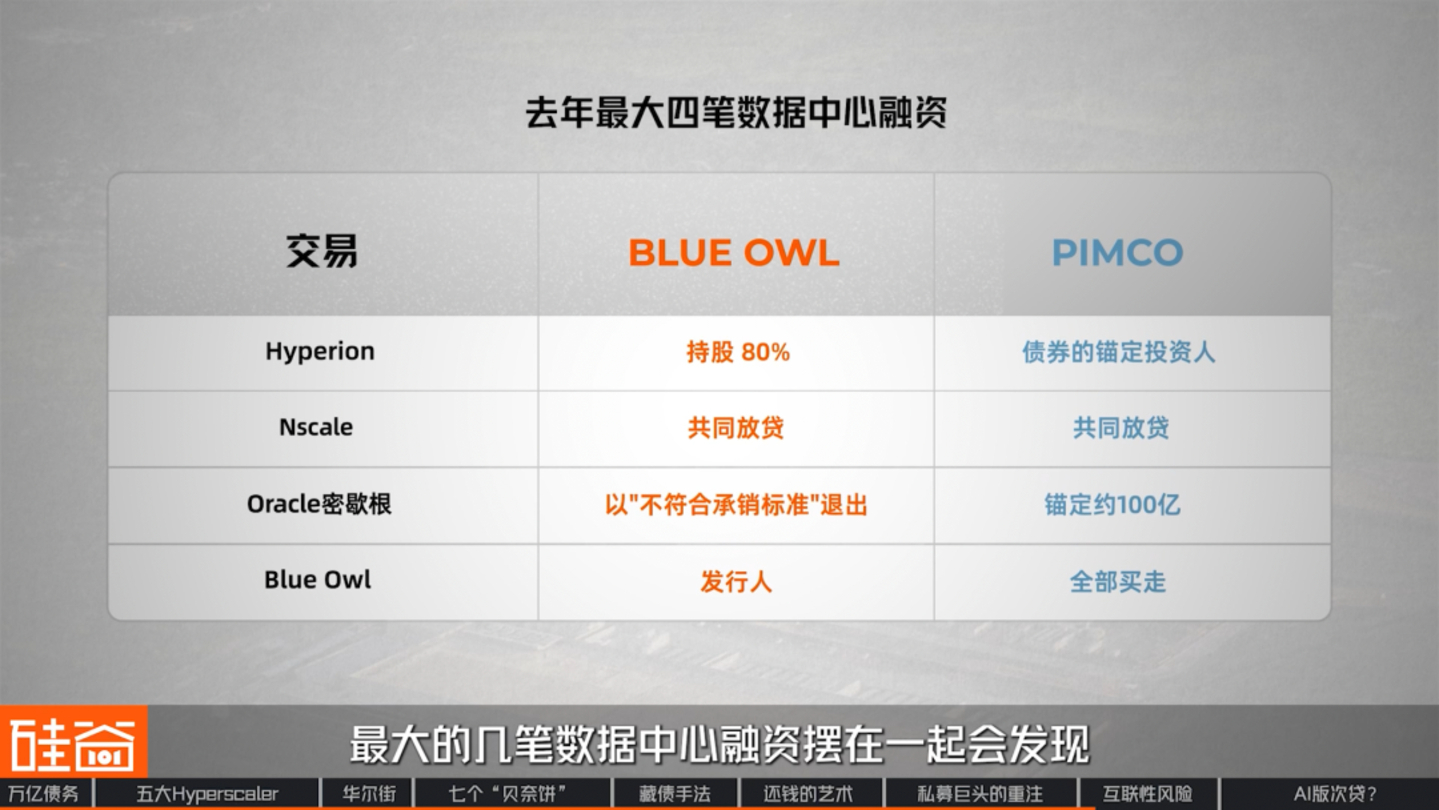
If we line up the largest data center financings from the past year, we’ll find the same two names appearing in four completely different positions.

The first one is Meta’s Hyperion, $27.3 billion. Blue Owl is a shareholder, holding 80%; PIMCO is the anchor investor for that batch of bonds. One party pays to build the building, the other lends money to it.
The second one is the $1.4 billion GPU-backed loan from AI cloud provider Nscale. This time the two firms switched positions and became side-by-side creditors, lending together.
The third one is Oracle’s $16.3 billion project in Michigan. Blue Owl looked at it and walked away, saying it “didn’t meet its underwriting standards”; PIMCO then stepped in and anchored about $10 billion. One project, one firm says no, another does it.
The fourth one is the $400 million deal we just mentioned. This time, Blue Owl is the issuer and PIMCO is the sole buyer.
So within a year, the relationship between these two names changed four times. But no matter how their positions shifted, the money that picked up the deal always came from the same inner circle.
Regulators have already noticed this. In a briefing this March, the U.S. Office of Financial Research wrote: “This concentration highlights the interconnectedness between traditional financial institutions and the private credit ecosystem.” And in its May report, the Financial Stability Board also listed “bank interconnectedness” as the industry’s top vulnerability.
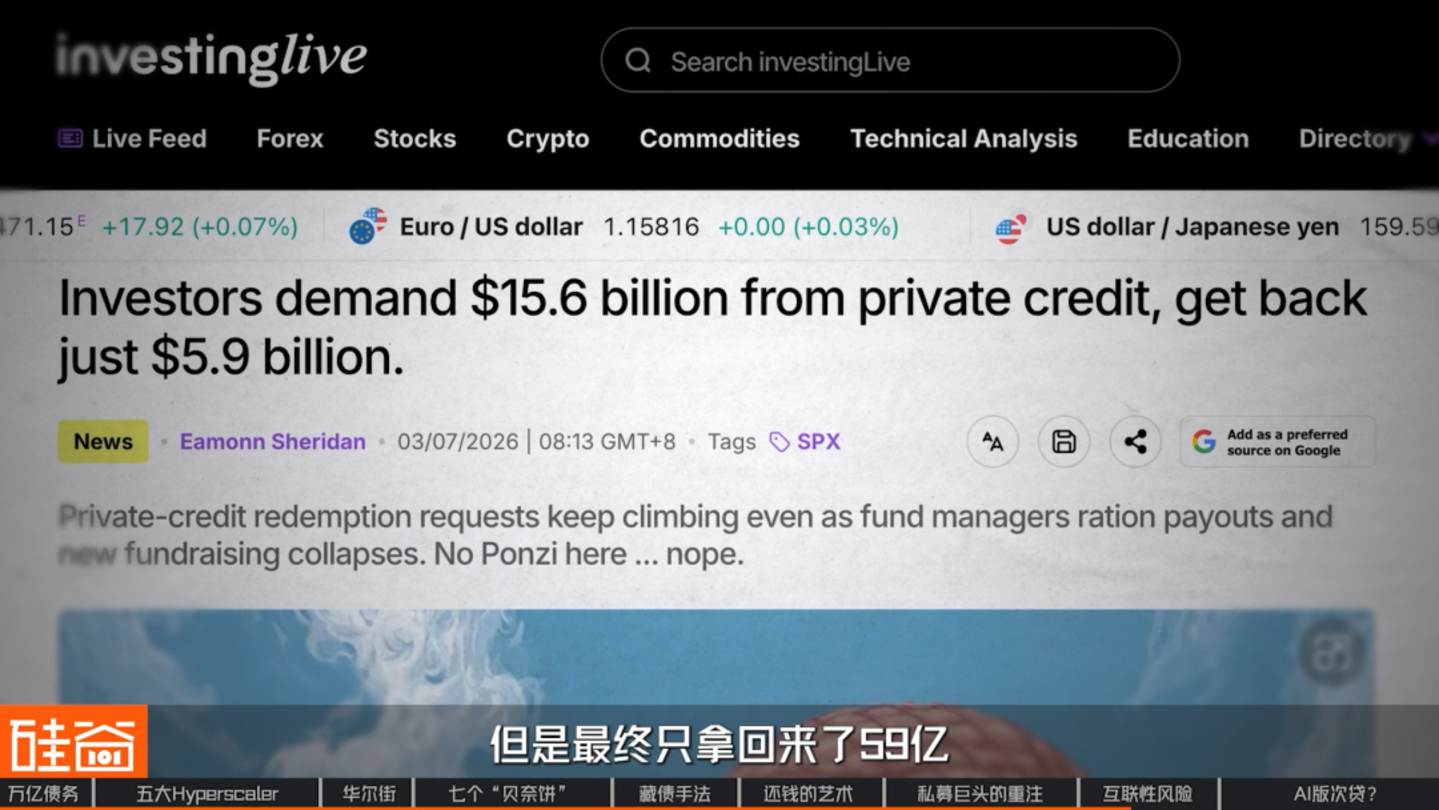
In the second quarter of this year, investors applied to redeem a total of $15.6 billion, but in the end only got back $5.9 billion. The gap here is not because the fund is trying to default. These semi-liquid funds generally have a quarterly redemption cap, usually 5% of the fund’s net assets. Once redemption requests exceed that cap, the fund refunds on a pro rata basis. For example, if you request to redeem $1 million, you may only be approved for $380,000, with the rest pushed to the next quarter and put back in line.
In the same quarter, these funds turned around and went to the bond market to borrow money. In the name of management companies, they issued investment-grade corporate bonds to replenish their own capital and maintain their lending capacity. Apollo, BlackRock, Ares, Blue Owl—one after another. But the capital these asset managers use is not their own; it comes from insurance companies and pensions. Right now, just the amount of bonds that pensions have already agreed to buy but haven’t yet paid for is close to $100 billion.
Rob Li
Managing Partner, Amont Partners, New York
Who is behind the money buying these bonds, whether it’s long-only funds, hedge funds, banks, or insurance companies? In the U.S., the biggest sources of funds are likely pensions, endowments, and foundations. University endowments and foundations are private money, but pensions are basically taxpayers’ money. So most of the money still comes from pensions and sovereign funds. In other words, the final payer is definitely the taxpayer.
So this funding chain looks like money circulating among insiders, but it has an exit, and that is the retirement accounts of ordinary people.
What’s even more troublesome is the collateral side. When other industries borrow long-term money, they pledge highways, bridges, or factory buildings—assets that can be used for decades and match the debt maturity. But a large part of the debt tied to AI is backed by graphics cards.
The public bonds issued by the giants all have repayment dates decades out. But the GPUs that these funds bought wear out in five or six years. Market research reports point out that by year three, an H100 GPU can only be sold for 45% of its original new price. But depreciation periods are set by the tech companies themselves: if they set them longer, the annual expense they allocate is smaller, and the profits on paper look better.
Rob Li
Managing Partner, Amont Partners, New York
In the past, we said depreciation was theoretically less than about 3 years. Now, for every cloud provider, depreciation at minimum is 6 to 7 years, and for buildings too, what used to be 10-plus years may now be 20 or 30 years. Clearly everyone is playing an accounting trick here, but this isn’t just Microsoft’s trick alone— all five companies are doing it; it’s not something Microsoft invented.
Short sellers did the math and concluded that the undercounted costs over the next three years could amount to a figure in the hundreds of billions of dollars.
Bruce Liu
CEO & CIO of Esoterica Capital (Jirong Investment), U.S.
The credit market is actually a very sophisticated market. There’s no right or wrong here, and it doesn’t mean the market has gone crazy. In this cycle and this environment, GPUs have become a relatively valuable asset. They have collateral value. The key is simply at what price, and I think that is the more important issue.
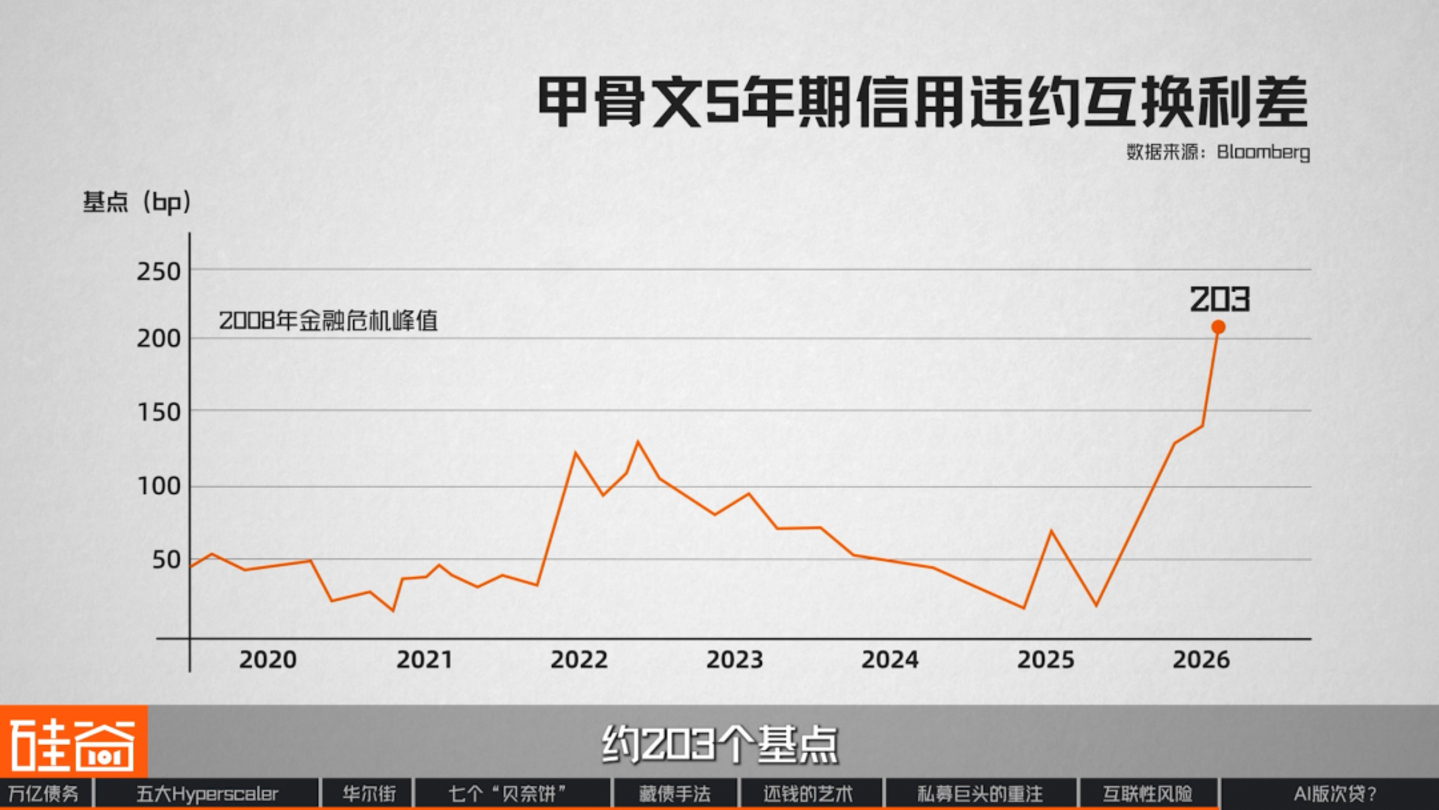
Now, the credit default swap market, or CDS, seems to be pricing this risk already. Anyone who has seen the film *The Big Short* should be familiar with this name. It is essentially default insurance, and the price of that insurance is actually the market’s score for default risk. The more expensive the premium, the more dangerous the market thinks it is.
Not long ago, the CDS price on Oracle had already broken historical records, reaching its highest level since the 2008 financial crisis, at about 203 basis points. Is that a warning sign?
Bruce Liu
CEO & CIO of Esoterica Capital (Jirong Investment), U.S.
Recently, the CDS spreads on these companies have been skyrocketing. Take Oracle as an example: before this, Oracle was a cash cow, with not much investment and making money just by relying on existing products and customers.
People need to understand that credit investors and equity investors think very differently. Creditors lend money to Oracle and don’t care how well it develops later; they only care about one thing: will it go bankrupt, and can I get my money back?
But Oracle today has undergone a complete transformation in its business model—it has started borrowing to build. From a creditor’s perspective, it is no longer the same company. Naturally, everything related to its credit will go up.
I think this is normal repricing. What I want to stress is that this is not a danger signal; it is the market doing what it should do—repricing the business. These companies are moving from the past, where they were asset-light businesses with very strong free cash flow, into a build-out cycle they may never have experienced before. Free cash flow may turn negative, and they need to keep building, a bit like oil companies. The credit market is simply repricing that change.
So if the market really can calculate it, what exactly is it calculating? Last month, Microsoft gave us a chance to see this clearly.
Microsoft announced that starting in fiscal 2027, the depreciation period for data centers and office buildings will be extended from 15 years to 25 years. They also said that in the future, more data center leases will shift from finance leases to operating leases, and therefore will no longer count as capex. This caused the 2026 capex figure to fall from about $190 billion to about $175 billion. Microsoft’s stock rose 9% that day. So was the market’s approval really because of an accounting adjustment?
Rob Li
Managing Partner, Amont Partners, New York
This has little to do with the accounting metric. Maybe people were excited for two seconds, but Wall Street quickly realized it was just a change in presentation, with no difference in actual spending. What really drove the stock up was that Microsoft Azure’s cloud growth was far better than expected, exceeding 40%. This shows that the main source of growth was the result of AI compute leasing, and it also shows that end demand is very strong.
Whether it’s large enterprises or small ones, they are indeed spending cash to rent computing power from Microsoft. Based on the prices charged to customers, we can estimate that buying chips, memory, and building data centers can roughly pay back in about three years. The corresponding ROIC is close to 30%, which is a pretty reasonable level. So they think Microsoft’s path can work.
Bruce Liu
CEO & CIO of Esoterica Capital (Jirong Investment), U.S.
Because the past few weeks have been a big risk-off environment. I think the market rewarding it had more to do with its cloud—Azure growth picking up. By contrast, Meta was being punished.
The reason Meta was punished by the market is also simple: it is spending money too, but the pace of monetization is unclear. So whether the market rewards or punishes capex depends largely on the prevailing narrative. When the market has confidence in AI, spending is right; when the market enters a correction or the AI narrative weakens, spending becomes wrong.
As for on-balance-sheet or off-balance-sheet, I think that’s just accounting treatment. I don’t think it’s intentional concealment, because when people do the math, they all factor these things in. At the end of the day, what everyone looks at is how much money the company actually spent.
And all of this information is disclosed; everyone can see it. From another angle, as long as research is being done, there is no intentional hiding. I think this is just accounting treatment, and historically people have always handled it this way.
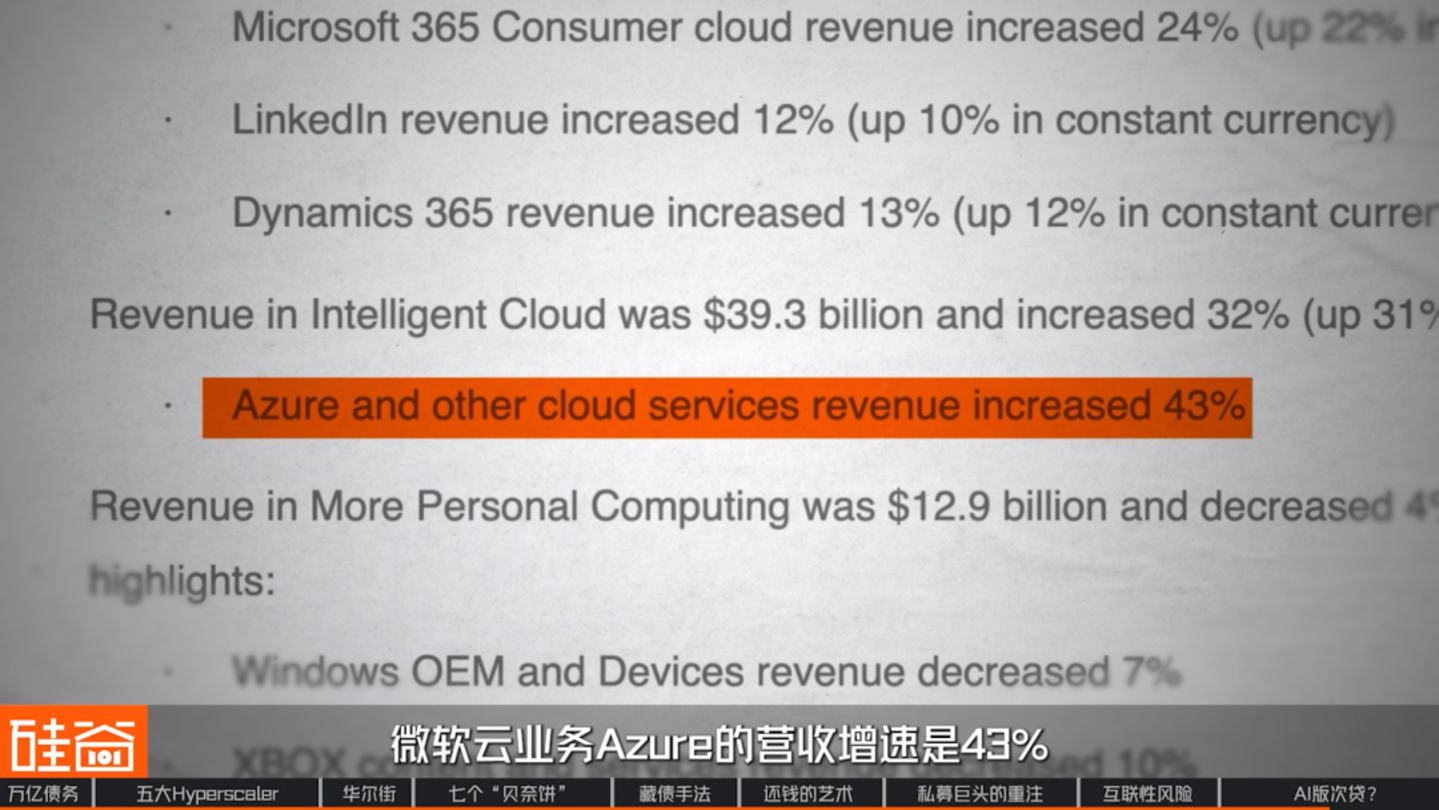
In the latest quarter, Microsoft Azure’s revenue growth was 43%, the fastest in several years. And contracted revenue that has not yet been recognized reached $678 billion, up 84% from a year earlier.
But what really matters is not the growth rate itself, but who is spending the money.
Christina Xu
Silicon Valley AI Infra investor, head of “Silicon Valley Non-Consensus”
So as long as the growth in this area is very stable and token volume is rising, because all financing structures ultimately have to come back to cash flow, this is something that can continue.
I think tracking cloud providers like Microsoft is a more rational metric. As long as this part keeps growing, you can say it is a capital cycle that can keep turning. We want to see its ROI and we also want to see that it has enough cash. None of that has made me worry so far.
So the market doesn’t really care how the accounting presentation changes. What it cares about is whether the money got translated into real revenue. That also explains why these huge off-balance-sheet debts are not as shocking to professional investors as one might think. But most importantly, in their eyes, the scale of “data center debt” is still very small.
Rob Li
Managing Partner, Amont Partners, New York
Although this industry has spent a lot of money, the whole pie is still relatively small compared with the share of housing in GDP back in 2007 and 2008, so I think it is very hard for it to create systemic risk.
Second, an important difference is that back then, it was the U.S. banking system that truly took over, shouldering a large amount of debt and risk, so the housing crisis became a systemic crisis in American banking. But over the past 20 years, U.S. banking regulation has been relatively strict, leverage has generally been low, and it is therefore hard to see the same situation of pulling the entire U.S. banking industry down with it.
Christina Xu
Silicon Valley AI Infra investor, head of “Silicon Valley Non-Consensus”
Overall, I think this market is still very large. In terms of scale, these data center debts have already entered the so-called trillion-dollar corporate bond market, and the money raised through data center issuance (project-level financing) is actually just a tiny fraction of the corporate bond market.
A trillion-dollar market, a category that is still only a small slice, and a batch of banks with tighter regulation and lower leverage. That is why, in the eyes of practitioners, the term “AI subprime” may not really hold up.
In this article, we broke down the various ways debt is “moved” off the books. We have to admit, when Wall Street meets Silicon Valley, these people really know how to play. But what this reveals is that AI is changing the capital structure of tech companies, and also changing the way the entire financial system prices technology.
This whole cleverly designed structure has a price at every layer: corporate bonds, project financing, and private credit, each with its own label. However, even if the balance sheet can be cleaned up, the risk does not disappear. It is simply cut apart, packaged, guaranteed, and then distributed along this financial chain to different people.
Over the past twenty years, the market has gotten used to understanding Silicon Valley tech companies as asset-light businesses: write code, sell software, generate cash flow, and then use that cash to buy back stock. But AI is reversing that logic. Today’s most cutting-edge tech competition looks more and more like the real estate industry: race for chips, secure power, buy land, build data centers. Then use the cash flows of the next ten or twenty years to pay for today’s construction.
Today’s construction is also based on a future assumption: that AI token demand will keep growing rapidly, and Silicon Valley and Wall Street are both betting on that AGI future. But before that future arrives, is the risk really controllable? Are the data center bonds that guests call “still small” really risk-free? Where exactly do bubbles exist in this market, and when will they burst? These are questions that should be raised at a time when capital markets are going crazy for AI, and we will keep watching closely.
(Source: Titanium Media)