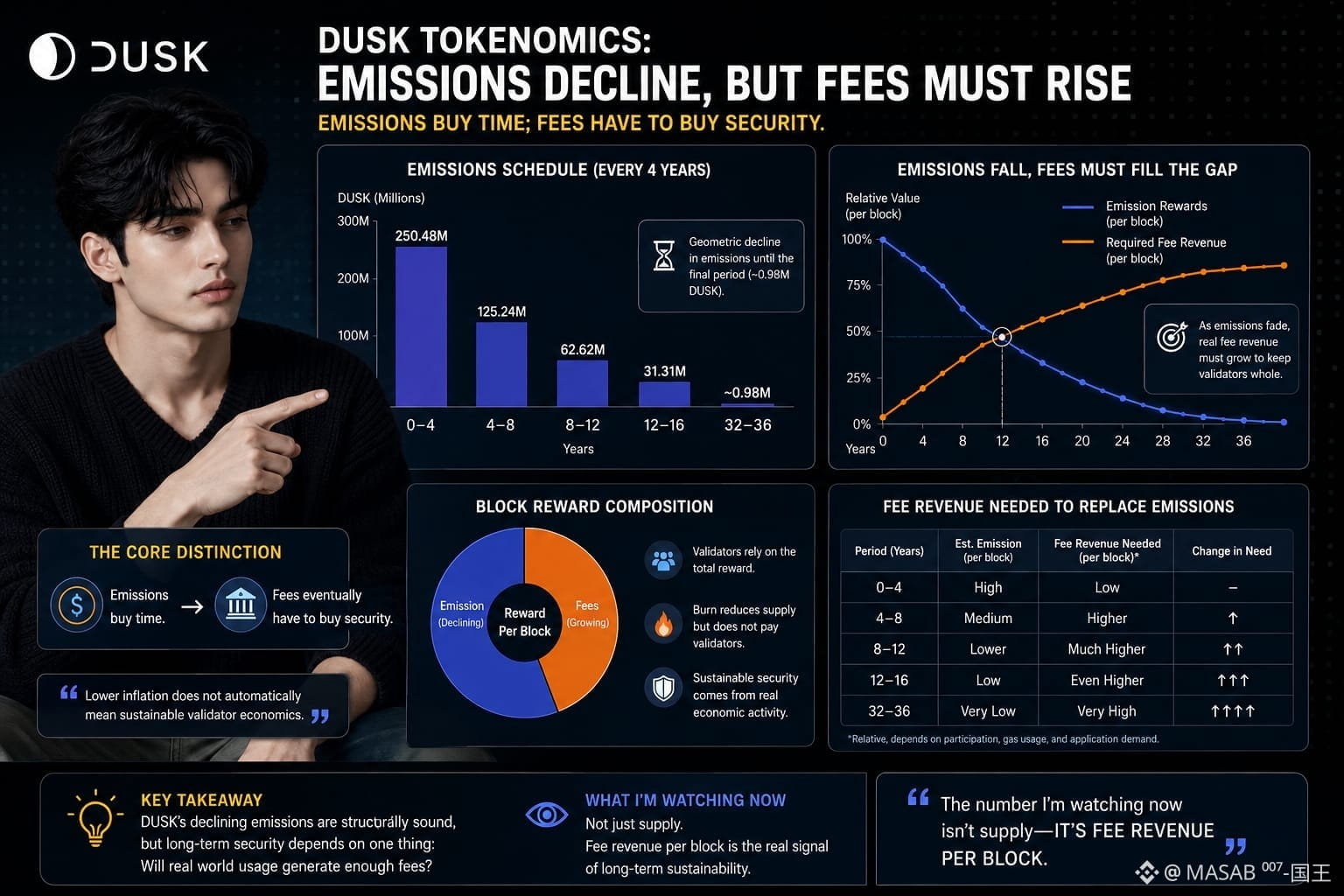

While revisiting Dusk’s tokenomics docs tonight, one number kept pulling me back: 250.48M DUSK is scheduled for the first four years, then 125.24M, 62.62M, 31.31M, until the final four-year period falls to roughly 0.98M.
The headline interpretation is easy: emissions decline,......inflation falls, scarcity improves.
But that isn’t the security question.
Dusk block rewards combine newly emitted DUSK with transaction fees.....So as issuance geometrically fades, the network increasingly needs real fee-paying activity to replace the subsidy validators are losing.
Emissions buy time; fees eventually have to buy security.
That distinction matters because lower inflation does not automatically mean sustainable validator economics. A smaller reward pool is only comfortable if gas, settlement and application activity grow enough to compensate. Burn complicates the picture further: burning undistributed rewards may reduce supply, but it does not fund the operators securing consensus.
I’m not saying Dusk’s schedule is flawed. A declining subsidy is structurally understandable. I just can’t tell yet whether future institutional usage will generate enough fees when emissions become tiny.
The tokenomics tab is still open. The number I’m watching now isn’t supply—it’s fee revenue per block.
@Dusk $DUSK #dusk
The headline interpretation is easy: emissions decline,......inflation falls, scarcity improves.
But that isn’t the security question.
Dusk block rewards combine newly emitted DUSK with transaction fees.....So as issuance geometrically fades, the network increasingly needs real fee-paying activity to replace the subsidy validators are losing.
Emissions buy time; fees eventually have to buy security.
That distinction matters because lower inflation does not automatically mean sustainable validator economics. A smaller reward pool is only comfortable if gas, settlement and application activity grow enough to compensate. Burn complicates the picture further: burning undistributed rewards may reduce supply, but it does not fund the operators securing consensus.
I’m not saying Dusk’s schedule is flawed. A declining subsidy is structurally understandable. I just can’t tell yet whether future institutional usage will generate enough fees when emissions become tiny.
The tokenomics tab is still open. The number I’m watching now isn’t supply—it’s fee revenue per block.
@Dusk $DUSK #dusk